What Does a Demolition Supervisor Do? Planning, Risk Control and Site Supervision
A demolition supervisor makes sure a structure comes down in a planned, controlled order without hurting workers, the public or anything that should stay standing. This guide explains the work in everyday terms.
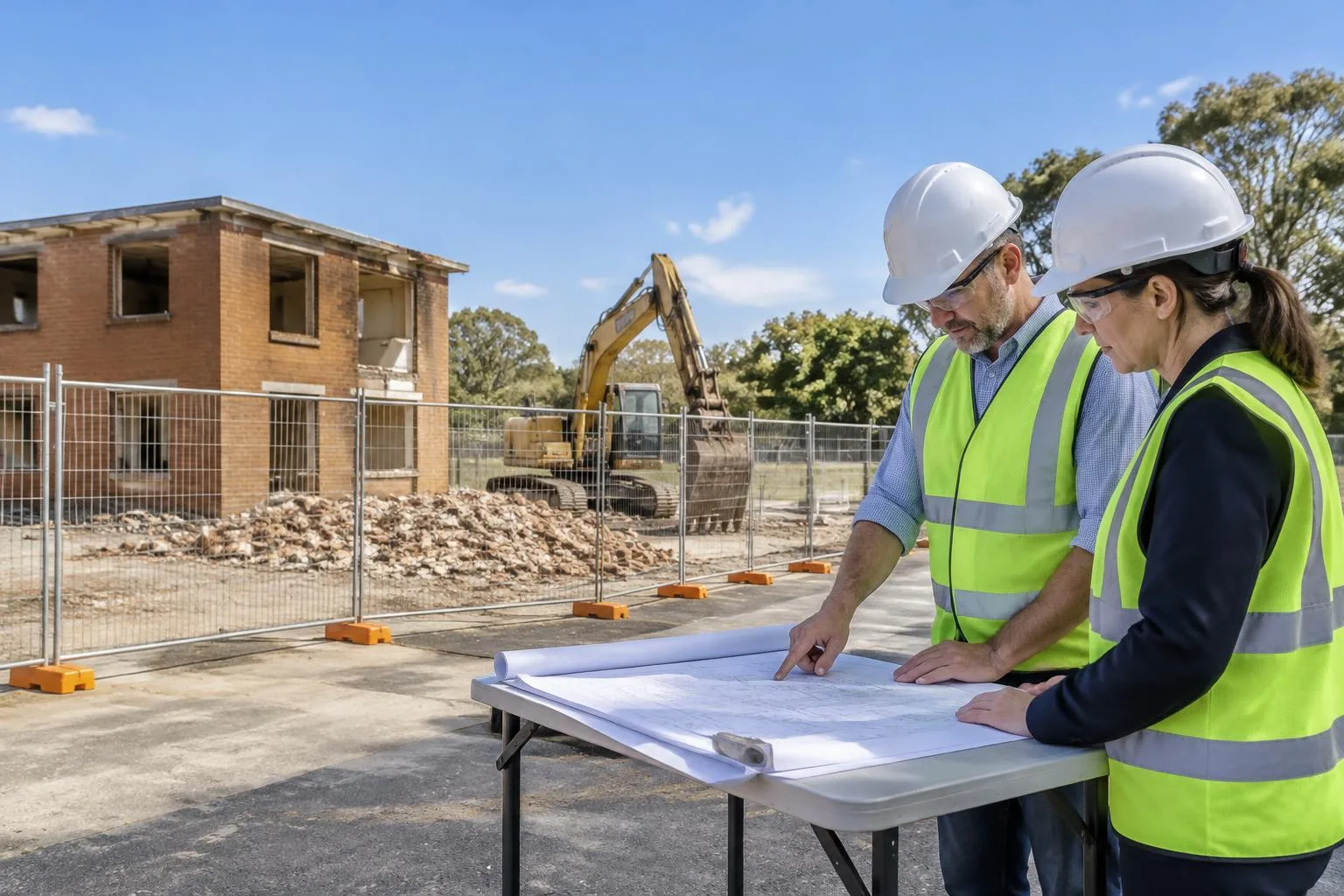
What the role involves
Demolition looks simple from the footpath, but the supervisor's job is mostly about thinking before anything is cut, pulled or dropped. The supervisor turns a plan into safe work on the ground. They brief the crew, watch how the structure behaves as it changes, and stop the job when something doesn't look right.
On many jobs the supervisor is the link between the client, the principal contractor, engineers, plant operators and the workers doing the job. They need enough technical understanding to read a structure and enough people skills to keep everyone working to the same plan.
Planning and sequencing
Sequencing is the order in which elements come out. There is no single universal order: the right sequence depends on the structure, the hazards present, the chosen method and appropriate engineering or specialist advice. Whatever the order, a sound sequence keeps the remaining structure stable at every stage so loads are never left unsupported. The supervisor checks that the plan suits the methods and plant on site and that each step leaves a safe state for the next.
Plans also deal with practical matters: access and egress, where waste and salvage will go, how trucks will enter and leave, and what happens if the weather turns. A supervisor who has walked the site and tested the plan against reality is far better placed than one relying on paperwork alone.
- 1. Plan
Consider the method, sequence and advice.
- 2. Verify
Compare site conditions with the information.
- 3. Control
Confirm suitable risk controls with the team.
- 4. Supervise
Observe the work and changing conditions.
- 5. Record
Keep decisions, checks and concerns traceable.
- 6. Review
Revisit assumptions and escalate uncertainty.
Review feeds back into planning. These are connected responsibilities, not a prescribed demolition sequence or a substitute for a site-specific plan.
Reviewing drawings and site information
Before work starts, the supervisor reviews whatever information exists: drawings, engineering advice, hazardous materials surveys and previous inspection reports. Older buildings often don't match their drawings because of renovations, undocumented additions and deterioration. That is why information on paper is always checked against a physical inspection. Where the structural behaviour is uncertain, the supervisor gets competent engineering input rather than guessing.
Drawings & structure
Plans, alterations and engineering advice.
Services
Locations, status and disconnection records.
Materials & condition
Surveys, inspections and deterioration.
Access & surroundings
Neighbours, movement and site boundaries.
People & work documents
Responsibilities, consultation and applicable SWMS.
Gaps & uncertainties
Missing information to clarify before relying on it.
Examples of information to consider, not a complete checklist. Verify what applies to the particular site and current rules.
Identifying hazards and controlling risk
Common demolition hazards include unplanned collapse, falls from height, falling objects, mobile plant, hazardous materials such as asbestos or lead paint, noise, vibration and manual handling. The supervisor identifies the hazards that apply to this job and makes sure controls are in place. Controls are chosen by working down the hierarchy of controls, starting with eliminating the hazard and only relying on personal protective equipment as a last line of defence.
Risk control isn't a one-off form. As each stage is completed the risks change, so the supervisor keeps reassessing them and adjusts controls before the crew moves on.
Utilities and service-location checks
Live electricity, gas, water, sewer and communications services are a serious risk. Before demolition, services should be identified, located and disconnected or made safe by the appropriate authority or a qualified person. Underground services may need to be located before any excavation or ground disturbance. The supervisor confirms disconnections in writing where possible and doesn't assume a service is dead because a drawing says so.
Consultation, SWMS and site communication
Some demolition work may fall within high-risk construction work requirements. The supervisor must check the applicable current rules and site documents, including whether a safe work method statement (SWMS) is required. Where one is used, it only helps if the people doing the work understand it. Supervisors run pre-start briefings, consult workers about the hazards and controls, and update the SWMS when the method changes. Clear communication also covers neighbours, other trades and anyone else affected by the work.
Exclusion zones, dust and changing site conditions
Exclusion zones keep people out of areas where material could fall, plant is operating, or the structure could move. The supervisor sets them up, checks they are respected, and moves them as the work progresses. Dust and debris are controlled with methods such as wetting down, screening and careful handling, especially where hazardous materials may be present.
Conditions change during the day: wind picks up, rain softens the ground, or an element behaves differently once it's exposed. Good supervisors watch for these changes and pause work when the original assumptions no longer hold.
Supervision, records and escalation
Supervision means being present and paying attention. That includes checking that workers hold the required tickets for their plant and tasks, that controls are actually being used, and that the work matches the plan. Supervisors keep records such as pre-start notes, inspections, permits, disconnection confirmations and incident reports. These show what was decided and why.
Knowing when to escalate matters just as much. Unexpected structural behaviour, suspected hazardous materials, near misses or a plan that no longer fits the site should be raised with the right people, such as the principal contractor, an engineer or the regulator where required. Escalation should happen before work continues.
How the role connects to training
What a supervisor needs, whether experience, training, licensing or nomination, varies by state or territory, the type of work, the employer and the current rules, so check the requirements that apply to you. Formal training gives structure to what experienced workers already know and helps fill gaps in planning, risk management and documentation. It does not guarantee a licence or authorisation.
For state-specific information, see our NSW demolition supervisor training, Queensland demolition supervisor training, Western Australia demolition supervisor training, South Australia demolition supervisor training and Northern Territory demolition supervisor training pages.