
Demolition as controlled change
Removal changes structural support, exposure and access; reliable supervision connects each stage with its conditions and limits.
What removal changes
A demolition supervisor works with a changing picture. People arrive, materials move, hidden construction becomes visible and yesterday's access route may disappear. The important relationship is between what is known, what is planned, what protects people and what is actually happening.
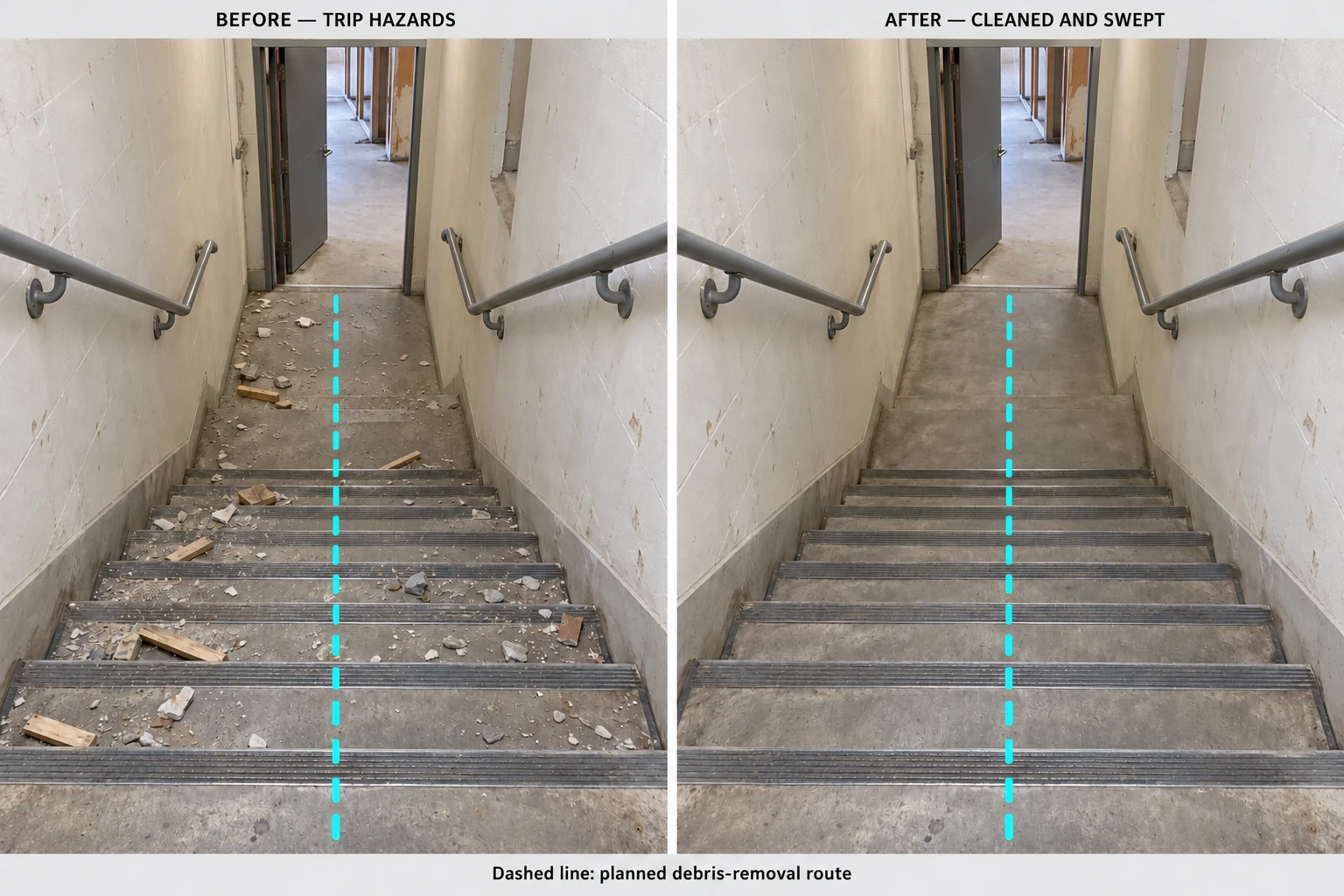
Left: small debris from internal demolition has made the planned route a trip hazard. Right: the same steps and landing have been cleared and cleaned. Keep checking the route as work progresses; remove loose pieces and dust using the site's dust-control method before the route is used again.
The dashed line is a teaching overlay, not a cable or site sign. It shows a planned route for controlled debris removal, not permission to drop or slide loose debris down stairs. A clear stairwell alone does not establish that a load or removal method is suitable.
OnShift educational illustration, AI-generated and visually reviewed for this preview; not a project photograph.
Open full-size illustrationA retained structure is a part of the built environment intended to remain. That description alone does not establish what supports it, what may disturb it or who has confirmed its condition. Its function, dependencies and limitations determine how surrounding work can affect it.
Instructions and physical consequences
A document matters because a physical decision depends on it. If a printed layout and the current drawing register show different revisions, the difference may concern a work boundary or access route. The discrepancy needs clarification before either copy directs affected work.
An instruction, an observation and an approval serve different purposes. The instruction describes intended work; the observation records a condition; the approval permits a defined action within its scope. Keeping these distinctions clear helps prevent an intended arrangement being mistaken for an established one.
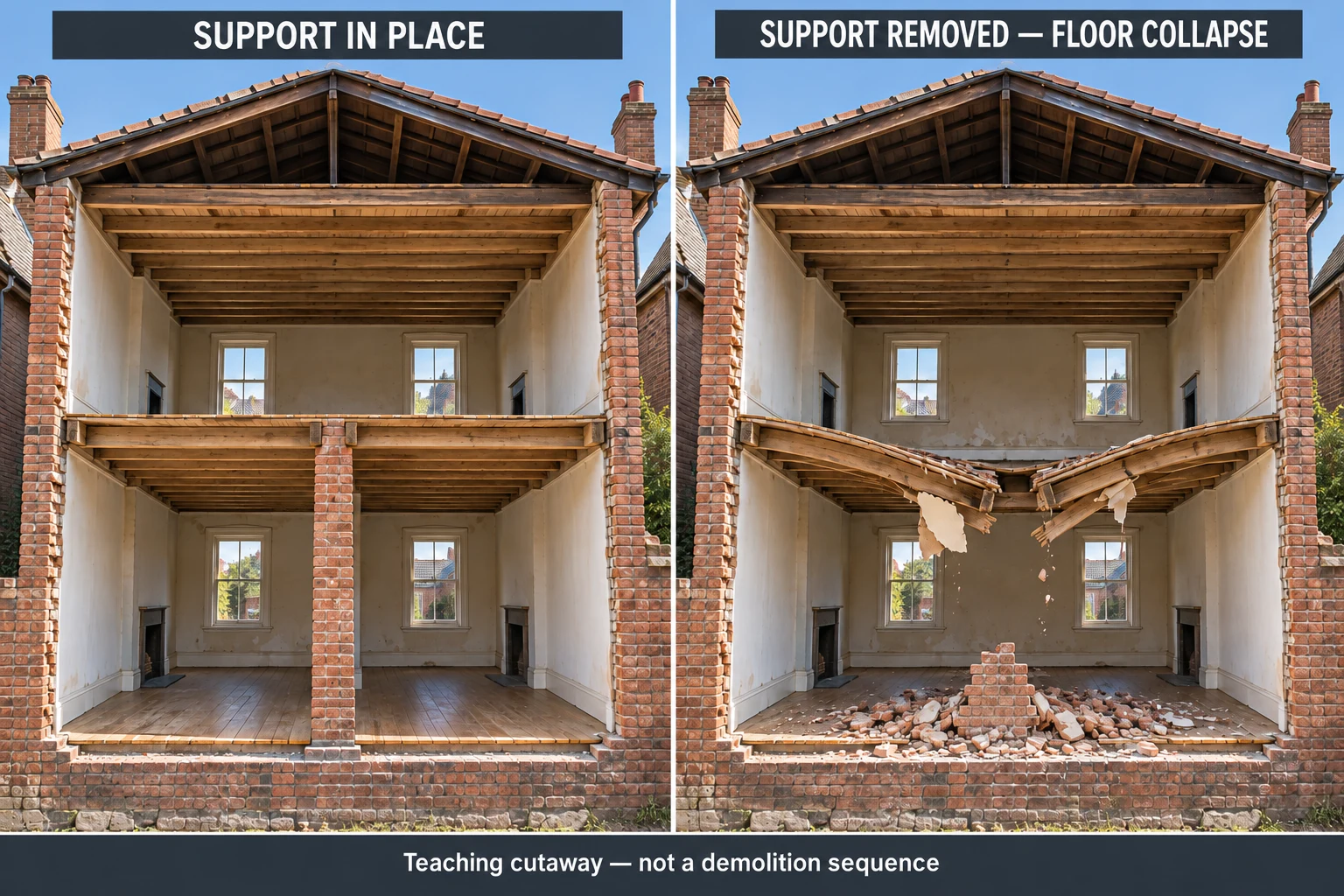
Left: the load-bearing wall supports the floor above. Right: removing that support without resolving the load path allows a partial floor collapse. This fictional comparison connects an instruction to its possible physical consequence.
The omitted facade is a teaching cutaway, not a demolition stage. This is not an incident reconstruction, demolition sequence or temporary-support design. Support requirements and the work sequence need project-specific assessment before removal.
OnShift educational illustration, AI-generated and visually reviewed for this preview; not a project photograph.
Open full-size illustrationInterpreting a control record
A control record for a material-transfer area needs to identify the activity, location, revision and intended use. These details establish whether the document applies to the work. Its supporting information and unresolved assumptions are equally important: changing a heading does not make an unrelated record applicable.
A hazard entry must explain the route to harm. Terms such as plant or debris identify a subject but not the exposure. The record needs to establish how movement or material could reach workers, visitors, neighbouring property or an environmental receptor. Deliveries and changing work areas can alter those pathways.
The control entry distinguishes measures that are proposed from those already implemented. It identifies how each measure reduces exposure, who establishes and maintains it, and what technical information it depends on. Exclusion distances and load limits require the relevant site-specific basis; they cannot be derived from a generic form.
Verification must address the condition being relied upon. A photograph may establish the location of a sign, but it cannot establish the capacity of a structural support. A signature may record acknowledgement without verifying the assumptions behind the arrangement.
If a delivery blocks the planned route, the review must address the changed movement and exposure. The revised arrangement must be communicated and obsolete instructions withdrawn from use. Traffic arrangements, the demolition work plan, relevant safe work method statements, emergency access and briefings must remain consistent. A permit authorises a defined activity under specified conditions; it does not replace unrelated technical confirmations.
How controls interrupt harm
A hazard reaches a person or environmental receptor through an exposure pathway. A control acts on the source or pathway to prevent or reduce harm. This relationship explains why identifying a hazard is only the start of risk control.
A diagram can make that relationship clear without establishing the dimensions or technical limits of a real control. Where a decision depends on a load, distance, location or drawing detail, it needs current project information. A simplified illustration cannot supply missing design information.
Technical terms
Hazard — A source or situation with potential to cause harm.
Risk — The possibility of harm, considered with its likelihood and consequence in context.
Exposure — The opportunity for a person or receptor to come into contact with a hazard.
Consequence — The harm or loss that could result.
Control — A measure that eliminates or reduces risk.
Remaining risk — Risk considered after the specified controls have actually been applied.
Elimination — Removing the hazard or hazardous exposure from the work.
Substitution — Replacing a hazard with a less hazardous alternative.
Isolation — Separating people from a hazard.
Engineering control — A physical or designed measure that acts on a hazard or exposure pathway.
Administrative control — An arrangement such as procedures, scheduling, information or supervision.
PPE — Personal protective equipment.
RPE — Respiratory protective equipment.
SWMS — Safe work method statement; a document for relevant high-risk construction work.
DWP — Demolition work plan.
Permit — A bounded authorisation within a defined control system, not universal proof of safety.
Induction — Introduction to relevant site conditions, responsibilities and arrangements.
Pre-start — A check or briefing before work or equipment use; distinct from scheduled servicing.
Verification — Checking evidence that the required condition or control exists and works as intended.
Consultation — Sharing relevant information, hearing affected workers' views and considering them in decisions.
Load path — The connected route by which forces pass through a structure to its supports.
Compression — A pushing action within a material or member.
Tension — A pulling action within a material or member.
Bending — A response to loading that tends to curve a member.
Shear — Action tending to make parts move past one another.
Temporary works — Engineered or other temporary arrangements supporting construction or demolition needs; specialist design and control may be required.
Respirable dust — Particles small enough to reach deep into the lungs.
LEL — Lower explosive limit; the lowest flammable gas or vapour concentration in air at which flame can propagate under the relevant conditions. Percentage of LEL is not percentage gas concentration or a safe-breathing decision.
Receptor — The person, property or environmental feature potentially affected.
Change control — The process of recognising a change, reviewing affected assumptions and controls, and communicating the revised arrangement.
Air monitoring — Competently planned measurement of airborne contaminants to assess exposure and control effectiveness.
Health monitoring — Medical monitoring for health effects, carried out or supervised by an appropriately experienced doctor when required.
The limits of an instruction
An authorised work instruction applies to defined conditions. It may depend on service confirmation, a particular structural stage or controls that must remain in place. When those conditions change, the instruction may no longer support the affected work.
Recognising that a control is missing does not require the same expertise as designing its replacement. A supervisor may stop affected work within the workplace arrangements while a specialist resolves the technical question. The pause protects people; the review establishes what can happen next.