
Records, registers, diaries and document control
Records preserve what happened; controlled instructions identify what is authorised now and how changes reach the work party.
Plans and records
A procedure or plan usually directs intended work. A record preserves information about what happened. A register organises items and their status so they can be found and managed. A diary records events over time. These are related functions, but confusing them can change the meaning of information. A blank inspection form is a tool for recording a check; it is not evidence that the check occurred.
A useful record identifies its subject, date, author, location and basis. Depending on purpose, it may also need the relevant equipment identity, document revision, observations, actions and unresolved items. The aim is not to fill every available box. It is to make the information interpretable by someone who was not present. An entry saying 'all good' gives little help if the work stage or scope of the check is unknown.
Registers support retrieval rather than replacing underlying evidence. A plant register can identify an item and point to inspection or maintenance records. A drawing register can identify the current issue and its status. An action register can show ownership and progress. If the linked records are absent or inconsistent, the register does not repair the gap. Treat it as an organised index to evidence and decisions, not a machine that turns incomplete information into certainty.
Interpreting a control record
A control record for a material-transfer area needs to identify the activity, location, revision and intended use. These details establish whether the document applies to the work. Its supporting information and unresolved assumptions are equally important: changing a heading does not make an unrelated record applicable.
A hazard entry must explain the route to harm. Terms such as plant or debris identify a subject but not the exposure. The record needs to establish how movement or material could reach workers, visitors, neighbouring property or an environmental receptor. Deliveries and changing work areas can alter those pathways.
The control entry distinguishes measures that are proposed from those already implemented. It identifies how each measure reduces exposure, who establishes and maintains it, and what technical information it depends on. Exclusion distances and load limits require the relevant site-specific basis; they cannot be derived from a generic form.
Verification must address the condition being relied upon. A photograph may establish the location of a sign, but it cannot establish the capacity of a structural support. A signature may record acknowledgement without verifying the assumptions behind the arrangement.
If a delivery blocks the planned route, the review must address the changed movement and exposure. The revised arrangement must be communicated and obsolete instructions withdrawn from use. Traffic arrangements, the demolition work plan, relevant safe work method statements, emergency access and briefings must remain consistent. A permit authorises a defined activity under specified conditions; it does not replace unrelated technical confirmations.
Revision and distribution
A controlled document needs an identity and a status. A title, unique number, revision, issue date, purpose and responsible authorisation help people establish what they are reading. Draft, tender, review and work-use documents can contain similar information but support different reliance. The newest file in a folder is not necessarily the authorised instruction.
A change needs distribution as well as approval. Identify the people and documents affected, issue the revision through the controlled process and withdraw superseded work copies from active use. Retain the history according to applicable requirements. The objective is not to erase the old version. It is to prevent that version continuing to direct current work while preserving why the change occurred.
Imagine a layout revision that moves an access boundary. The office copy is updated, but a laminated plan at the work area remains unchanged. The system now gives two instructions. A revision register may be perfectly accurate while the crew still follows the obsolete copy. Verification therefore includes the point of use. Check that relevant subcontractors, operators and relief personnel received the change and understand its consequence. Where local mark-ups identify a discrepancy, label their status clearly. A field note can report an issue; it becomes an instruction only through the authorised process.
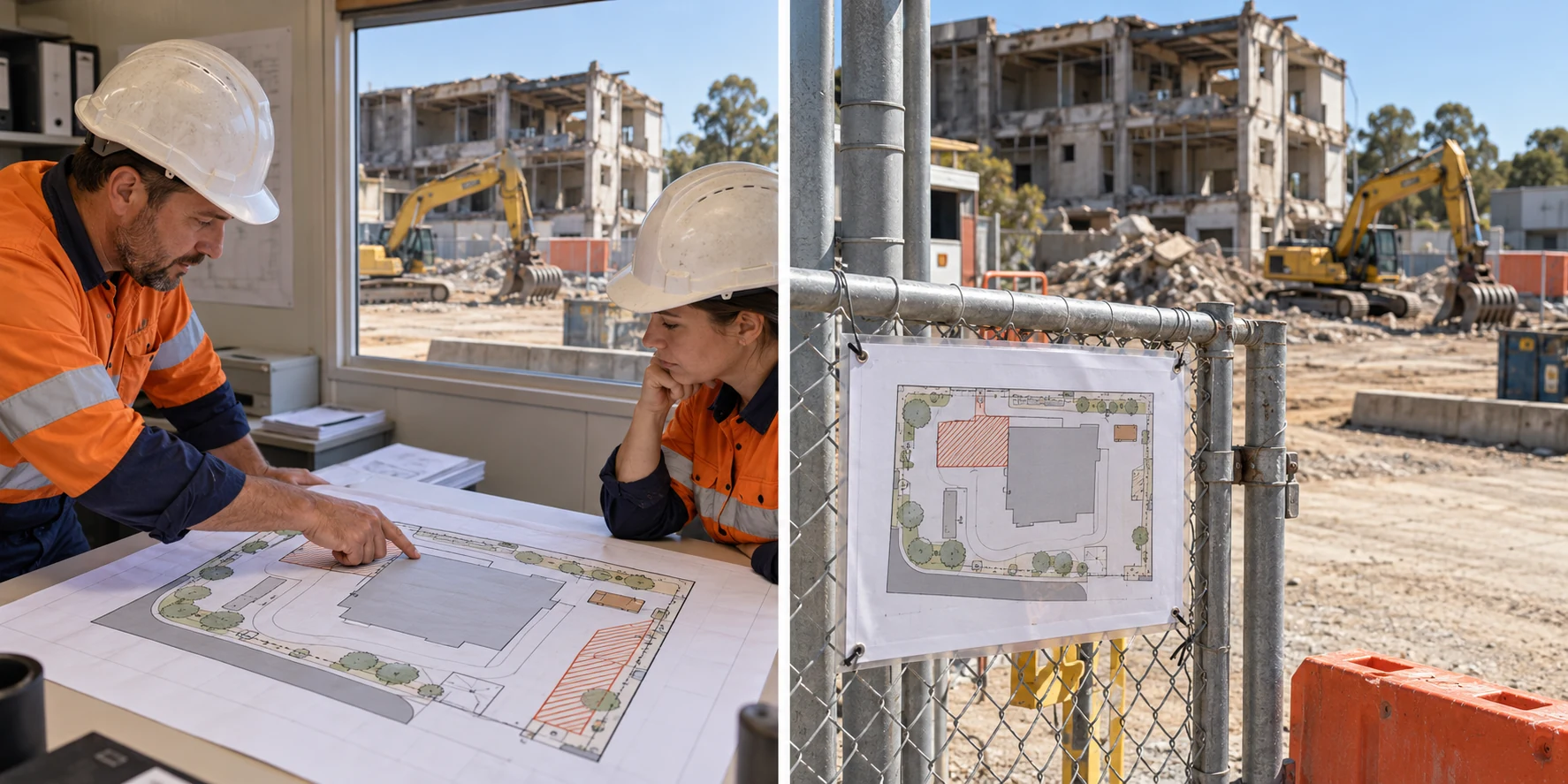
Check that the work-area copy matches the authorised issue and that affected people received and understood the change.
The simplified plans illustrate a document-control question; their status and approval cannot be inferred from appearance.
OnShift educational illustration, AI-generated and visually reviewed for this preview; not a project photograph.
Open full-size illustrationRelationships between project documents
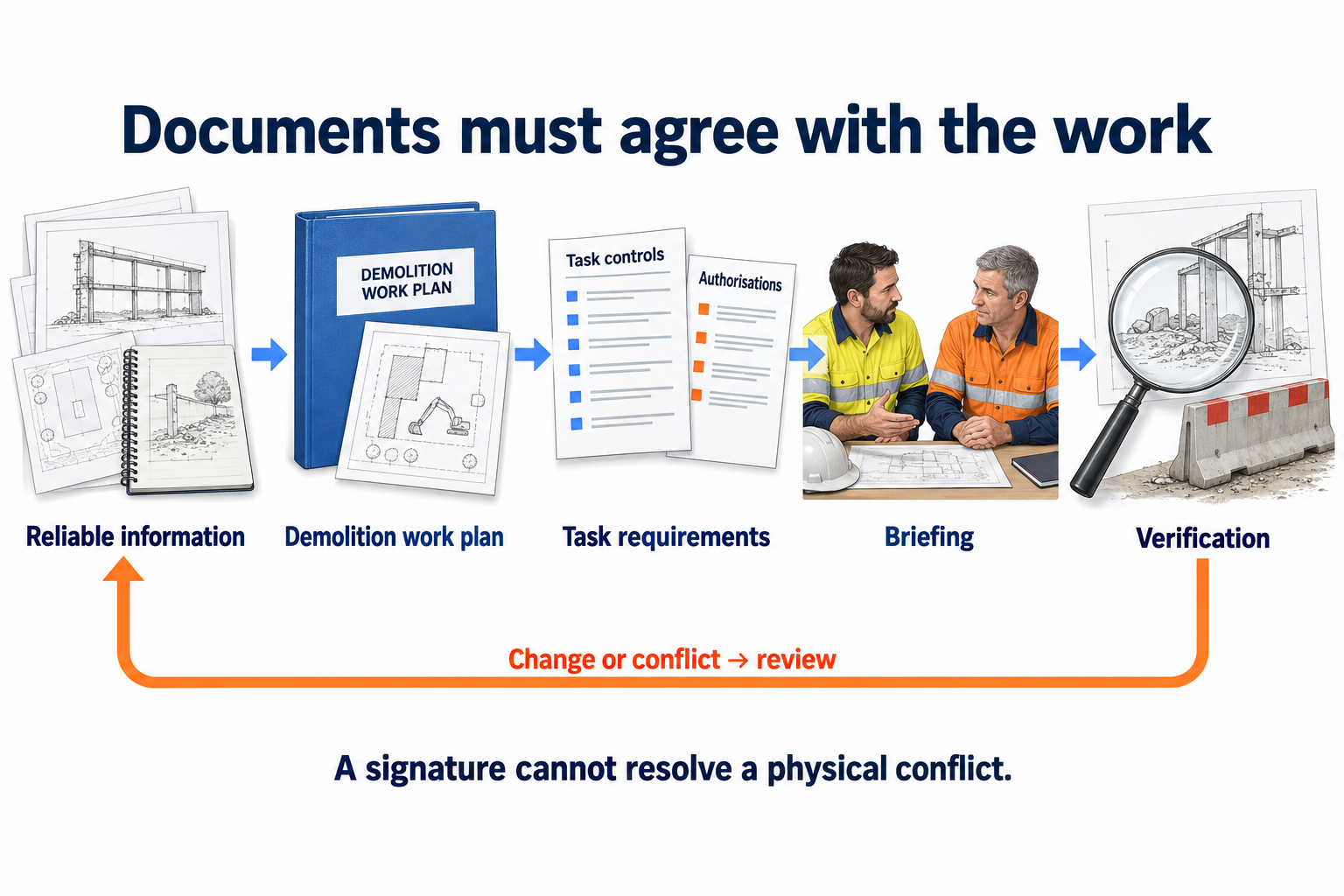
Site information connects planning, task controls, communication and verification.
 Open full-size illustration
Drawings, site observations, engineering information and hazardous-material findings establish the information used for planning. The demolition work plan coordinates the project; task controls and relevant authorisations address the work being undertaken. Briefings communicate the current arrangements, while verification establishes whether those arrangements have been implemented and remain effective.
A change or inconsistency requires the affected information and decisions to be reviewed. Documents must remain consistent with both one another and the physical conditions on site. A repeated signature cannot resolve a conflict between the plan and the work.
Factual diaries and photographs
A site diary is useful when it records events close to the time they occur. Describe the work stage, relevant conditions, people or roles, instructions, observations, disruptions and actions. Separate what you saw from what someone reported. Identify approximate times as approximate. Do not later make a reconstruction look like a contemporaneous entry. The timing is part of the record's meaning.
Consider an invented entry about a delivery delay. A weak version says 'trucks late, poor planning'. A more useful account identifies the scheduled activity, the observed arrival time, the resulting restriction, the person informed and the revised arrangement. The cause of the delay may remain unconfirmed. That record can support later coordination and commercial review without prejudging responsibility.
Photographs need context: date, location, direction and a description of what they show. A close-up can document a condition while concealing where it is. Use photographs lawfully and safely, with appropriate privacy and security controls. Do not enter a hazardous area merely to improve the record. If an event involves an incident scene, follow preservation and investigation requirements. A diary should preserve facts, not become a substitute for the required notification or a way to retrospectively authorise work.
Digital records and source information
Digital tools help retrieve, extract, combine and communicate information. A supervisor may search an official source, compare revisions, compile inspection findings or send a controlled update. Each operation needs a check that the meaning survived. A copied table may lose a footnote; an image may crop the title block; a spreadsheet filter may hide unresolved actions. A clean display is not proof that the source is complete.
Keep a traceable reference to the original information. Record the publisher, document identity, revision or capture date and relevant location. When combining records, preserve their units and definitions. A count of loads, a mass from weighbridge receipts and an estimated volume are different measures. Do not add them together or present one as another merely because software accepts the calculation. Check totals and samples against original entries.
Access and security matter too. Give authorised people the information they need while protecting medical, personal, commercial and site-security data. Use the organisation's approved systems and recovery arrangements. A personal chat group should not become the only record of a safety-critical instruction. Artificial intelligence may assist drafting or summarising if authorised, but it cannot establish that an inspection occurred, invent missing data or approve a control. The responsible person must check the content and retain the underlying source.
Corrections, retention and handover
Errors should be corrected without hiding the history. Preserve the original entry, identify the correction, explain the reason where needed and record who made it and when. Do not backdate a signature or replace an unfavourable observation with a later reassuring one. The later condition can be recorded separately. A truthful sequence is more useful than a polished record that cannot explain what changed.
Retention periods depend on the record type and applicable law, contract and organisational requirements. Some health, exposure, incident or project records have specific requirements and restricted access. Establish those requirements through the appropriate current sources. Closing a project does not automatically authorise deletion of its records or public distribution of its documents.
A handover should identify what is complete, what remains restricted, what is awaiting a decision and who owns the next action. Include the current versions and the location of supporting evidence. Avoid a broad 'all closed' statement where exceptions remain. The receiving person needs to understand the actual condition, not merely the intended one. Preserving identity, status, source and sequence allows the receiving person to distinguish a later correction from what was known at the time.