
Consultation, communication, induction, training and toolbox talks
Consultation informs decisions, induction explains the workplace, and training develops the understanding and skills needed for the task.
Consultation before a decision
Communication transfers information. Consultation is a two-way process that gives affected workers a meaningful opportunity to contribute to health and safety decisions. It involves sharing relevant information, hearing views, considering those views and communicating the outcome. Where workers are represented by a health and safety representative, that representative must be involved in the consultation. The business also needs to consult, cooperate and coordinate with other duty holders on shared matters.
The timing matters. Asking for signatures after an arrangement has already been fixed may record acknowledgement, but it does not create an opportunity to influence the decision. Consultation with directly affected or likely affected workers is required at several decision points. These include identifying hazards and assessing risks, and deciding how to eliminate or control risks. They also include considering the adequacy of welfare facilities or changing workplace facilities, and proposing changes that may affect health or safety. It is also required when deciding procedures for consultation, resolving safety issues, monitoring worker health and workplace conditions, and providing information and training. These are required decision points, not optional opportunities for discussion. Workers often know the practical details that determine whether a proposed control can be used.
Imagine a proposal to relocate a wash area. The office layout looks convenient, but workers explain that the route crosses a delivery interface and that storage blocks access during busy periods. Those observations can change the design before exposure occurs. Consultation has added information, not merely delayed the programme. It does not require every participant to agree with every outcome. It does require a genuine process and an explanation of the decision. A concern should not disappear because its author is junior or employed by another contractor.
General, site and task information
General construction induction, site induction and task instruction have different purposes. General induction provides a foundation for construction work. Site induction explains the particular workplace and its arrangements. Task instruction concerns the work a person will undertake. Completing one does not automatically replace the others. Familiarity with demolition also does not reveal this site's retained services, access restrictions or emergency arrangements.
A worker needs relevant information about the work area, hazards, controls, reporting routes, amenities, consultation and emergency response. A contractor needs detailed understanding of interfaces, responsibilities, access, permits and coordination with other businesses. A visitor needs proportionate information about restrictions, safe access, accompaniment and what to do if conditions change. High-visibility clothing does not give a visitor knowledge of plant movement or permission to enter a restricted area.
Induction should connect words to places. An instruction about an assembly area is stronger when people understand its location and the route relevant to their work. A reference to a retained service needs a clear boundary and the current information source. If a person returns after a significant layout change, their earlier attendance does not mean they know the new arrangement. Update the information according to the change. Keep records of what was explained, when, to whom and against which document version, without treating the signature as proof of every practical capability.
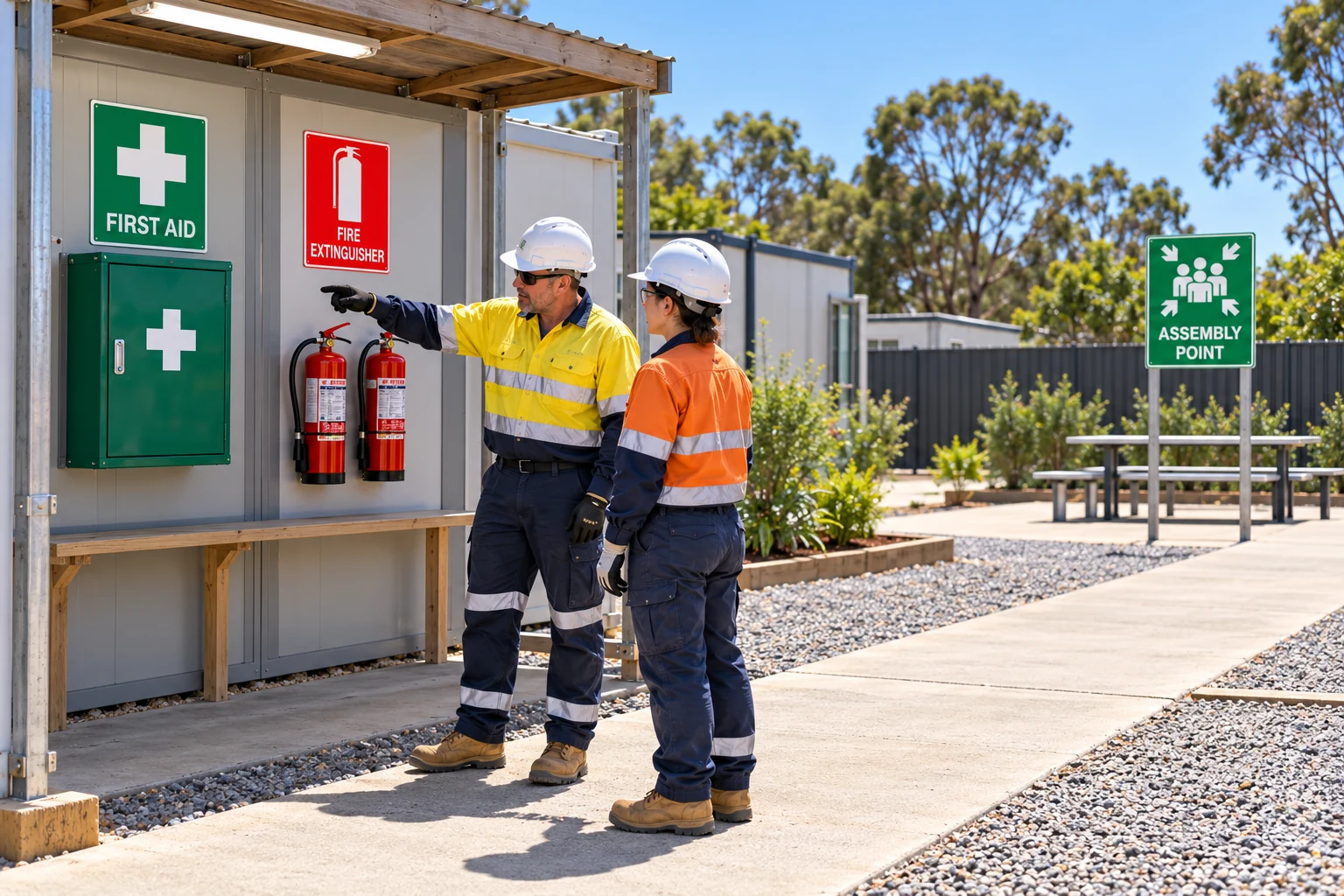
Show people the locations and routes that apply to this site. Check their understanding when the layout changes.
This is a fictional induction scene, not an emergency-plan design or certification of the sign artwork.
OnShift educational illustration, AI-generated and visually reviewed for this preview; not a project photograph.
- SafeWork NSW · Demolition work Code of Practice
- SafeWork NSW · Emergency plans
- SafeWork NSW · Duty to consult
Training matched to the task
A toolbox talk is a focused discussion about a relevant issue. It can refresh a control, explain a change or invite feedback about a recurring problem. It is not a substitute for substantial training, supervised practice or required role-specific education. A person learning unfamiliar equipment needs more than attendance at a short talk. Health and safety representatives also have role-specific training arrangements that should not be collapsed into general workforce briefings.
Start by identifying the learning need. Is the difficulty an unfamiliar term, a misunderstood boundary, a missing skill or an impractical control? The response differs. Repeating instructions will not solve a barrier that prevents the work being performed as planned. Equally, buying equipment will not automatically teach its limitations. A useful education plan identifies the audience, intended understanding, delivery method, support and how effectiveness will be examined.
Check understanding respectfully. Ask people to explain the relevant arrangement in their own words or identify the boundary on the current information, within a safe setting. Avoid a public test designed to embarrass someone. Silence can mean understanding, confusion, language difficulty or reluctance to speak. Provide suitable language and accessibility support. Use qualified interpreting support where needed for safety-critical information, rather than assuming that an informal translation preserves every condition. Participation should improve understanding, not merely complete an attendance sheet.
Technical terms
Hazard — A source or situation with potential to cause harm.
Risk — The possibility of harm, considered with its likelihood and consequence in context.
Exposure — The opportunity for a person or receptor to come into contact with a hazard.
Consequence — The harm or loss that could result.
Control — A measure that eliminates or reduces risk.
Remaining risk — Risk considered after the specified controls have actually been applied.
Elimination — Removing the hazard or hazardous exposure from the work.
Substitution — Replacing a hazard with a less hazardous alternative.
Isolation — Separating people from a hazard.
Engineering control — A physical or designed measure that acts on a hazard or exposure pathway.
Administrative control — An arrangement such as procedures, scheduling, information or supervision.
PPE — Personal protective equipment.
RPE — Respiratory protective equipment.
SWMS — Safe work method statement; a document for relevant high-risk construction work.
DWP — Demolition work plan.
Permit — A bounded authorisation within a defined control system, not universal proof of safety.
Induction — Introduction to relevant site conditions, responsibilities and arrangements.
Pre-start — A check or briefing before work or equipment use; distinct from scheduled servicing.
Verification — Checking evidence that the required condition or control exists and works as intended.
Consultation — Sharing relevant information, hearing affected workers' views and considering them in decisions.
Load path — The connected route by which forces pass through a structure to its supports.
Compression — A pushing action within a material or member.
Tension — A pulling action within a material or member.
Bending — A response to loading that tends to curve a member.
Shear — Action tending to make parts move past one another.
Temporary works — Engineered or other temporary arrangements supporting construction or demolition needs; specialist design and control may be required.
Respirable dust — Particles small enough to reach deep into the lungs.
LEL — Lower explosive limit; the lowest flammable gas or vapour concentration in air at which flame can propagate under the relevant conditions. Percentage of LEL is not percentage gas concentration or a safe-breathing decision.
Receptor — The person, property or environmental feature potentially affected.
Change control — The process of recognising a change, reviewing affected assumptions and controls, and communicating the revised arrangement.
Air monitoring — Competently planned measurement of airborne contaminants to assess exposure and control effectiveness.
Health monitoring — Medical monitoring for health effects, carried out or supervised by an appropriately experienced doctor when required.
Confirmation of important messages
Noise, distance, visibility and competing tasks can all interrupt communication. A message is not effective merely because it was transmitted. For safety-critical work, the agreed communication system needs a sender, an intended recipient, a clear meaning and confirmation that the meaning was understood. The practical signals and procedures must come from the authorised workplace arrangements.
A fictional example illustrates the principle. A supervisor advises that a particular access route is unavailable. One person hears the route name but not the restriction. A simple acknowledgement such as 'received' may conceal that misunderstanding. Confirmation of the meaning, including which route and what restriction applies, is more informative. If communication is lost or conflicting instructions arise, the affected operation must be controlled through the agreed safe process; silence is not permission to continue.
Digital communication has similar limits. A file shared in a chat may be obsolete, cropped or unavailable to a subcontractor. A read receipt does not prove understanding. Use controlled references and ensure the information can be retrieved at the point of use. Identify who receives revisions, how urgent changes are communicated and how superseded instructions are withdrawn. Digital convenience should strengthen the same document-control discipline used for paper, not create a second uncontrolled instruction system.
Feedback and recurring problems
Disagreement can reveal a genuine interface problem. Separate the observation, the person's concern and the proposed solution. A driver may report waiting, a worker may report blocked access and a neighbour may report dust. These accounts can describe different effects of the same arrangement. Examine the facts before deciding that one person is simply being difficult. Maintain necessary controls while the issue is resolved.
A useful record of consultation identifies the subject, people involved, views raised, decision, reason and follow-up. It does not need to reproduce every sentence. Its purpose is to preserve the decision and show how unresolved concerns will be addressed. Give feedback to the people who raised the matter. Otherwise, the system teaches them that reporting disappears into a folder.
Review education through the work as well as the meeting. If people attended a talk about access but the same shortcuts continue, investigate why. The route may be inconvenient, the instruction may conflict with another task or the control may have deteriorated. Do not assume that every recurrence is solved by another talk. Induction, task instruction, training and consultation have different purposes. Their effectiveness depends on understanding and workable arrangements as well as accurate records.