
Demolition work plans and sequencing
A demolition work plan connects technical inputs, task controls and stage conditions. Sequencing depends on established prerequisites and the controlled condition left between activities.
The coordinating role of the demolition work plan
A demolition work plan explains how the project is to be coordinated through its stages. It draws together scope, site information, structural constraints, hazardous materials, services, plant, people, public protection, environmental controls and review points. Its value lies in making those inputs work together. A stack of separate reports is not yet a coherent operating plan.
The plan should identify the current project and revision, the areas and activities covered, responsible roles and the information on which it relies. It needs enough detail for the people using it to understand the stage boundaries and critical controls. It should refer to specialist documents precisely rather than paraphrasing their technical conditions into ambiguous shorthand.
Distinguish the work plan from a safe work method statement, or SWMS. The work plan coordinates the wider project and interfaces. A SWMS addresses the relevant high risk construction activity, its hazards and controls, including implementation, monitoring and review. A permit authorises defined work under conditions. None repairs a missing technical input in another.
Specialist inputs, task controls and implementation records support the central work plan. A changed specialist input may affect several dependent documents. An unanswered engineering, environmental or licensing question remains unresolved even if a planning form requires an entry.
Relationships between project documents
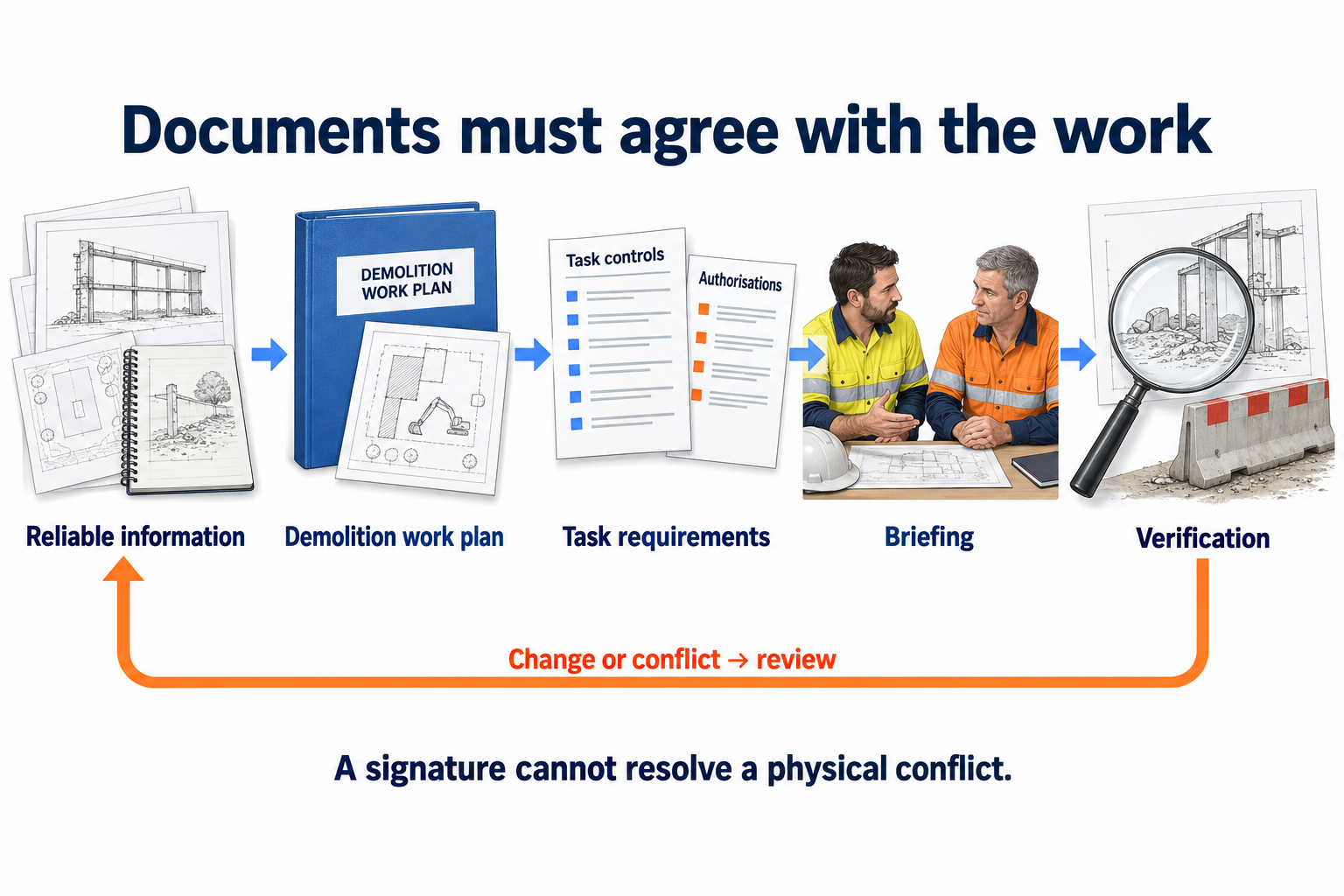
Site information connects planning, task controls, communication and verification.
 Open full-size illustration
Drawings, site observations, engineering information and hazardous-material findings establish the information used for planning. The demolition work plan coordinates the project; task controls and relevant authorisations address the work being undertaken. Briefings communicate the current arrangements, while verification establishes whether those arrangements have been implemented and remain effective.
A change or inconsistency requires the affected information and decisions to be reviewed. Documents must remain consistent with both one another and the physical conditions on site. A repeated signature cannot resolve a conflict between the plan and the work.
Dependencies and hold points
Sequencing describes the order and relationships between activities. The important word is relationships. A list of dates may place one activity before another without explaining why. A useful plan identifies what must be true before the next activity can begin and what condition must remain when the current one ends.
Some dependencies are technical, such as a retained element needing support before an associated change. Others concern service isolation, hazardous-material work, access, permits or environmental capacity. Resource dependencies also matter. Two activities cannot rely on the same exclusive work area or specialist person at the same time unless the arrangement allows it.
A finish-before-start relationship means the dependent activity cannot begin until its predecessor has reached the required condition. Sometimes several conditions must join: an access arrangement might need both physical installation and documented inspection before release. Finishing only one does not release the route. Other conditions are continuous rather than one-time milestones. Separation, support and emergency access may need to remain effective throughout the dependent activity, not merely at its start.
Activities can run together only where their shared space, resources and hazards have been considered. Drawing two parallel bars on a programme does not establish that independence. If a predecessor changes or its release is withdrawn, trace the effect through every dependent activity and continuing condition. Review the resulting holds, resources and dates together. Adding labour to the next task cannot remove an unresolved technical dependency; shortening a date bar cannot make a required inspection occur.
A hold point is a point beyond which the specified work does not proceed until a required review or release occurs. It needs a clear subject, required evidence, responsible reviewer and release authority. A milestone saying engineering complete is weaker than a defined release linked to a particular stage and controlled instruction.
An access arrangement may depend on a protective structure being installed and inspected. The dependency is not merely that installation appears earlier on the programme. It is that the required inspection and release are complete before people use the route.
Interpreting a control record
A control record for a material-transfer area needs to identify the activity, location, revision and intended use. These details establish whether the document applies to the work. Its supporting information and unresolved assumptions are equally important: changing a heading does not make an unrelated record applicable.
A hazard entry must explain the route to harm. Terms such as plant or debris identify a subject but not the exposure. The record needs to establish how movement or material could reach workers, visitors, neighbouring property or an environmental receptor. Deliveries and changing work areas can alter those pathways.
The control entry distinguishes measures that are proposed from those already implemented. It identifies how each measure reduces exposure, who establishes and maintains it, and what technical information it depends on. Exclusion distances and load limits require the relevant site-specific basis; they cannot be derived from a generic form.
Verification must address the condition being relied upon. A photograph may establish the location of a sign, but it cannot establish the capacity of a structural support. A signature may record acknowledgement without verifying the assumptions behind the arrangement.
If a delivery blocks the planned route, the review must address the changed movement and exposure. The revised arrangement must be communicated and obsolete instructions withdrawn from use. Traffic arrangements, the demolition work plan, relevant safe work method statements, emergency access and briefings must remain consistent. A permit authorises a defined activity under specified conditions; it does not replace unrelated technical confirmations.
The condition between activities
Demolition is not a continuous motion from intact building to empty site. There are pauses, shift changes, inspections, weather interruptions and plant changes. The structure and site must remain controlled during those intervals. A plan that describes only active work can miss the most exposed temporary condition.
For each stage, understand the retained structural condition, access restrictions, stored materials, services, environmental controls and security needs. The assessed arrangement may impose limits on loading, equipment position or the duration of a temporary condition. These limits must come from the relevant technical sources and remain visible in the instructions.
The end-of-shift state deserves deliberate attention. Partly completed work may leave altered edges, exposed services, unstable material or changed drainage. The next crew needs a record of what is complete, what remains restricted and what evidence is outstanding. A progress percentage cannot communicate those conditions.
A plan may schedule two tasks on the same day without establishing whether they can occur simultaneously. The missing distinction can create a conflict between a plant route and a specialist exclusion area. Review the overlap, not just the calendar dates. Safe opportunities for parallel work depend on independence or controlled interfaces, not on the desire to recover time. This is why a programme, work plan and daily briefing should tell the same story about the current stage and the state left behind.
Demolition method selection
Method selection depends on the actual structure, materials, connections, access, space, neighbouring uses, services, hazardous materials and available capability. Different approaches change where people are exposed and what forces, loads, dust, noise and debris are generated. There is no universal method that can be selected from the building's height or material name alone.
Hand-based work may allow local control while placing people close to the material. Mechanical work can change that proximity but introduce larger movement envelopes, reactions and debris energy. Cutting and handling components introduces support and lifting interfaces. Specialist collapse methods require their own engineering and controlled arrangements.
A useful comparison explains the decision factors and the evidence required, rather than providing an unsupported winner. For a retained boundary wall, factors may include its dependencies, neighbouring occupancy, available controlled space and the assessed temporary condition. A machine's availability is relevant to resources but cannot override an unsuitable technical arrangement. A smaller machine can change proximity, duration, access and exposure; size alone cannot establish the lower-risk option.
The work plan should state the adopted approach through the authorised project process and identify the controlling technical references. If those inputs are incomplete, mark the affected decision as unresolved. Full applicable standards and project-specific engineering remain necessary where required. Regulator guidance informs planning; the project still needs an authorised method based on its actual conditions and applicable requirements.
Keep interpretation and proposal visibly separate when marking a plan copy. Preserve the source title and revision. Use a short legend such as “source feature”, “proposed arrangement” and “unconfirmed interface”. Write the words as well as using different line styles, so the distinction does not depend on colour.
Consider a generic exercise plan that identifies a boundary but provides no truck turning check. You can trace the boundary as source information and sketch a possible internal route as a proposal. Add a note that turning space, ground support and gate interaction require checking. The drawn route is not evidence that a vehicle fits. This small example demonstrates a recording method, not a completed solution for any of the four cases.
When comparing methods, explain which condition makes each option workable and which dependency could prevent it. For a framed building, changes to support or restraint matter. At a public interface, access and separation matter. The same option can be attractive for one reason and unresolved for another.
Technical terms
Hazard — A source or situation with potential to cause harm.
Risk — The possibility of harm, considered with its likelihood and consequence in context.
Exposure — The opportunity for a person or receptor to come into contact with a hazard.
Consequence — The harm or loss that could result.
Control — A measure that eliminates or reduces risk.
Remaining risk — Risk considered after the specified controls have actually been applied.
Elimination — Removing the hazard or hazardous exposure from the work.
Substitution — Replacing a hazard with a less hazardous alternative.
Isolation — Separating people from a hazard.
Engineering control — A physical or designed measure that acts on a hazard or exposure pathway.
Administrative control — An arrangement such as procedures, scheduling, information or supervision.
PPE — Personal protective equipment.
RPE — Respiratory protective equipment.
SWMS — Safe work method statement; a document for relevant high-risk construction work.
DWP — Demolition work plan.
Permit — A bounded authorisation within a defined control system, not universal proof of safety.
Induction — Introduction to relevant site conditions, responsibilities and arrangements.
Pre-start — A check or briefing before work or equipment use; distinct from scheduled servicing.
Verification — Checking evidence that the required condition or control exists and works as intended.
Consultation — Sharing relevant information, hearing affected workers' views and considering them in decisions.
Load path — The connected route by which forces pass through a structure to its supports.
Compression — A pushing action within a material or member.
Tension — A pulling action within a material or member.
Bending — A response to loading that tends to curve a member.
Shear — Action tending to make parts move past one another.
Temporary works — Engineered or other temporary arrangements supporting construction or demolition needs; specialist design and control may be required.
Respirable dust — Particles small enough to reach deep into the lungs.
LEL — Lower explosive limit; the lowest flammable gas or vapour concentration in air at which flame can propagate under the relevant conditions. Percentage of LEL is not percentage gas concentration or a safe-breathing decision.
Receptor — The person, property or environmental feature potentially affected.
Change control — The process of recognising a change, reviewing affected assumptions and controls, and communicating the revised arrangement.
Air monitoring — Competently planned measurement of airborne contaminants to assess exposure and control effectiveness.
Health monitoring — Medical monitoring for health effects, carried out or supervised by an appropriately experienced doctor when required.
Plan revisions and decision history
A controlled plan needs an identifier, revision, issue status and authorised distribution. Workers should know which version applies to their activity and where the referenced documents are available. Retain superseded versions in the controlled history while removing them from active use. This preserves the reason for earlier decisions without allowing conflicting work instructions to circulate.
Changes can arise from newly exposed construction, service information, hazardous materials, weather, plant substitution or client scope decisions. Identify which assumptions and downstream activities are affected. Hold dependent work where necessary, obtain the relevant review, revise the documents and brief the people who need to act differently.
A field note is useful evidence of an observation, but it is not automatically an authorised technical change. A verbal instruction may need urgent protective action, yet the lasting change still requires a traceable record through the project's process. Preserve who decided what, on which evidence, for which area and conditions.
Responding to changed conditions
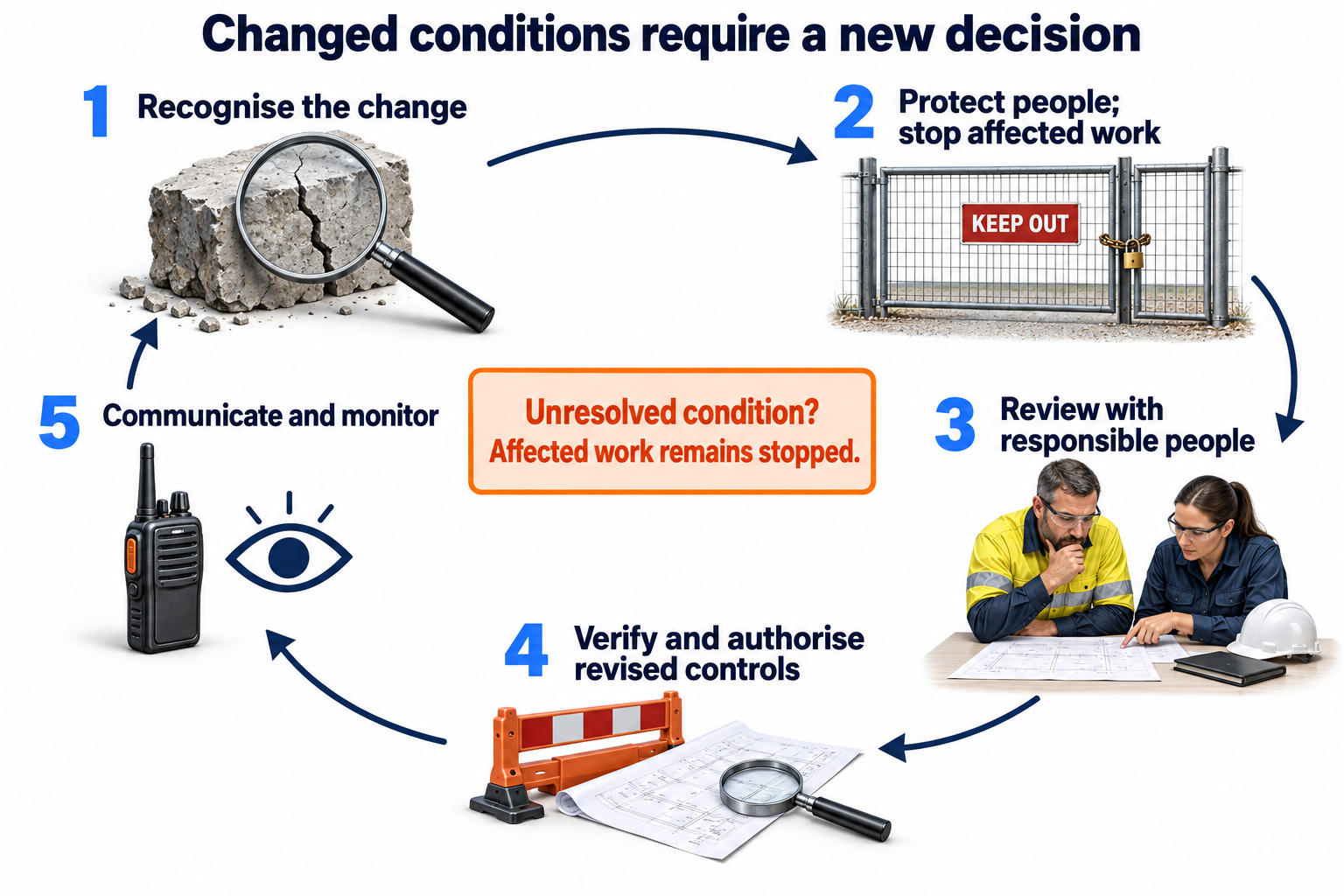
A change requires review of the assumptions and controls governing affected work.
 Open full-size illustration
A changed condition can invalidate the assumptions supporting a work stage. Protecting people and stopping affected work limits further exposure while the responsible people review the change. Revised controls require the appropriate technical input, verification and authorisation before affected work resumes.
The revised arrangement must reach everyone whose work depends on it. Monitoring then establishes whether it remains effective. An unresolved condition is not cleared by the continued existence of an earlier plan. Emergency response follows the site's emergency arrangements and the authority responsible for the incident.