
Connecting project decisions
Structural, equipment and material decisions connect site information with planning, control verification and business responsibilities.
Decisions depend on one another
A workplace concern often crosses several areas of knowledge. Its location may come from a drawing, its significance from a structural or exposure question, and its immediate consequences from the work happening around it. Different people may hold the information and authority needed to resolve it.
These decisions depend on one another. Reliable information supports selection of a work arrangement. The arrangement requires controls to be established. Their performance then needs to be checked under actual conditions. A method recorded in a plan does not establish that its controls are installed, and installation does not establish continuing effectiveness.
Structural advice and work instructions
A drawing discrepancy involving a retained element illustrates the connection. Reading the drawings locates the element and reveals differences in views, revisions or scope. Structural principles explain why load paths, restraints and material behaviour matter. Hazard identification establishes who or what could be exposed if an assumption is wrong. Planning identifies the affected work stage and required specialist input. The supervisor controls the affected work within their authority and communicates the authorised decision.
The resulting technical question needs to identify the assumption about the retained element that requires confirmation and the work depending on it. The supervisor can define that uncertainty without taking over the specialist's design responsibility.
Specialist advice may change the drawing information, stage arrangement or restrictions. Those changes must reach task controls and the work party. If the advice stays in an email while the old drawing remains active, the technical decision has not reached the people relying on it. A technically sound answer has not yet become a reliable work instruction. Document control and communication therefore carry structural decisions into the work.
Equipment selection and surrounding work
Equipment selection starts with the intended application and conditions. Operational knowledge explains the tool or plant's purpose, limitations, compatibility, serviceability and information needs. Hazard reasoning examines exposure to movement, energy, dust, noise and other effects. Planning considers access, support, resources and interfaces. Supervision checks that the actual selection and use remain within the authorised arrangement.
Familiarity with a tool does not establish that its condition or application is suitable today. Small plant, hand tools and hot-work equipment each bring limitations that need to fit the task and its surroundings.
Consider a replacement-tool decision. The original item is unavailable. A substitute may change power needs, attachment compatibility, exposure controls, fire risk, handling or the user's training needs. The review needs to establish which dependencies change before the substitute is used. Hot work adds particular ignition and atmosphere questions, but a permit alone cannot answer them. Follow the actual source information and authorised review for the proposed activity.
Hazard, exposure and harm
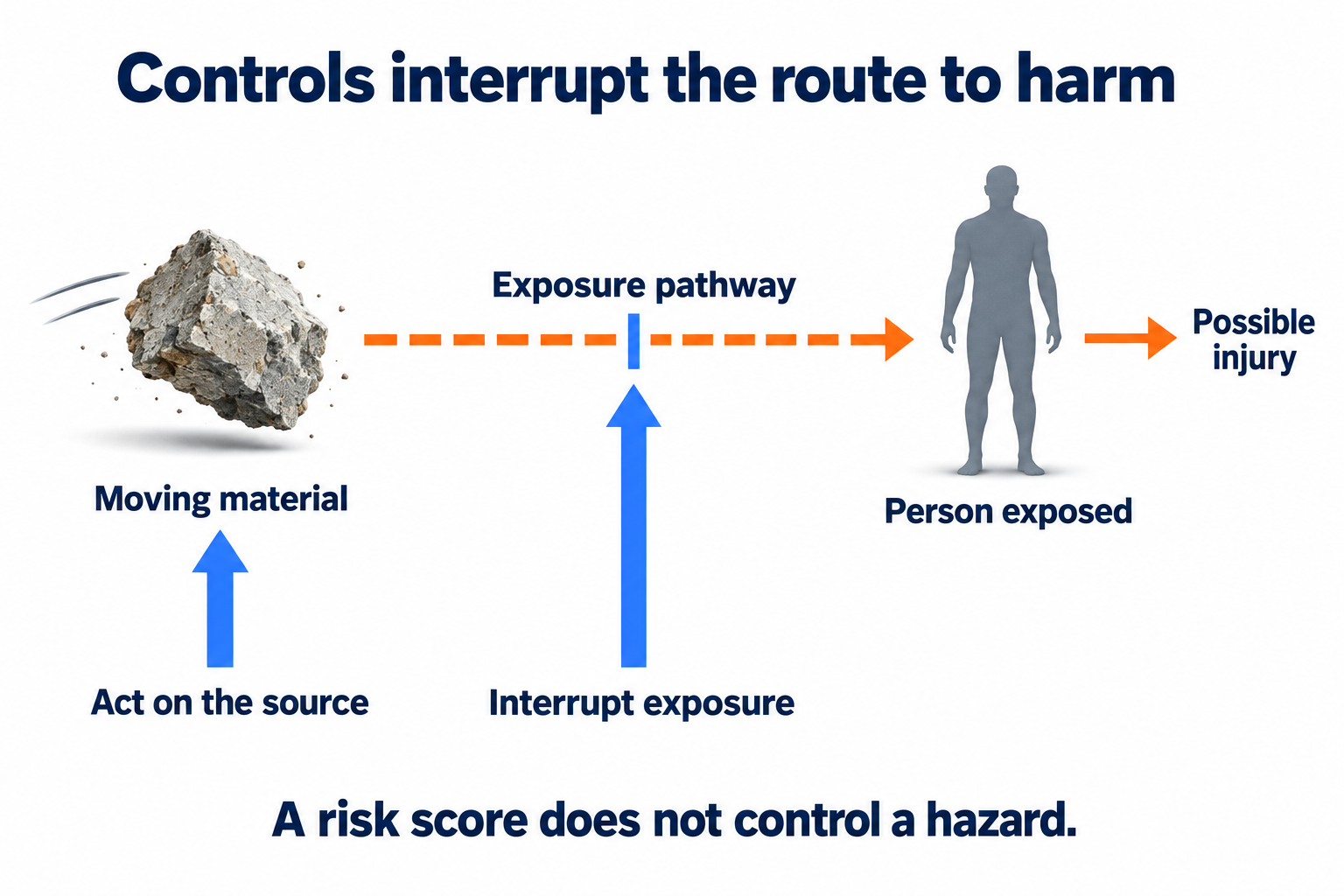
Controls prevent harm by acting on a hazard or its exposure pathway.
 Open full-size illustration
A source of potential harm reaches a person or environmental receptor through an exposure pathway. For example, moving material can strike a person who enters its path. The consequence depends on the material, movement and exposure involved.
Controls act on the source or interrupt the connection before harm occurs. The arrows below the main chain indicate these intervention points. A control must be in place and effective: assigning a risk score does not itself change the hazard or exposure.
A local problem and its business causes
A recurring waste-handling problem may appear local, but its causes can lie in scope, procurement, scheduling, destination arrangements or training. Project planning establishes the intended work and risk controls. Supervision examines how those arrangements operate. Inspections, audits and incident investigation can identify where the business needs to change its support for the work.
Imagine repeated mixing of material streams. The immediate correction may concern the affected material. But the wider enquiry asks whether containers were available, identification was maintained, space matched the work and receiving requirements were understood. Environmental knowledge adds the material's lawful route beyond the site. The problem should not be reduced to a reminder if the system makes segregation impractical.
The decision map therefore runs in both directions. Business planning supports the workface, while observations from the workface inform business improvement. A supervisor who reports the pattern with evidence can help management address the cause. A report containing only a count of mixed loads may not explain the dependency. Describe what changed, who was affected and which decision needs review. That information helps management identify where it can address the cause.
Inputs, decisions and consequences
A permit depends on information and controls; the work party depends on understanding its conditions. A monitoring result depends on a method and context; the next decision depends on competent interpretation. A handover depends on the actual site condition; the receiving party depends on its exceptions being clear.
The title of a document does not explain those relationships. A current work plan coordinates the stage, but it must reflect current specialist information and actual controls. When either changes, the plan and the instructions drawn from it may need review.
Knowing why a decision matters, having evidence for it and being authorised to make it are different matters. Identifying all three helps a project team locate a missing input without treating one person's knowledge as authority over every related decision.
Technical terms
Hazard — A source or situation with potential to cause harm.
Risk — The possibility of harm, considered with its likelihood and consequence in context.
Exposure — The opportunity for a person or receptor to come into contact with a hazard.
Consequence — The harm or loss that could result.
Control — A measure that eliminates or reduces risk.
Remaining risk — Risk considered after the specified controls have actually been applied.
Elimination — Removing the hazard or hazardous exposure from the work.
Substitution — Replacing a hazard with a less hazardous alternative.
Isolation — Separating people from a hazard.
Engineering control — A physical or designed measure that acts on a hazard or exposure pathway.
Administrative control — An arrangement such as procedures, scheduling, information or supervision.
PPE — Personal protective equipment.
RPE — Respiratory protective equipment.
SWMS — Safe work method statement; a document for relevant high-risk construction work.
DWP — Demolition work plan.
Permit — A bounded authorisation within a defined control system, not universal proof of safety.
Induction — Introduction to relevant site conditions, responsibilities and arrangements.
Pre-start — A check or briefing before work or equipment use; distinct from scheduled servicing.
Verification — Checking evidence that the required condition or control exists and works as intended.
Consultation — Sharing relevant information, hearing affected workers' views and considering them in decisions.
Load path — The connected route by which forces pass through a structure to its supports.
Compression — A pushing action within a material or member.
Tension — A pulling action within a material or member.
Bending — A response to loading that tends to curve a member.
Shear — Action tending to make parts move past one another.
Temporary works — Engineered or other temporary arrangements supporting construction or demolition needs; specialist design and control may be required.
Respirable dust — Particles small enough to reach deep into the lungs.
LEL — Lower explosive limit; the lowest flammable gas or vapour concentration in air at which flame can propagate under the relevant conditions. Percentage of LEL is not percentage gas concentration or a safe-breathing decision.
Receptor — The person, property or environmental feature potentially affected.
Change control — The process of recognising a change, reviewing affected assumptions and controls, and communicating the revised arrangement.
Air monitoring — Competently planned measurement of airborne contaminants to assess exposure and control effectiveness.
Health monitoring — Medical monitoring for health effects, carried out or supervised by an appropriately experienced doctor when required.