
Hazard identification and the hierarchy of control
Hazards cause harm through exposure pathways. Effective controls interrupt those pathways and remain subject to checks as demolition conditions change.
Hazards, exposure and the hierarchy of control
A hazard is a source of potential harm. Risk concerns how likely that harm is to occur and how severe its consequences could be. On a demolition site, naming a hazard is only the start of an explanation. A loose piece of masonry has potential to injure someone. Exposure describes the opportunity for contact: a person passes beneath it, another worker disturbs it, or debris reaches an adjoining place. The consequence is the resulting harm. A control changes that chain.
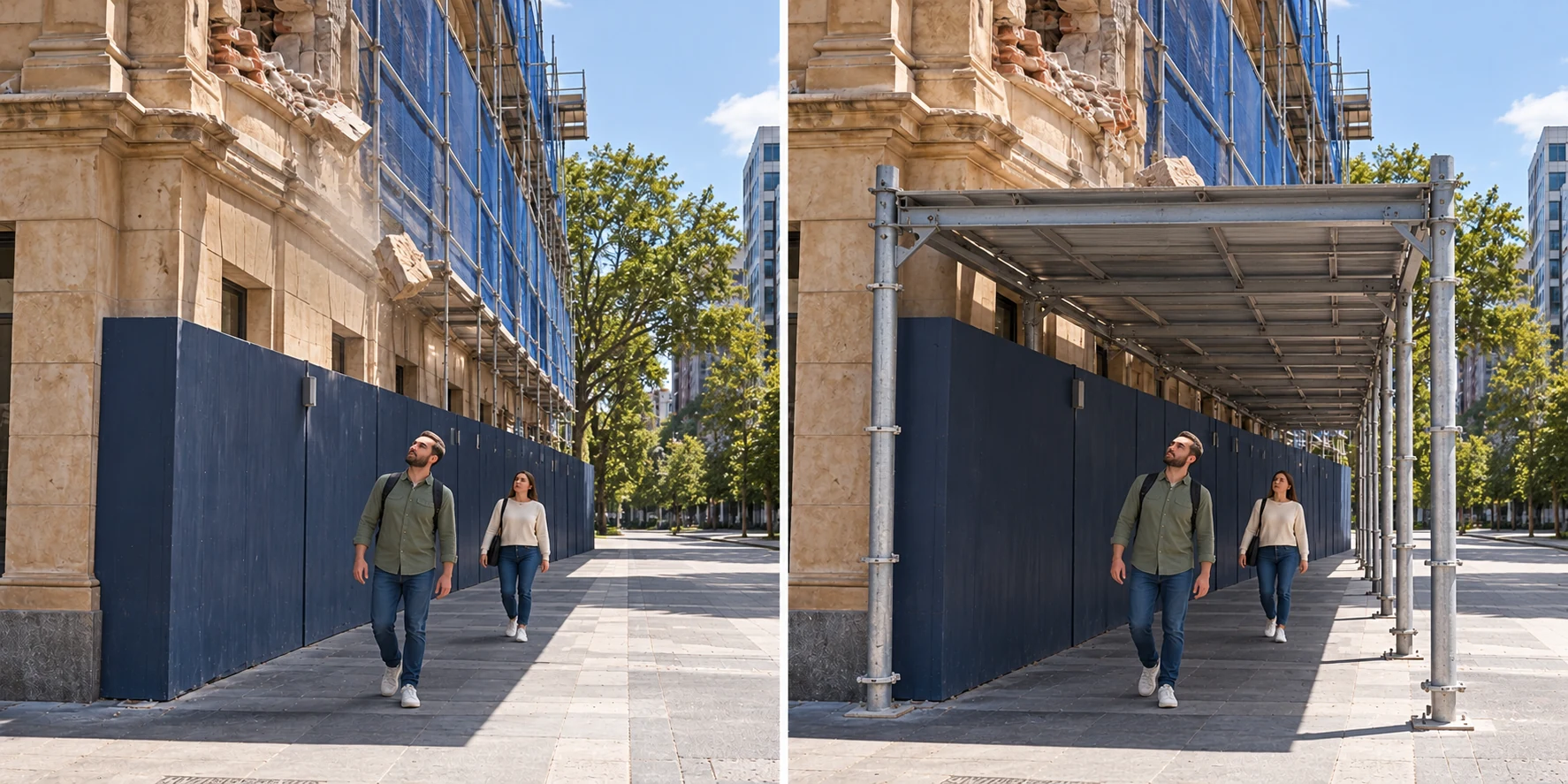
Compare the exposure pathway. The overhead structure illustrates physical interception; the unprotected view shows the potential for serious harm.
The left view is unsafe. This is not a gantry design, capacity claim or permission to keep a route open beneath demolition.
OnShift educational illustration, AI-generated and visually reviewed for this preview; not a project photograph.
- SafeWork NSW · Managing risk in the workplace
- SafeWork NSW · Demolition work Code of Practice
- SafeWork NSW · Managing hazards and risks
Workers moving materials near an opening may pass beneath loose fragments. Writing 'falling objects' on a form names the hazard. But it does not explain how fragments could fall, who could be in their path, or which measure prevents that contact. A useful explanation links those things. It also states what information is missing. The opening may have concealed edges or uncertain support. Those uncertainties matter before anyone proposes a method.
A risk score is a way a particular system records a judgement. It is not a measurement of structural stability or proof that a task is safe. The same number can conceal very different assumptions. If a supervisor cannot explain the event being considered, the people exposed, and the control being relied on, the number has done little useful work.
The connection between source, pathway, person and consequence explains how harm can occur. Controls interrupt different parts of that connection. Eliminating the hazardous work removes the associated exposure. Substitution changes the process or material to reduce the hazard. Isolation separates people from the hazard. Engineering measures physically control release or movement. Instructions, access rules, scheduling and supervision are administrative measures. Personal protective equipment acts close to the person and depends on suitable selection, fit, condition and use.
The hierarchy is an order of preference, not a menu of equally protective choices. First consider whether the hazard or the hazardous work can be eliminated. Where that is not reasonably practicable, consider substitution, isolation and engineering measures to minimise risk. Administrative arrangements and personal protective equipment address what remains; they depend more heavily on people remembering, understanding and consistently following the arrangement. Measures may work together. Choosing a lower-order measure does not remove the need to consider a more reliable one.
Control categories help compare how measures work and how reliably they protect people. A barrier's name does not tell you whether it can withstand debris. A sign does not physically stop a vehicle. A respirator does not remove dust from the workplace. Several measures may be needed together, with checks that each does its intended job. The detailed selection must come from the actual task, conditions, applicable requirements and competent advice.
A pedestrian route through a material-handling area illustrates the difference between controls. A sign and briefing depend on each person noticing and responding correctly. Rerouting the journey away from that area removes that particular interaction. Physical separation may control the pathway where the interaction cannot be removed. Available space, hazards on the alternative route, emergency access and actual plant movement still need competent review. Verification establishes whether the agreed separation exists, remains usable and accommodates changing work.
Remaining risk is the risk after the controls being assessed have been applied. It is not the risk after someone has merely promised to apply them. The distinction separates a proposed arrangement on paper from a verified arrangement on site. Responsibility for installation and checking, evidence of performance and review triggers make that distinction clear.
Project information and document limits
A drawing describes an intended or recorded physical arrangement. A specification describes requirements for the work or its result. An inspection adds observations about actual conditions. An engineering report may explain structural behaviour, assumptions and limitations. A hazardous-material survey identifies suspect or confirmed materials, their locations and the limits of the investigation. Each document answers a different question.
A building has a rear work area beside an occupied neighbouring property. A plan shows a doorway. The site inspection finds the doorway blocked. A traffic sketch assumes that doorway is the pedestrian escape route. The documents describe an arrangement that cannot work. Resolving the conflict requires confirmation of the actual condition and review of the affected plans by the responsible people.
A project risk assessment identifies significant hazards, exposed people and proposed control reasoning across the work. The demolition work plan brings together how the demolition project is to be organised and controlled. A safe work method statement, or SWMS, sets out the relevant high-risk construction work. It sets out that work's hazards and risks, and the measures and arrangements for controlling them. A permit is a defined authorisation within a particular control system. An induction introduces people to the site and its arrangements. A briefing connects current work, current conditions and the people doing it.
These are relationships, not interchangeable labels. A signed induction does not verify an electrical isolation. A hot-work permit does not establish that a structure can support the proposed operation. A risk assessment does not replace specialist identification of an unknown material. If a document is being used to answer a question outside its purpose, the apparent reassurance may be false.
A document's title, location or work area, revision, issue date, purpose, author and review status establish what it applies to. Drawing legends and orientation also matter. A north arrow gives orientation; a scale gives the relationship between drawn and actual size; a dimension states a measurement. Reducing a print can invalidate measurement from its scale. Critical dimensions and uncertain site conditions require reliable confirmation rather than estimates from a distorted sheet.
A document's usefulness also depends on its assumptions, issue purpose and investigation limits. A report issued for coordination may not support the intended work. Its inspection may exclude a hidden space now exposed. Linked documents may use different revisions or work boundaries. A document can be current in date yet incomplete for the decision.
Site information informs planning, task controls, briefings and verification. Changed conditions can affect any of these, requiring the original information and dependent arrangements to be reviewed. The documents need to reflect the developing understanding of the site.
The Work Health and Safety Act 2011 and the Work Health and Safety Regulation 2025 form the NSW legislative framework. Older guidance may retain references to superseded regulations, so its legal references need checking before use. Codes of practice, Australian Standards, engineering designs and company procedures have different purposes. None alone settles every duty, licence condition or project decision.
Interpreting a control record
A control record for a material-transfer area needs to identify the activity, location, revision and intended use. These details establish whether the document applies to the work. Its supporting information and unresolved assumptions are equally important: changing a heading does not make an unrelated record applicable.
A hazard entry must explain the route to harm. Terms such as plant or debris identify a subject but not the exposure. The record needs to establish how movement or material could reach workers, visitors, neighbouring property or an environmental receptor. Deliveries and changing work areas can alter those pathways.
The control entry distinguishes measures that are proposed from those already implemented. It identifies how each measure reduces exposure, who establishes and maintains it, and what technical information it depends on. Exclusion distances and load limits require the relevant site-specific basis; they cannot be derived from a generic form.
Verification must address the condition being relied upon. A photograph may establish the location of a sign, but it cannot establish the capacity of a structural support. A signature may record acknowledgement without verifying the assumptions behind the arrangement.
If a delivery blocks the planned route, the review must address the changed movement and exposure. The revised arrangement must be communicated and obsolete instructions withdrawn from use. Traffic arrangements, the demolition work plan, relevant safe work method statements, emergency access and briefings must remain consistent. A permit authorises a defined activity under specified conditions; it does not replace unrelated technical confirmations.
Structural loads, restraint and released energy
Demolition changes the way a structure carries load. A load path is the connected route through which forces are transferred, ultimately to supporting ground or another designed support. A roof may transfer load to beams, beams to columns or walls, and those elements to foundations. The visible piece being removed can therefore affect parts that are not immediately beside it.
Compression is a pushing action; tension is a pulling action. Bending involves different parts of an element responding differently as it curves under load. Shear involves forces tending to move parts past one another. Real members and connections can experience combined actions. The actions and the way members and connections resist them are part of the engineering assessment of a removal sequence.
Appearance alone is unreliable. A wall that looks like a simple partition may conceal support, bracing, services or alterations. A relatively small connection may restrain a much larger element. Corrosion, fire damage, water damage, earlier modifications and incomplete records can change the assumptions on which a plan depends. A structure is not necessarily stable because it stood yesterday: today's work may remove a restraint, redistribute load or expose damage.
Distinguish three related mechanisms. Structural instability concerns loss of the arrangement that supports or restrains the structure. Falling objects can involve smaller detached items even while the main structure remains standing. Flying debris can be projected by an operation rather than falling vertically. These mechanisms can affect different areas. A line drawn directly underneath the work may not describe all possible paths of material.
An exclusion zone is an area kept clear to separate people from an identified hazard. Its dimensions and protective arrangements depend on the work, material behaviour, plant, surrounding features and competent planning. A light pedestrian barrier may communicate a boundary without being designed to resist impact. A designed protective system has a different purpose and needs its own installation and inspection arrangements.
Floors and ground also carry loads created by the work. Plant, attachments, stockpiles and accumulated debris add weight and can concentrate it. Water can add load or affect ground conditions. A floor opening, basement, service trench or buried void may matter to support even if the surface looks continuous. The supervisor needs reliable information about the intended loads and supporting conditions, not an assumption based on the equipment fitting through the gate.
New cracking may appear beside an area where the planned conditions were thought to be unchanged. The observation is not a diagnosis. It could have more than one cause, and a photograph alone cannot establish stability. The observation is a trigger to make people safe, stop affected work and preserve the information. It also triggers the required competent assessment before anyone relies on the previous arrangement.
Designing temporary supports, approving a sequence and assessing a damaged structure's stability require appropriate technical competence and authority. Observations from the workface inform those decisions but cannot replace the necessary investigation and design.
Fall hazards also change as the structure is dismantled. A surface may look continuous while containing fragile roofing, concealed openings or unsupported areas. Edges and newly exposed penetrations change as demolition progresses. An apparently intact surface does not establish that access is safe. Access planning, suitable prevention measures and any necessary rescue arrangements require the appropriate competent people. A warning alone does not demonstrate that a fragile surface can support someone.
High-reach excavation equipment creates another interface between the machine and the structure. Relevant information includes the specific machine and attachment, the proposed working envelope, and ground and support conditions. It also includes structural behaviour and the planned separation from people and retained assets. A familiar machine or a manufacturer's capacity statement alone cannot establish that a particular demolition arrangement is suitable. Missing or changed inputs require engineering and plant-planning review before the arrangement is relied on.
Exposure and delayed harm
Some demolition hazards are obvious because material moves or machinery approaches. Other harm develops through exposure that is difficult to see, hear accurately or feel at the time. A worker can finish a shift without an injury being apparent while still having experienced a harmful exposure. Absence of immediate symptoms is not a control check.
Demolition can release particles from the material being disturbed and from settled contamination. Concrete, brick and mortar can contain crystalline silica. Certain activities can create respirable particles small enough to reach deep into the lungs. A visible cloud is an obvious warning, but the absence of a visible cloud does not demonstrate that exposure is controlled. Appearance is not a substitute for the assessment and monitoring that the circumstances require.
Asbestos is a separate material-identification and control issue. Do not assume that everything described as dust is managed in the same way. Suspect materials need to be addressed through the appropriate identification, assessment and authorised work arrangements. A survey also has a scope: inaccessible or concealed areas may not have been inspected. Newly exposed material can therefore change the information available.
Control reasoning begins before personal protection. Ask whether the hazardous disturbance can be avoided, whether a less hazardous process is suitable, and how release and spread can be controlled. Suitable engineering measures may involve controlling dust at its source and separating affected areas. The actual system must suit the material and operation. Wet methods can introduce electrical, slip or contaminated-water issues. An extraction system needs more than the presence of a hose: its suitability, condition and use matter.
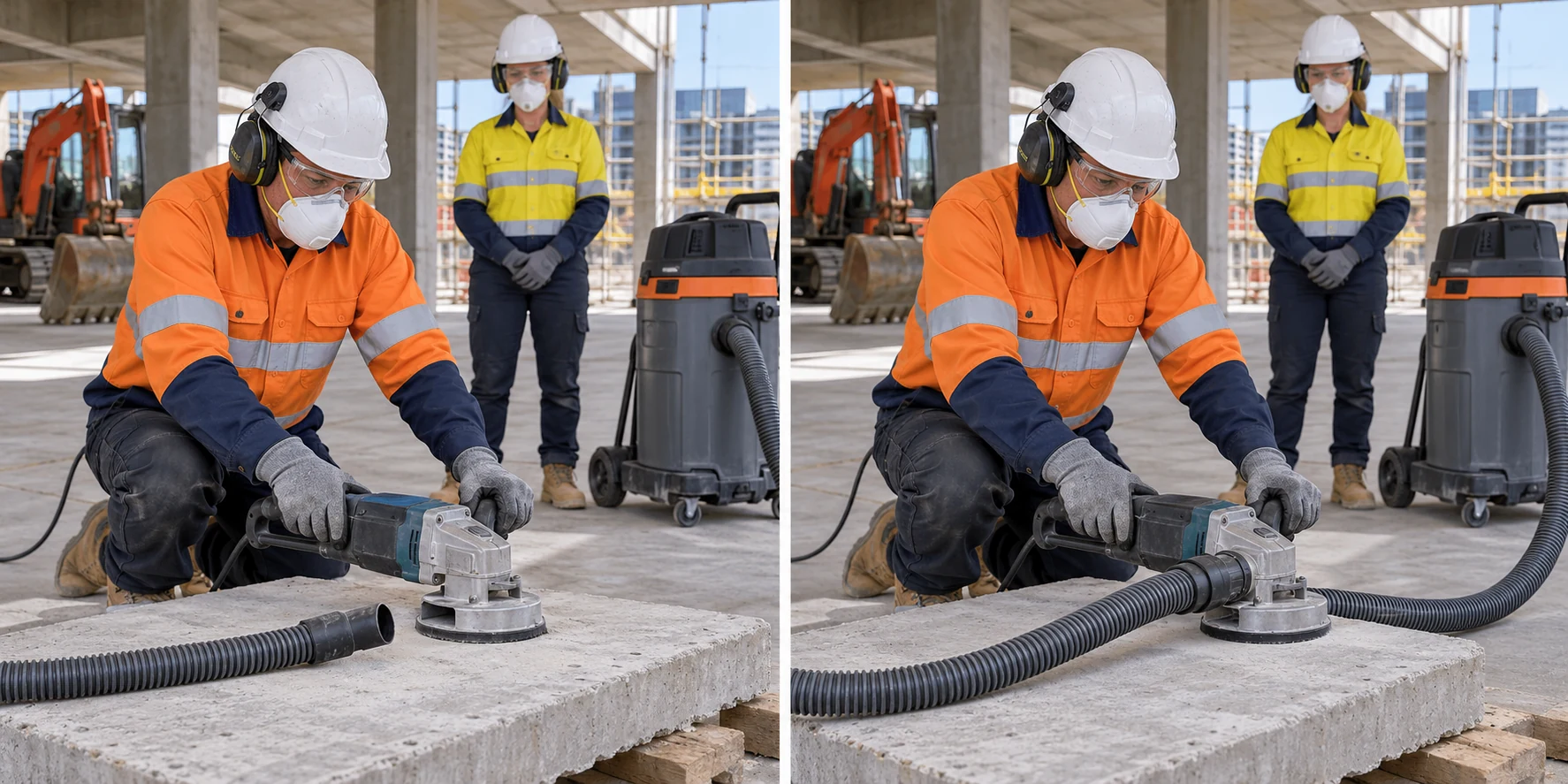
Check the capture arrangement at the source. The condition, suitability and use of the whole extraction system matter.
The disconnected view depicts a control defect. Neither a connected hose nor visible PPE proves exposure is controlled.
OnShift educational illustration, AI-generated and visually reviewed for this preview; not a project photograph.
- SafeWork NSW · Demolition work Code of Practice
- SafeWork NSW · Crystalline silica
- SafeWork NSW · Workplace exposure standards
- SafeWork NSW · Health monitoring
Respiratory protective equipment, or RPE, is not interchangeable with any face covering. Selection must match the hazard and required protection. Fit, compatibility with other equipment, maintenance and training matter. A tight-fitting respirator depends on a suitable seal. Do not infer effective protection because someone is wearing a mask.
Noise can damage hearing and interfere with warnings and communication. Duration and sound level both matter. A task that is tolerable for a moment may create a different exposure over repeated or prolonged work. Equipment choice, maintenance, physical separation and scheduling can affect exposure; suitable hearing protection is part of a wider arrangement. A supervisor should also ask whether the communication method remains effective in the actual noise environment.
Vibration has more than one interface. Hand-held equipment can expose the operator's hands and arms; mobile plant can transmit vibration through the seat and body. Vibration can also affect surrounding structures or sensitive neighbours. Those are related but distinct assessments. A single tick labelled 'vibration controlled' does not explain which exposure or receptor has been considered.
Air quality includes more than mineral dust. Exhaust, fumes from heating or cutting, vapours and poor ventilation may create additional problems. An odour is not a reliable measurement of danger, and lack of odour is not proof of safety. Unknown contaminants and uncertain ventilation require appropriate competent assessment.
Air monitoring and health monitoring answer different questions. Suitable air monitoring measures airborne contaminants to help assess exposure and the effectiveness of controls. The sampling strategy and interpretation need competent expertise, such as an occupational hygienist. Health monitoring looks for effects on a person's health and is carried out or supervised by a doctor with relevant experience when required. A health result is not proof that today's air is safe, and an air sample is not a medical examination. Neither replaces prevention. The applicable triggers, methods and follow-up need to be checked for the substance and work involved.
People, plant and manual tasks
Plant creates risks through more than its cutting or breaking attachment. Movement, reversing, slewing, blind spots, suspended or carried material, crushing points, noise and ground conditions can combine. A person may be exposed while approaching an operator, walking to a welfare facility, making a delivery or doing unrelated work beside the activity.
Plant travel and operating areas, pedestrian routes and material delivery points need to be considered together. Operator sightlines and potential trapping points change as the machine or its load moves. A layout focused only on the workface can overlook the people crossing these areas to reach other parts of the site.
A high-visibility garment can help a person be seen. It does not create a safe space between a person and a machine. A reversing alarm can warn of movement, but it cannot guarantee that someone understands the signal, hears it above other noise or can escape. A designated communication method needs clear roles, acknowledgement and an agreed response when communication fails. It is one part of the arrangement, not permission to work inside an uncontrolled operating area.
Tool selection also changes risk. A tool must be suitable for the material, task and conditions, with the correct accessories and the necessary guarding or protective features. Power, reach and convenience are not the only selection criteria. Consider what force, dust, noise, vibration, recoil or debris it creates and what demands it places on the user. An attachment that fits physically is not automatically an approved combination.
Pre-start checks look for conditions affecting serviceability before use. Scheduled maintenance addresses deterioration and servicing over time. These functions overlap but are not the same. A recent service record does not rule out damage since the service. Conversely, a quick visual check does not replace required maintenance or specialist inspection. Faults need to be reported and managed so defective equipment is not simply passed to the next worker.
Manual tasks can also create harm without a single dramatic event. Force, awkward posture, repetition, sustained effort and unpredictable loads can combine. Demolition materials may be sharp, irregular, dirty, unstable or difficult to grip. Telling people to lift correctly does not remove a poor handling arrangement. Think about reducing handling, changing material flow, using suitable mechanical assistance and designing access and working height around the task.
Trips and falls are connected to that same arrangement. Rubble, trailing leads, hoses, poor lighting, slippery surfaces and changes of level can obstruct movement. An access route is a control only while it remains usable. A route shown on yesterday's plan can become blocked during today's load-out. Housekeeping is therefore part of controlling the work, not merely improving appearance at the end of a shift.
Fatigue, rushed decisions and unclear instructions affect how people interact with all these hazards. A worker unfamiliar with the site may not recognise a boundary that long-term staff take for granted. A worker who is worried about being blamed may hesitate to report a fault. Consultation means making it possible for those observations to affect the arrangements, not just collecting signatures.
Services, stored energy and ignition
A service is not just a line on a drawing. Electrical, gas, water, telecommunications and other systems can pass through, beneath, above or alongside the demolition area. Some may continue to supply neighbouring premises or retained parts of the site. A label, an old plan or an inactive appliance cannot establish that a service is disconnected or safe to disturb.
Distinguish identification, isolation and verification. Identification establishes what the service or energy source is and where it affects the work. Isolation separates the relevant source through the appropriate authorised arrangements. Verification establishes that the required condition has actually been achieved. The details belong to the relevant competent and authorised people. A supervisor's responsibility to obtain and understand confirmation is not authority to perform specialist electrical or gas work.
There can also be stored energy. A system may retain pressure, movement, heat or electrical energy after a normal operating control has been switched off. Gravity remains a source of energy in raised equipment or unsupported material. The word 'off' can therefore describe a control position without establishing the energy state. The control arrangement needs to identify remaining energy, the authorised people addressing it and the evidence on which work relies.
A fire can develop when fuel, an ignition source and a suitable oxidising environment coincide. Hot work can create heat or sparks capable of reaching material outside the operator's immediate view. Residual contents in equipment, concealed combustible material, flammable vapour and incompatible work nearby can matter even when the immediate surface appears clear.
A hot-work permit is part of a defined authorisation and control system. It should relate to the actual location, conditions, activity, precautions and period of work. It is not a permanent approval attached to a tool. If circumstances change, the assumptions behind the permit may no longer hold. Checks, fire prevention arrangements, monitoring and emergency provisions need to be suited to the work by competent people.
The lower explosive limit, or LEL, is the lowest concentration of a flammable gas or vapour in air at which flame can propagate under the relevant conditions. A reading expressed as a percentage of that limit differs from the percentage concentration of gas in air. Instrument suitability, calibration, sampling location and changing conditions affect interpretation. A reading below the limit does not establish safe breathing: toxicity and oxygen conditions remain separate hazards. Work and entry decisions require competent assessment of all relevant hazards within the authorisation system.
Confined spaces add another important distinction. A space is not classified solely by being small or difficult to enter. The relevant definition and actual hazards determine the arrangements. Oxygen deficiency or enrichment, contaminants, engulfment and restricted rescue possibilities can make an apparently quiet space dangerous. An unplanned entry to help someone can create additional casualties.
If unexpected services, suspect vapours or uncertain energy states are discovered, the information gap itself matters. Keep people clear of the affected risk, stop affected work and use the site reporting and competent-review arrangements. Testing, disconnection and entry require the relevant specialist procedures and authority.
Public and environmental exposure
A demolition project affects more than the people inside its work area. Pedestrians, deliveries, passing vehicles, neighbouring occupants and adjoining structures can be exposed. Air, water and waste can carry effects beyond the place where the activity starts. The site boundary connects the work with surrounding people, properties and environments.
Traffic planning connects access, vehicle movement and pedestrian needs. A gate can be a meeting point for several risks: turning vehicles, public footpaths, waiting trucks, obstructed visibility and people trying to enter. A traffic checklist can help identify concerns, but completed boxes do not create an implemented layout. The arrangement needs to fit the actual road and site conditions and the applicable approvals and authorised traffic-control requirements.
Neighbours may be affected by debris, dust, noise, vibration, altered access or changes to shared structural conditions. A neighbouring building's use also matters. The effect on an occupied workplace, a home or a sensitive facility may differ. Communication can help coordinate work and identify concerns, but notifying a neighbour is not a substitute for controlling the hazard. Complaints can also provide information about an exposure that the site team has not observed from inside the work area.
Rainfall and water used during operations can pick up sediment or contamination. Stormwater pathways can connect the work area to drains and waterways. Groundwater is water below the ground surface and may interact with excavation, contamination or nearby structures. These are not interchangeable terms. A plan concerned only with puddles visible on the surface may miss below-ground or off-site effects.
Controls need to consider the material, flow path and receiving environment. The receiving environment is sometimes called the receptor: the person, property or environmental feature that could be affected. A stockpile beside a flow path can create a different risk after rain. A measure intended to reduce airborne dust can create contaminated runoff if the water is not appropriately managed.
Waste also needs a chain of reliable decisions. Identify the material and its relevant classification, keep incompatible or suspect streams from becoming an undifferentiated mixture, and establish a lawful destination and transport arrangement. A low disposal price or a verbal assurance is not evidence that a destination can lawfully receive the material. NSW EPA guidance places responsibility on those arranging construction and demolition waste disposal to check the destination and retain appropriate records.
A load-out record, transport record and facility receipt should tell a consistent story about the material, quantity, movement and destination. The exact classification, tracking and record obligations depend on the waste and current requirements. Unexpected contamination or suspect asbestos changes the problem; do not treat it as ordinary rubble simply because it is mixed with familiar material.
Relocating a material-storage area before forecast rain can change several risks at once. Water flowing through the new area may carry material towards a drain or neighbouring property. The new position can also alter access and loading. Environmental controls, traffic arrangements and storage restrictions therefore need review together.
Groundwater is an environmental receptor even when it cannot be seen. Existing monitoring wells may record conditions below the site; they are not redundant pipes to remove casually. Their identity, purpose and protection need to be established with the responsible environmental specialists and site information before affected work is planned. Damage can compromise monitoring or create a contamination pathway. Marked monitoring infrastructure, environmental reports and site plans help establish what needs protection. Unexplained or damaged installations require referral to the responsible environmental specialists; sampling, repair and abandonment require their own technical arrangements.
Control verification and changed conditions
A control exists in two different states: proposed and implemented. A plan may specify a barrier, a protected route or specialist confirmation. Verification asks whether the required arrangement is in place, suitable for the current conditions, understood by those relying on it and being maintained.
A control description needs to connect the measure with its function, responsible role, check and response to failure. The word 'barrier' alone leaves those matters unresolved. A specified separation arrangement needs an identified work boundary and an assigned person to check it before affected work. It also needs a process for reporting and reviewing changes. The specification comes from the approved project arrangements.
Checks should be proportionate to the control. Some conditions can be observed directly. Others require records, instruments, specialist examination or authorised confirmation. A photograph may show that a sign is present without proving that the structure behind it is stable. A signature may record acknowledgement without proving understanding. Good verification uses evidence that answers the relevant question rather than merely evidence that is easy to collect.
Changes can invalidate yesterday's reasoning. Work progresses into a new area; weather changes; different plant arrives; an opening is exposed; a drawing is revised; a delivery blocks a route; monitoring indicates an exposure concern; or workers report that a control is not practical. An incident or near miss is an important review signal, but waiting for one is not the only way to recognise the need for review.
The agreed pedestrian route is separated from plant, but an unexpected delivery occupies part of it. Workers begin taking a shortcut. The earlier risk assessment may still show the same control, yet the physical arrangement has changed. Repeating the instruction 'use the designated route' does not resolve the obstruction. The obstruction can also affect emergency access and the assumptions in linked plans. The affected work and access arrangements need to be made safe and reviewed, with a usable arrangement communicated before people rely on it.
Consultation is part of that review. People doing the task can identify practical difficulties, emerging hazards and mismatches between the intended and actual work. Other duty holders may control related conditions, such as services, adjoining work or deliveries. Coordination matters because one party's change can undermine another party's control. A supervisor should not assume a boundary between contracts is a boundary between risks.
When a concern is raised, preserve the distinction between observation and conclusion. Record what was seen, where and when, which work was affected, what immediate protective response occurred and who was informed. Do not turn an unconfirmed explanation into a fact. 'Unexpected material exposed behind lining' is different from declaring its identity without the necessary assessment.
Before affected work resumes, the responsible people need the relevant issue resolved, suitable controls established and checked, and the changed arrangements understood. The authority to approve that resumption depends on the issue and the site's responsibilities. A supervisor cannot replace engineering or specialist approval by adding their own signature.
Emergency response and recovery
An emergency plan connects foreseeable events with communication, evacuation or other protective arrangements, accountability, first aid, emergency services and the people assigned to act. A supervisor needs to understand that arrangement well enough to recognise when it should be activated and communicate clearly under pressure.
Demolition can create conditions in which an instinctive rescue attempt adds risk. Unstable structures, hazardous atmospheres, live energy and moving plant may still be present after someone is injured. A structural-collapse rescue plan is not permission for an untrained person to enter a collapse area. Specialist rescue arrangements, site emergency procedures and emergency services must guide the response.
Emergency communication needs the location, what occurred or was observed, known hazards, access limitations and the assistance needed. Known facts must remain distinct from uncertainties. A vague direction such as 'come around the back' may be unusable to emergency responders or anyone unfamiliar with changed access.
Accountability means knowing who may be affected and using the site's arrangements to account for people. It does not mean sending someone into an unsafe area to look. Changes in crew, contractors, visitors and work location can all matter. An induction system and current site communication support emergency arrangements only if the information remains usable when needed.
After immediate protection and response, incident reporting, notification, site preservation and recovery decisions may apply. The exact legal duties depend on what happened and current requirements. Do not assume that an internal incident form replaces a required regulator notification, or that production can restart because the injured person has left. Relevant authorities, competent review and the site's responsibilities govern those decisions.