
Engineering reports and conditions for stopping work
An engineering report's conclusions depend on its scope, evidence and assumptions. Those conditions must be reflected in the work, and missing or changed information can prevent an affected stage from proceeding.
An engineering report answers defined questions
An engineering report is not a universal declaration about a building. It addresses a defined scope using identified information, assumptions and methods. A structural condition opinion, a demolition-stage design, a temporary-works design and a geotechnical assessment are different products. One may inform another, but they are not interchangeable.
The report's identity includes the structure, location and stage addressed, its author and professional role, and its date, revision and issue status. The author's relevant competence and the drawings, surveys and reports relied on also matter. Authority depends on the project's applicable professional and regulatory requirements, rather than a letterhead alone.
A report may describe observed defects without designing the demolition method. It may assess a particular temporary support arrangement without authorising a different machine. It may depend on a service or hazardous-material condition being established elsewhere. A conclusion cannot be separated from these boundaries without changing its meaning.
For example, a report may consider a retained wall under a stated temporary condition. The work team later proposes a different opening and storage arrangement nearby. The earlier report remains relevant background, but it is not automatically a response to the new condition. Any confirmation used in a work briefing must apply to the condition now proposed.
A useful enquiry distinguishes a known source from the assumption that needs checking. In the Cronulla exercise, a client-reported footing type and a simulated structural model can start different questions. The first may require verification of actual dimensions and ground conditions. The second defines the limits of an exercise calculation, not a real engineering certificate.
A simulated initial email introduces a professional role for learning. It does not establish that a learner consulted an engineer or that an engineer approved actual work. Where consultation is required, retain the actual exchange and explain how its conditions affect the decision.
Interpreting a control record
A control record for a material-transfer area needs to identify the activity, location, revision and intended use. These details establish whether the document applies to the work. Its supporting information and unresolved assumptions are equally important: changing a heading does not make an unrelated record applicable.
A hazard entry must explain the route to harm. Terms such as plant or debris identify a subject but not the exposure. The record needs to establish how movement or material could reach workers, visitors, neighbouring property or an environmental receptor. Deliveries and changing work areas can alter those pathways.
The control entry distinguishes measures that are proposed from those already implemented. It identifies how each measure reduces exposure, who establishes and maintains it, and what technical information it depends on. Exclusion distances and load limits require the relevant site-specific basis; they cannot be derived from a generic form.
Verification must address the condition being relied upon. A photograph may establish the location of a sign, but it cannot establish the capacity of a structural support. A signature may record acknowledgement without verifying the assumptions behind the arrangement.
If a delivery blocks the planned route, the review must address the changed movement and exposure. The revised arrangement must be communicated and obsolete instructions withdrawn from use. Traffic arrangements, the demolition work plan, relevant safe work method statements, emergency access and briefings must remain consistent. A permit authorises a defined activity under specified conditions; it does not replace unrelated technical confirmations.
Observations, assumptions and conclusions
A report's evidence can include drawings, surveys, inspections, measurements, investigations and information supplied by others. Each has a scope and reliability that the report should make understandable. An accessible surface inspection cannot establish every concealed connection. An old drawing may inform the interpretation while requiring confirmation of alterations.
An observation records what was found within the investigation. An assumption is a proposition used in the reasoning without the same level of direct confirmation. A conclusion is the interpretation reached using the evidence and assumptions. These categories should not be flattened into a single statement that the engineer has checked everything.
Look for exclusions and conditions. Phrases identifying inaccessible areas, assumed dimensions, unverified materials or reliance on another report tell the reader where the conclusion's boundaries lie. They are not necessarily defects in the report; sometimes they define further work or a hold point. They become a problem if the work proceeds as though the missing confirmation has already occurred.
For example, a report may assume an indicated support continues to a footing while recording that its lower portion was inaccessible during inspection. The drawing may support that assumption, but the report's conditions determine what confirmation is needed before the affected stage. The supervisor should preserve the distinction in the work pack. Stating that the report exists is weaker than a record showing that the appropriate person resolved the relevant assumption for the work now proposed.
Engineering conditions in the work plan
Engineering conditions must be usable by the people controlling the work. They may identify retained elements, allowable configurations established by the design, temporary support requirements, loading restrictions, inspection points or conditions for moving between stages. The work plan and task controls must reflect those requirements without changing their technical meaning.
A hold point needs a defined subject, evidence, responsible authority and release boundary. For example, a requirement to verify a support arrangement must identify the arrangement and the stage it controls. The confirmation should reference the applicable drawing or report and record the outcome. A verbal recollection that somebody looked at it is difficult to rely on or hand over.
Confirmation of installation against a design and confirmation that the design suits the proposed conditions are different questions. An arrangement can match an outdated drawing and still be unsuitable for changed loads. Conversely, an appropriate design does not prove that the installed work matches it. Both links need the evidence required by the controlled system.
The engineer's role, contractor's role and supervisor's role must remain clear. A professional design conclusion does not replace the contractor's implementation, supervision and task controls. A supervisor's coordination does not authorise redesign. If the structural condition conflicts with the proposed access, plant or sequence, the information owners need to resolve the interface together. The resulting instructions must describe compatible work and conditions that can be verified.
Missing evidence and unexpected structural conditions
Affected work must stop when a required condition is unmet or an unexpected change leaves the basis for proceeding unresolved. This may arise at a planned hold point or during work. Examples include missing required structural information, an unexplained support or restraint, and an unplanned opening. Others include suspected prestressing outside the assessed method, unexpected ground conditions or a required temporary-work condition not being met.
Unexpected movement, damaged supports or separation at a connection can indicate an immediate structural concern. Apply the site's stop, withdrawal, exclusion and emergency arrangements as relevant. Do not approach unstable construction to obtain a better photograph or test whether a second disturbance produces movement. A concern does not need a complete diagnosis before people are protected from the affected hazard.
The reason for the stop should be described in terms of the evidence and dependency. For example, a plan may depend on a restraint whose condition has become uncertain. Identifying that restraint and the work relying on it gives the structural review a specific starting point. The affected extent must still be determined competently; do not minimise it to preserve production or broaden it without understanding the connected system.
Restart is a separate decision from stopping. Visible movement ceasing, equipment becoming available again or the end of a delay does not itself resolve the technical issue. The relevant investigation, revised information, implementation checks and authorisation must establish the conditions for the affected work.
Applying a technical response and recording release
For example, the current structural package may assume a roof member has intermediate restraint. During authorised work elsewhere, an observation suggests one restraint connection differs from the referenced detail. The useful query identifies the member's location and level, the report and drawing revisions, the observed difference and the demolition stage that depends on it. It does not propose removing the member to see what happens.
The technical response may require further information, a revised design or confirmation that an identified condition remains within the assessment. Whatever the response, its scope and evidence need to be clear. If further investigation is required, its access and safety arrangements must be planned rather than improvised by the observer.
Closing the query involves more than receiving a reply. The work pack must incorporate the applicable outcome. Changed arrangements must be implemented and checked as required. Affected people must understand the current conditions. The release of any hold point must be recorded for the specific stage. Unresolved dependencies remain visible for the next shift or later stage.
At handover, the important record is what remains, in what condition, under which restrictions and with which temporary works or further actions. A completion statement should fit the verified scope and not imply that every future use has been assessed.
Responding to changed conditions
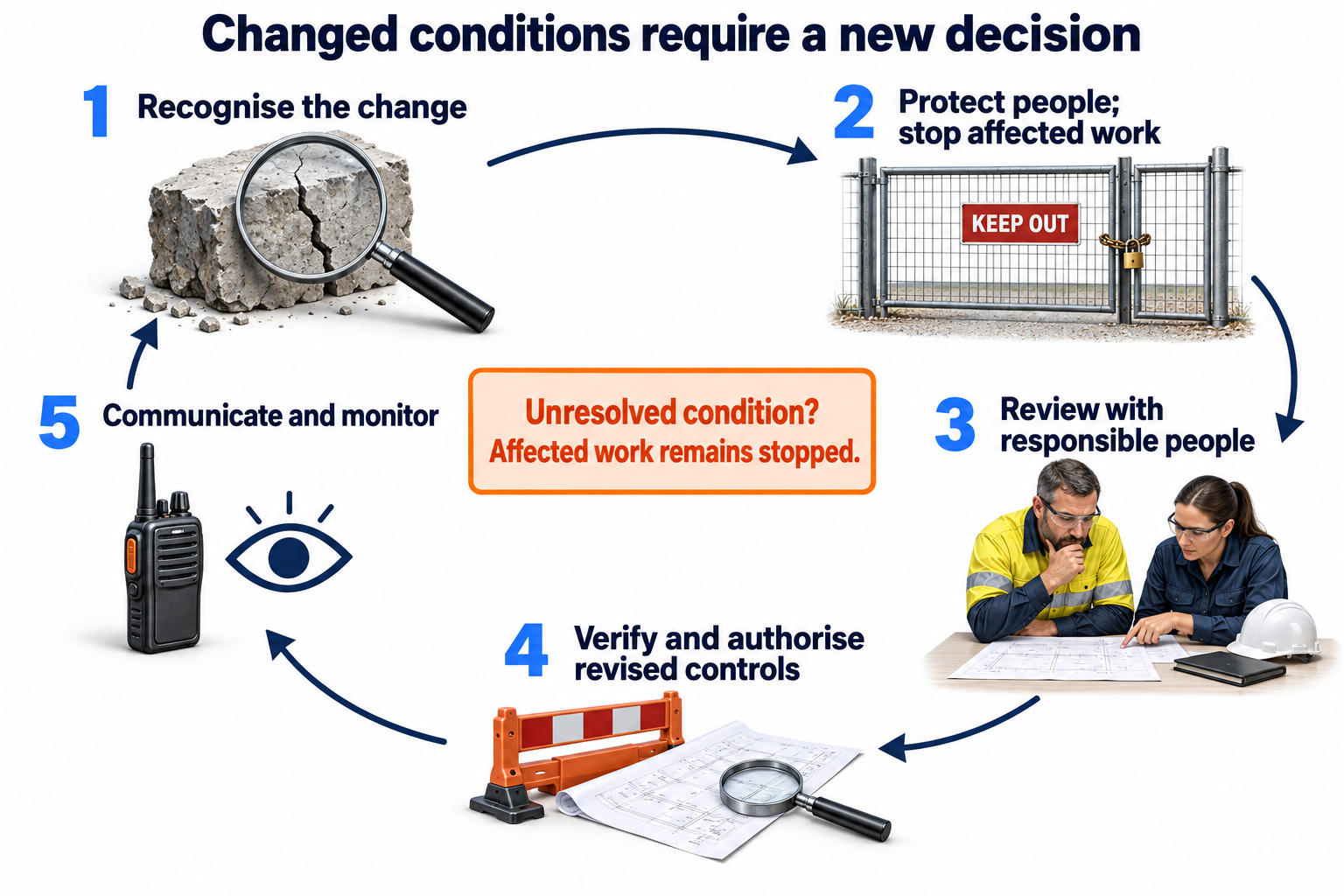
A change requires review of the assumptions and controls governing affected work.
 Open full-size illustration
A changed condition can invalidate the assumptions supporting a work stage. Protecting people and stopping affected work limits further exposure while the responsible people review the change. Revised controls require the appropriate technical input, verification and authorisation before affected work resumes.
The revised arrangement must reach everyone whose work depends on it. Monitoring then establishes whether it remains effective. An unresolved condition is not cleared by the continued existence of an earlier plan. Emergency response follows the site's emergency arrangements and the authority responsible for the incident.