
SWMS, risk assessments and control verification
Risk assessments explain how harm could occur. SWMS describe high risk construction work and its controls, while verification establishes whether those controls are implemented and effective.
Different documents support different decisions
A risk assessment examines hazards, the circumstances in which harm could occur and the controls needed. It may address the whole project, a particular activity or a changed condition. A safe work method statement, or SWMS, is required for high risk construction work. It describes that work, its hazards and risks, and the control measures with arrangements for implementation, monitoring and review.
A demolition work plan coordinates the project and its stages. A permit authorises defined work subject to conditions. An inspection record documents what was checked. These documents should agree, but they are not substitutes. A permit cannot repair an irrelevant SWMS, and a signed SWMS cannot establish that a service was actually isolated.
The practical purpose of a SWMS is to make critical task controls understandable and usable. Excessive generic text can hide the controls that matter, while vague phrases such as use caution provide too little direction. Meaningful stages expose changes in hazards and controls without reproducing every minor movement or unrelated company rule.
Work beside moving plant creates a separation and communication interface. A relevant SWMS needs to connect that interface to the actual separation and communication arrangements. Attaching a general traffic policy without identifying the work-area arrangement leaves a gap. The document should be informed by consultation with the people doing the work and coordinated with other affected duty holders. Their knowledge helps test whether the proposed controls are feasible at the actual location.
The path from hazard to harm
A hazard description should explain enough of the mechanism to guide control selection. Loose overhead material can fall into an occupied access route and strike a person. That sentence identifies a source, an event, an exposure pathway and a receptor. Falling objects is a useful category, but it is not yet the full risk picture.
Control thinking then asks how the event or exposure can be eliminated or minimised. Can the hazardous condition be avoided? Can the source be addressed through the authorised method? Can people be separated, suitable protection provided and the control verified? Administrative instructions and personal protective equipment address particular parts of the system but should not be treated as automatic substitutes for stronger measures.
A risk matrix can help organise discussion, but its numbers are not physical measurements. Multiplying labels does not establish structural stability or a safe exposure level. Two people assessing a risk can produce the same score while considering different events. The written mechanism, assumptions and controls are therefore essential to understanding the result.
A residual risk rating describes the assessed risk after specified controls, not after somebody has merely written their names. If a critical control is missing or ineffective, the assumed residual state does not exist. A rating based on an established exclusion route cannot be relied on while that route is open to delivery drivers. Review the real condition instead of retaining the lower score because the form was already approved.
Hazard, exposure and harm
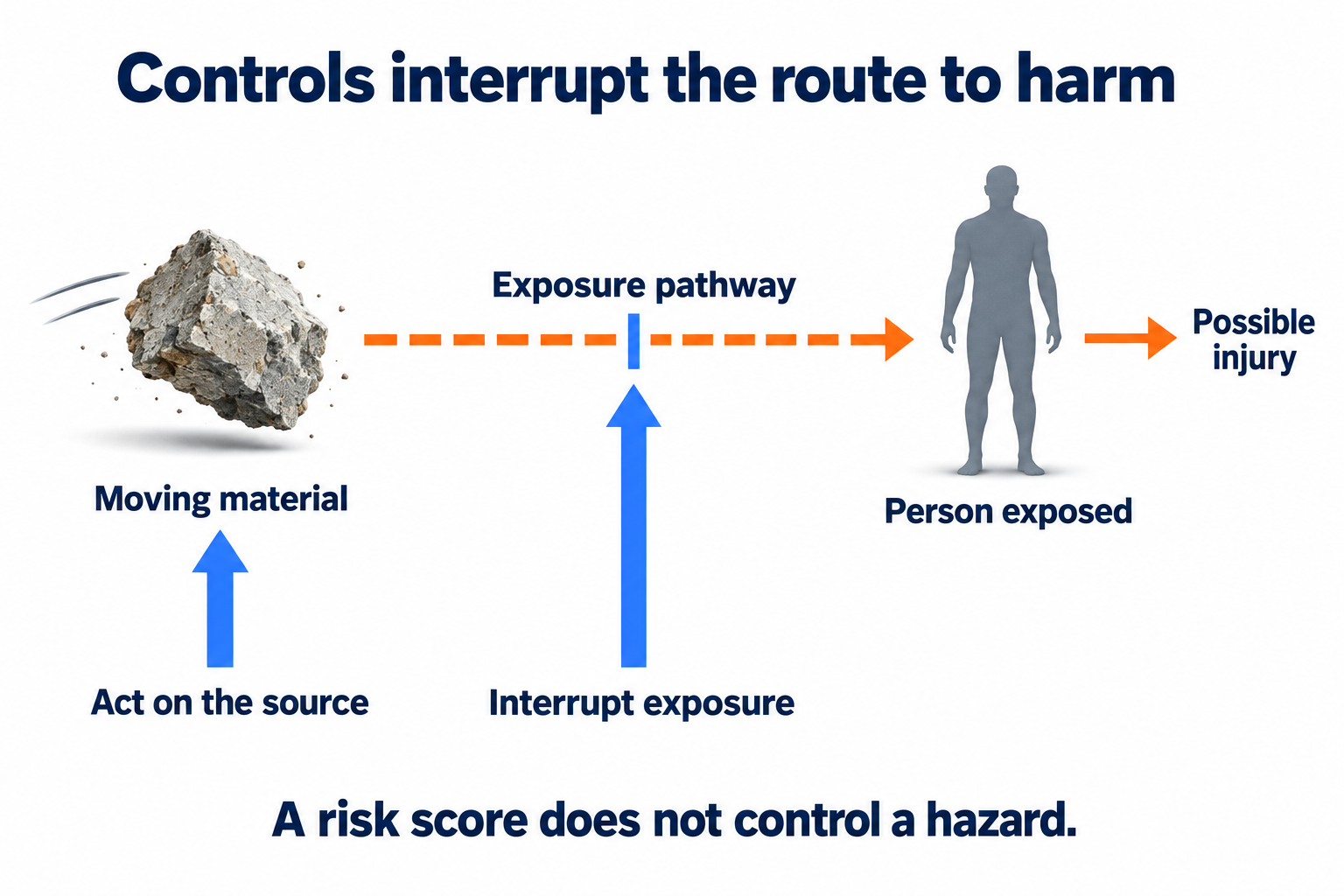
Controls prevent harm by acting on a hazard or its exposure pathway.
 Open full-size illustration
A source of potential harm reaches a person or environmental receptor through an exposure pathway. For example, moving material can strike a person who enters its path. The consequence depends on the material, movement and exposure involved.
Controls act on the source or interrupt the connection before harm occurs. The arrows below the main chain indicate these intervention points. A control must be in place and effective: assigning a risk score does not itself change the hazard or exposure.
Control statements and verification
A useful control statement explains the protective function, where it applies, who implements it and how its condition will be checked. It also identifies the response if the control is absent or fails. The amount of detail should match the significance of the control and the needs of the work party.
Compare maintain exclusion with an arrangement that identifies the current controlled boundary, authorised access process, responsible role, inspection reference and response to a breach. The second is more usable because people can recognise the required state. It does not need to invent an exclusion distance; that value or layout must come from the assessed work arrangement.
Reference specialist information accurately. If an engineering instruction sets a loading restriction, the task document should identify the current reference and relevant area. Copying a number without its conditions can make the instruction unsafe. If a manufacturer specifies an equipment limitation, the actual model and configuration must match.
A control record links the hazard, measure, responsible person, verification and current status. Together these explain which pathway the measure interrupts, who establishes it, how it is checked and what follows a failure. A missing link leaves part of the control arrangement undefined.
Interpreting a control record
A control record for a material-transfer area needs to identify the activity, location, revision and intended use. These details establish whether the document applies to the work. Its supporting information and unresolved assumptions are equally important: changing a heading does not make an unrelated record applicable.
A hazard entry must explain the route to harm. Terms such as plant or debris identify a subject but not the exposure. The record needs to establish how movement or material could reach workers, visitors, neighbouring property or an environmental receptor. Deliveries and changing work areas can alter those pathways.
The control entry distinguishes measures that are proposed from those already implemented. It identifies how each measure reduces exposure, who establishes and maintains it, and what technical information it depends on. Exclusion distances and load limits require the relevant site-specific basis; they cannot be derived from a generic form.
Verification must address the condition being relied upon. A photograph may establish the location of a sign, but it cannot establish the capacity of a structural support. A signature may record acknowledgement without verifying the assumptions behind the arrangement.
If a delivery blocks the planned route, the review must address the changed movement and exposure. The revised arrangement must be communicated and obsolete instructions withdrawn from use. Traffic arrangements, the demolition work plan, relevant safe work method statements, emergency access and briefings must remain consistent. A permit authorises a defined activity under specified conditions; it does not replace unrelated technical confirmations.
Understanding and implementing the SWMS
A signature can record participation or acknowledgement. It does not by itself establish understanding, competence or control performance. A useful briefing connects the SWMS to the actual area, equipment, roles and current conditions. Workers' explanations of the actual boundaries and change-reporting arrangements help reveal misunderstandings. Clarification and suitable communication support turn acknowledgement into a shared understanding of the work.
Language, literacy, hearing, noise and visual access can affect communication. Use suitable explanations and assistance so that the information is understood. A worker who cannot read a dense document should not be left with the appearance of participation and no practical understanding. Keep the task explanation consistent with the controlled document.
During work, verification asks whether the described controls exist and remain effective. Inspection, observation, measurements and specialist records may all contribute, depending on the control. Record the actual conditions and the actions taken when something differs. A completed checklist is evidence of a check only to the extent that it accurately describes what was checked.
A briefing describes a clear pedestrian route, but a delivery later blocks it. The earlier signatures do not authorise people to improvise a route through plant movement. The affected arrangement needs to be controlled and reviewed. This is why implementation and monitoring belong in the SWMS. The document must remain connected to changing reality rather than becoming a one-time administrative event.
Review, revision and current requirements
Review is needed when the work or conditions no longer match the SWMS, when controls are ineffective, or when new information changes the risk picture. High risk construction work must be carried out in accordance with its SWMS. Where it is not, the affected work must stop. The required arrangements must be restored or revised before that work resumes. Do not edit the document merely to make an uncontrolled activity look consistent after the event.
A sound review identifies the change, affected controls, relevant people and technical inputs, then records the revised decision and communication. Preserve the earlier version and the reason for revision. The current work copy should be clear, while the history explains how the team arrived at it.
Source currency matters. SafeWork NSW's current code register explains the effect of section 26A of the Work Health and Safety Act. That section commenced in July 2026. An approved code's standard must be met, or the alternative must achieve an equivalent or higher standard for the relevant hazard or risk. Older template wording that treats approved codes as merely optional should not be carried forward uncritically. Check current law and applicability for the project.