
Plan currency, amendments and site orientation
Drawing currency, authorised use and physical accuracy are different properties. Revisions, site references and technical clarifications must remain coordinated with the work they control.
Current, authorised and accurate are different claims
A current drawing is the issue identified by the project's document-control system as current for a particular purpose. An authorised drawing has the required status for its intended use. An accurate drawing corresponds to the relevant physical facts within its stated scope and limitations. These claims are related, but none automatically proves the others.
A recently emailed file may be preliminary. An older issue may remain the authorised reference for an unchanged part of the work. An as-built record may document what was recorded at completion but omit later alterations or concealed departures. A survey can be precise about the features it measured and silent about what it could not access. The title of a document does not remove its limitations.
The date shown in a computer folder is particularly weak evidence of design currency. Copying or downloading a file can change its file-system date without changing its content. The drawing number, revision, issue purpose and controlled register provide the relevant identity. The issue transmittal or other project record explains how that identity was issued for use.
For demolition, currency must be checked across the coordinated package: drawings, structural information, service records, hazardous-material information and work planning. A revised demolition boundary can affect documents that have not themselves been redrawn. The important question is whether the work is being planned from a mutually consistent and applicable set, not whether every page carries the same date. A complete-looking folder can still contain conflicting or inapplicable information.
Cardwell illustrates the difference between current issue and historical purpose. UP062, the dangerous-goods manifest, and UP063, the site layout, are dated historical records. They may help identify the recorded fuel installation. They do not establish present contents, accurate excavation coordinates or current isolation.
Compare those records with the survey, tender addendum and relevant project requirements. The proposed fuel schedule, UP046, describes proposed equipment, not an updated inventory of the old tanks. If the records disagree, identify the particular item, location and date. Ask the responsible person to resolve the decision affected; do not simply choose the newest-looking page.
Plan, elevation and section
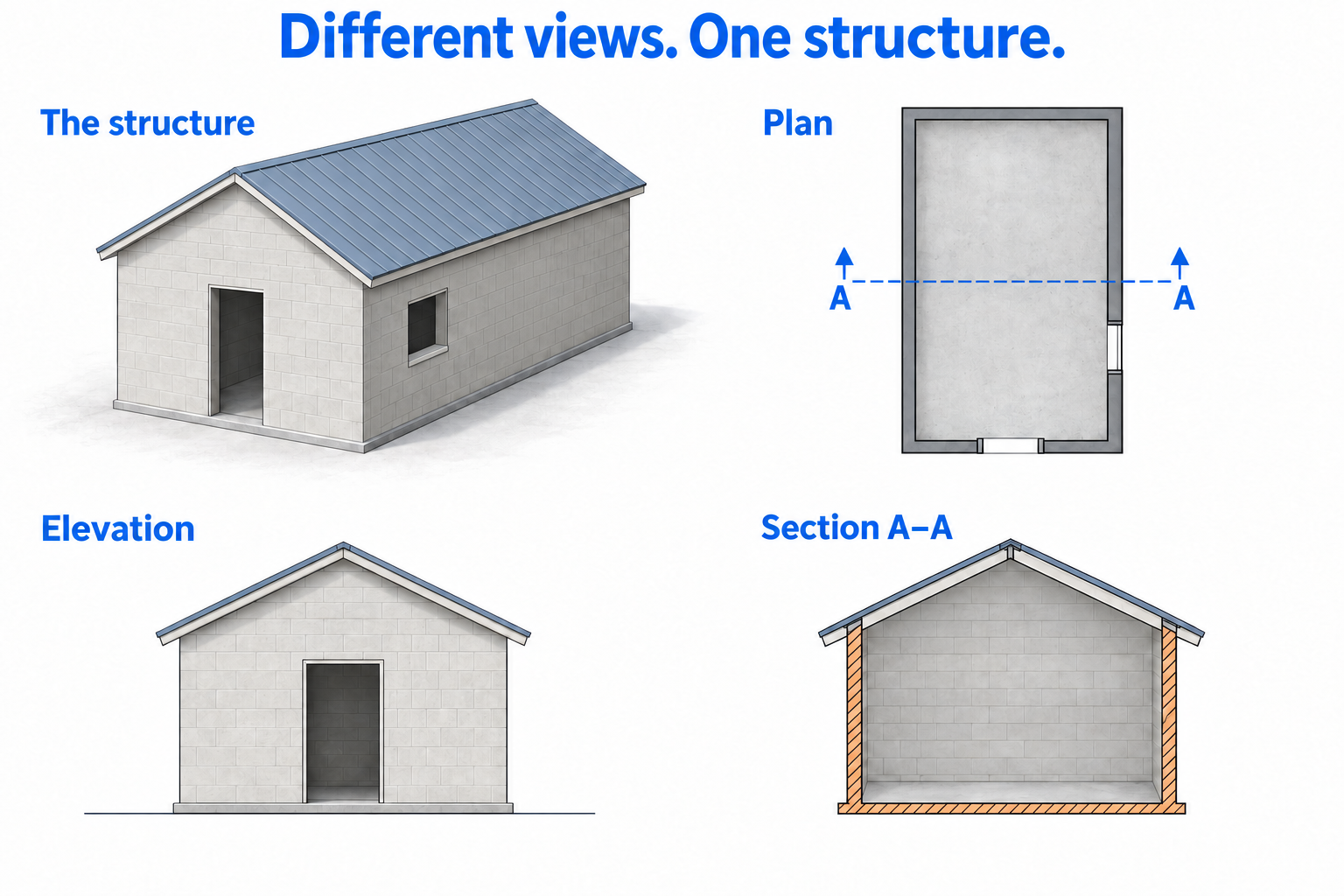
Drawing views describe different spatial relationships within the same structure.
 Open full-size illustration
A plan shows the horizontal arrangement viewed from above. An elevation shows the vertical outline of an external face. A section represents a cut through the structure, revealing internal relationships between elements such as roofs, walls and floors.
Drawing references connect these views to orientation, levels, dimensions and details. A plan may locate a connection without establishing its height; an elevation may show its external position without revealing a concealed arrangement. A missing referenced section or detail leaves an information gap.
The illustrated views are not to scale. Apparent line thickness cannot establish structural support, and dimensions cannot be measured from these shapes. On an actual drawing, interpretation depends on the project identity, revision, issue purpose, legend, units and applicable notes.
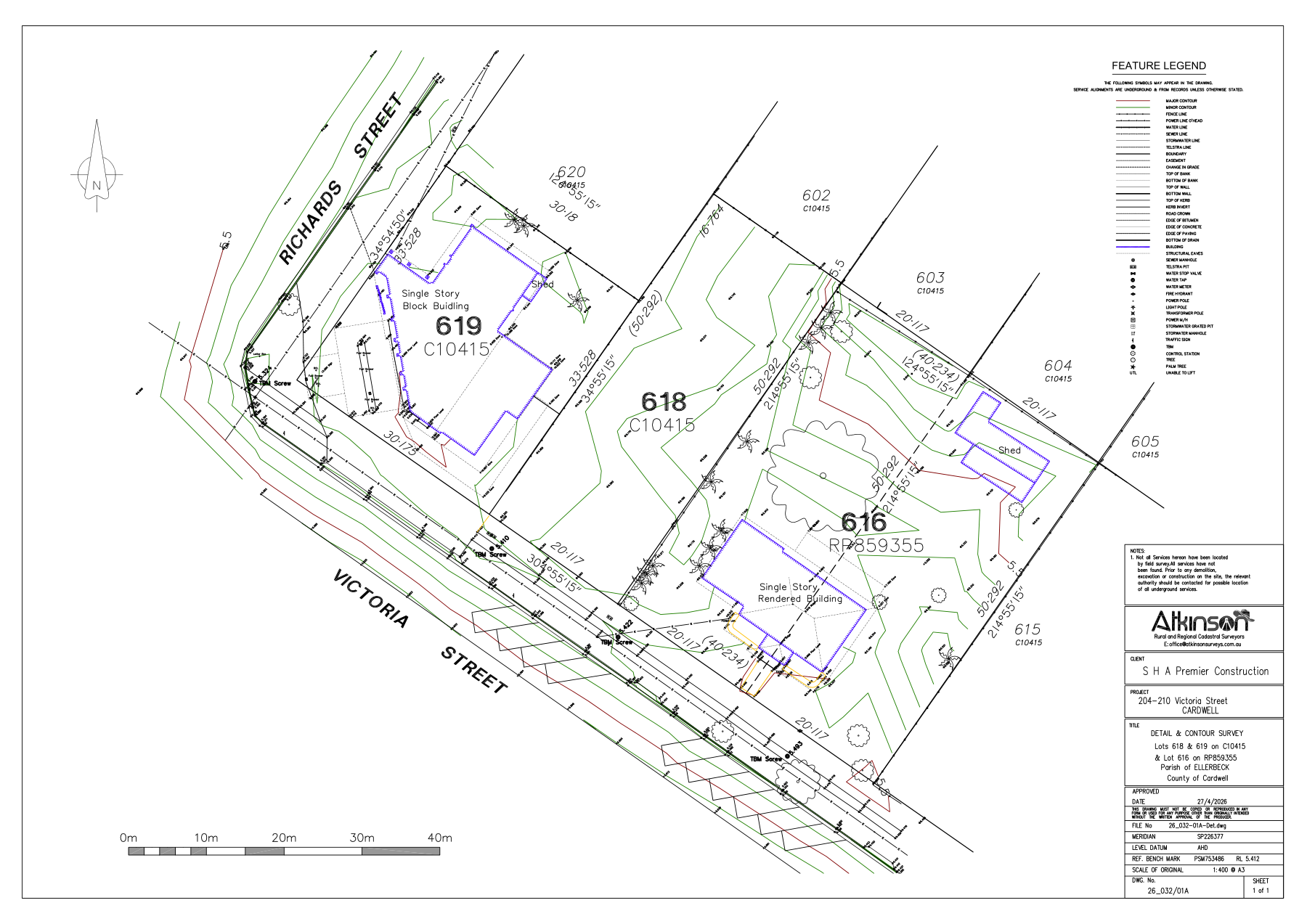
Unaltered existing survey overview
ORIGINAL / HISTORICAL SOURCE — SEE CAPTION Source stage and limitation must be checked. Historic fuel or site material does not establish current condition, clearance, approval or tank depth.
 Open full-size illustration
Unaltered existing survey overview
Source stage and limitation must be checked. Historic fuel or site material does not establish current condition, clearance, approval or tank depth.
This visual is draft case-study teaching material. Reading it is not an inspection, a measurement or evidence of performance.
Revisions and distribution
Revision control connects a change to its identity, reason, affected documents and users. The drawing number usually identifies the document, while the revision identifies a particular issue of it. The issue purpose describes how it may be used. A revision cloud or other change mark can help locate an amendment, but its absence is not proof that nothing relevant changed. The actual issue and revision information must be read.
A useful change review asks what changed and what depends on it. A revised access opening might affect vehicle movement, exclusion arrangements, service information and temporary support. A changed level might alter a quantity estimate or the interpretation of a connection. The effect is not limited to the small area enclosed by a cloud.
Superseded copies need to remain distinguishable from the information authorised for active work. This applies to printed packs, downloaded devices, subcontractor copies and extracts attached to method statements. Keeping an old issue for traceability is different from leaving it available for accidental use. The project's controlled system should preserve the history while making the operative issue clear.
A briefing is part of distribution but does not replace the document itself. People need to understand the practical difference and where the authoritative change is recorded. A message saying use the new plan gives little help if the recipient has several files with similar names. Identifying the drawing, revision, issue purpose and affected activity makes the update reviewable and reduces the chance of two crews acting on different assumptions.
Site orientation in three dimensions
Site orientation connects a drawing reference to a real location. A north arrow helps direction, but it may represent the north convention stated by the drawing. That can differ from the direction suggested by how a page is held. Structural grids identify reference lines; levels identify vertical positions. Stable, verified features help relate those references to the site.
Left and right are unreliable location descriptions without a stated viewpoint. The left side changes when a person turns around or approaches from another entrance. A reference such as the retained wall at an identified grid and level is more durable, provided the grid is correctly established. Elevation labels and section directions help prevent a drawing being mentally mirrored.
Orientation also includes the work's relationship to neighbours, public routes and retained areas. A boundary line on a plan must not be confused with a convenient fence or wall without appropriate confirmation. Similar-looking buildings, repeated bays and later alterations can make a confident visual match wrong.
For example, two service rooms on different levels may look similar. A photograph of a pipe penetration may appear to match either room. Without a level, viewpoint and reliable location reference, attaching the photograph to a query can create a false connection. The useful record states where and how the observation was obtained and which document reference it is intended to support. Obtain observations only through authorised safe access; identifying a location on a plan is not permission to enter a restricted area or approach unstable construction.
Discrepancies and requests for information
A discrepancy is a difference between information sources or between a source and an observation. It may be a genuine error, a difference in scope, an outdated record or a misunderstood view. The first task is to describe the difference accurately, not to decide immediately which source must be wrong.
Separate facts from inferences. The drawing shows no opening is a statement about the drawing. An opening was observed at a stated location is a statement about the observation. The opening was installed after construction is an inference unless supported by evidence. Keeping those categories separate makes the query clearer and avoids embedding an unproved history in the proposed answer.
A request for information should identify the relevant document and revision, physical location, conflicting or missing information, affected activity and required clarification. It should also state any existing restriction or hold point so that the decision's urgency and boundary are understood. Supporting images or sketches must be labelled and should not silently become substitute design documents.
Suppose a current drawing shows a continuous slab where a controlled observation identifies a covered opening. The issue can affect travel, loading and the interpretation of the supporting system. The response is not to estimate cover strength from its appearance. A coordinated clarification is needed about the opening, support, restrictions and affected documents. Travel and loading restrictions may be needed while the opening's support and condition are resolved, even before the cause of the discrepancy is known.
Interpreting a control record
A control record for a material-transfer area needs to identify the activity, location, revision and intended use. These details establish whether the document applies to the work. Its supporting information and unresolved assumptions are equally important: changing a heading does not make an unrelated record applicable.
A hazard entry must explain the route to harm. Terms such as plant or debris identify a subject but not the exposure. The record needs to establish how movement or material could reach workers, visitors, neighbouring property or an environmental receptor. Deliveries and changing work areas can alter those pathways.
The control entry distinguishes measures that are proposed from those already implemented. It identifies how each measure reduces exposure, who establishes and maintains it, and what technical information it depends on. Exclusion distances and load limits require the relevant site-specific basis; they cannot be derived from a generic form.
Verification must address the condition being relied upon. A photograph may establish the location of a sign, but it cannot establish the capacity of a structural support. A signature may record acknowledgement without verifying the assumptions behind the arrangement.
If a delivery blocks the planned route, the review must address the changed movement and exposure. The revised arrangement must be communicated and obsolete instructions withdrawn from use. Traffic arrangements, the demolition work plan, relevant safe work method statements, emergency access and briefings must remain consistent. A permit authorises a defined activity under specified conditions; it does not replace unrelated technical confirmations.
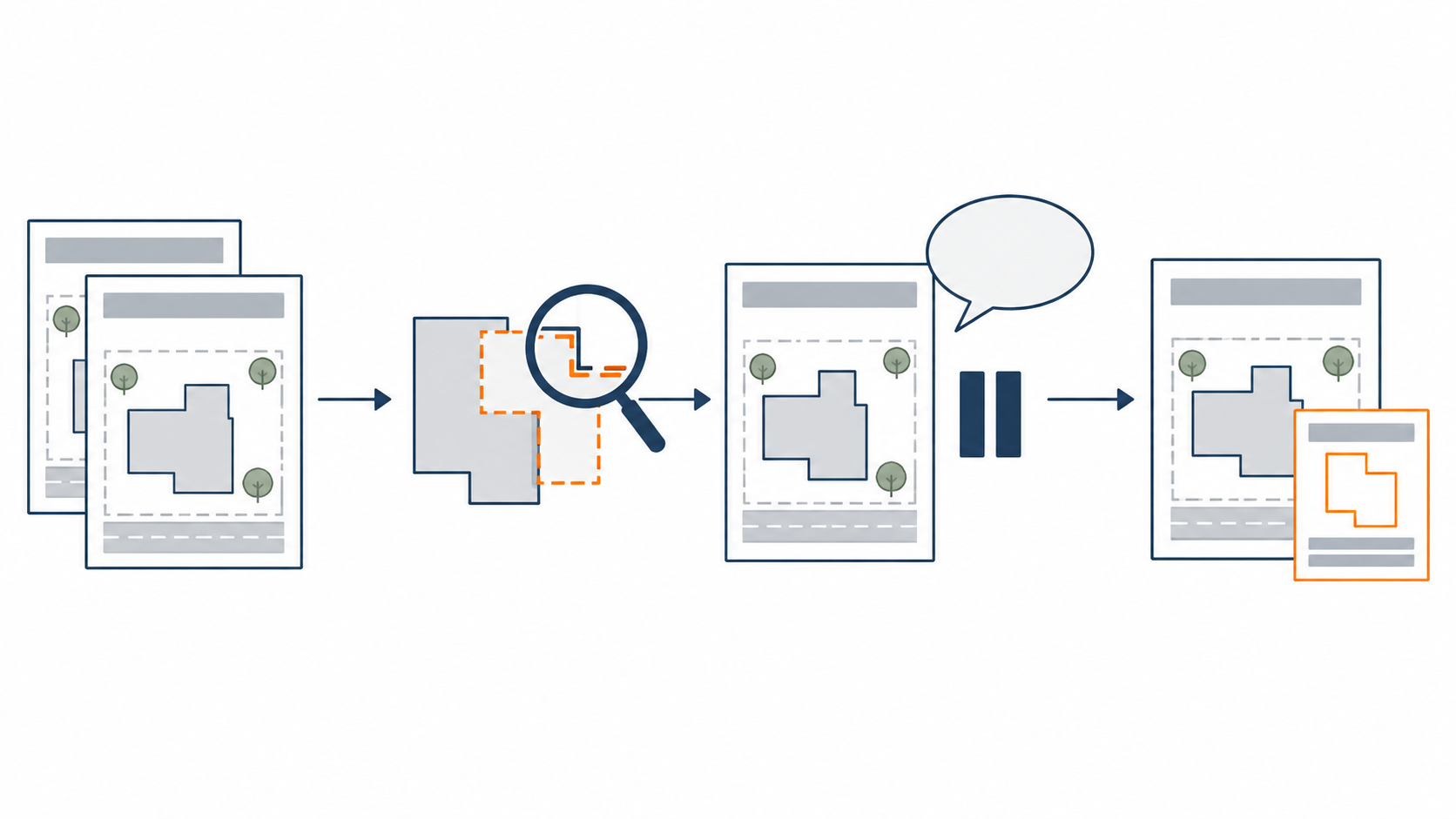
From conflicting information to clarification
LEARNING AID A generic learning aid explains a principle. It does not establish a project fact, hidden condition, capacity, approval or work release.
 Open full-size illustration
Read left to right: compare records; identify the difference; hold the affected decision and seek clarification; record the resulting decision. The final document is a record, not an approval stamp or authority to resume work.
A generic learning aid explains a principle. It does not establish a project fact, hidden condition, capacity, approval or work release.
This visual is draft case-study teaching material. Reading it is not an inspection, a measurement or evidence of performance.
Coordinating a clarification before work restarts
Resolving a query creates information, but that information must be incorporated into the work system. The response should be identifiable, applicable to the actual location and clear about its conditions. If it changes the method, support, loading or access, the relevant work planning and briefings must change with it. A technically correct response left in one person's inbox does not control the work face.
The release of a hold point should record what was confirmed, by whom, against which documents and for which stage. It must not be stretched into permission for later stages or different conditions that were not considered. The next shift needs both the revised information and the remaining limits.
For example, a clarification may confirm an opening and introduce a restricted travel area. The corrected drawing, traffic arrangements and relevant work pack all need to agree. An old diagram in a plant briefing could otherwise direct people back across the restricted area, despite the engineering query having been answered.
The revised restriction also needs to be verified in the work arrangements. The handover must distinguish resolved matters from outstanding conditions and identify which information applies to the next stage.
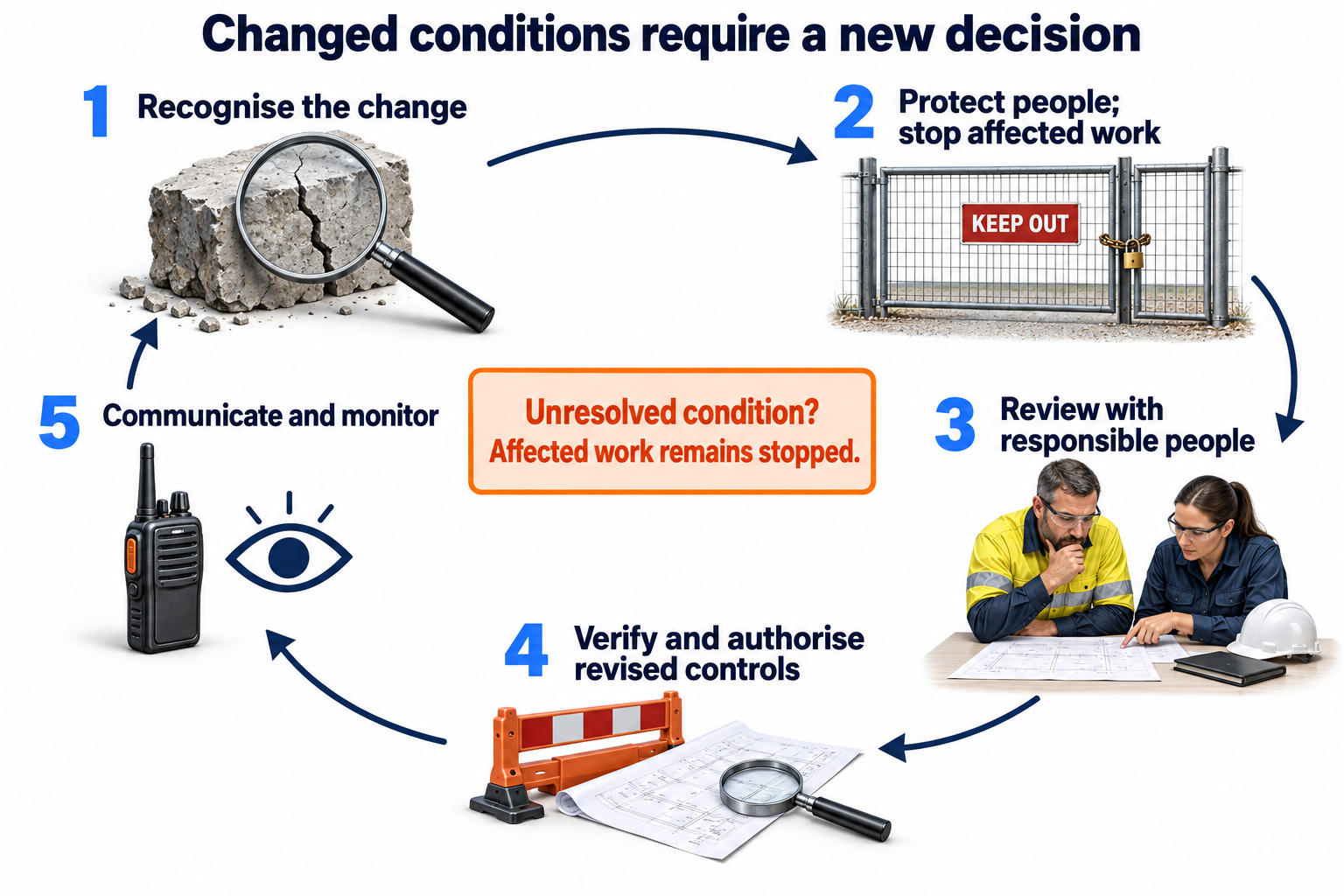
Responding to changed conditions
A change requires review of the assumptions and controls governing affected work.
 Open full-size illustration
A changed condition can invalidate the assumptions supporting a work stage. Protecting people and stopping affected work limits further exposure while the responsible people review the change. Revised controls require the appropriate technical input, verification and authorisation before affected work resumes.
The revised arrangement must reach everyone whose work depends on it. Monitoring then establishes whether it remains effective. An unresolved condition is not cleared by the continued existence of an earlier plan. Emergency response follows the site's emergency arrangements and the authority responsible for the incident.