
Hot work: cutting, grinding, gas equipment and fire prevention
Hot work can ignite materials through flame, sparks, hot particles and conducted heat. Gas-system compatibility, concealed ignition paths, airborne contaminants and changing permit conditions all affect control of the work.
Heat and ignition sources
Hot work is work capable of producing heat, flame, sparks or other ignition sources. In demolition it can include gas cutting, welding, thermal cutting and abrasive cutting or grinding. The ignition hazard depends on whether the process can ignite nearby materials or the atmosphere, including material outside the operator's view.
An oxygen-fuel cutting process combines a fuel-gas flame with oxygen and a material-specific cutting action. It does not work in the same way on every metal. Electric-arc processes produce intense local heat, and plasma cutting uses an electrically energised gas stream. Abrasive tools remove material through contact with an abrasive surface; they can produce hot particles without using an open flame.
A method comparison should consider both the ignition hazard and the other exposures created. Substituting a mechanical process can remove a flame while adding pinch points, reaction forces, fragments or noise. Thermal work on coatings can create hazardous airborne contaminants. The apparent convenience of a portable tool does not establish that the material, location or surrounding structure is suitable.
Material identification matters. Bare-looking metal may retain paint, oil or residues. A closed section may conceal material or connect to a different space. Establishing what is being worked on and what lies around, behind and within it is part of the planning evidence. An unidentified vessel, line or structural member leaves essential work conditions unresolved.
Components and protective functions in a gas cutting set
A gas cutting set is an assembly of components with different functions. Cylinders contain the specified gases. A regulator controls delivery from the supply within its intended service. Hoses convey the gas. The torch controls and combines the appropriate streams at the work end. Connections, valves and protective devices must be suitable for the gases, equipment and manufacturer's arrangement. Parts that physically connect are not necessarily compatible.
Oxygen is an oxidiser, not the fuel in the usual oxygen-fuel combination. An oxygen-enriched environment can make materials ignite more readily and burn more intensely. Fuel gas provides combustible material. Confusing these roles can conceal the significance of contamination, leakage or poor storage conditions. Gas identity must come from reliable identification and documentation, not from an assumed universal colour convention.
A non-return valve is intended to resist reverse flow. A flashback arrestor is intended to stop flame propagation through the protected gas passage and may incorporate other functions. The names are not interchangeable. Suitability, required arrangement, inspection and replacement depend on the approved equipment information and applicable requirements. A visible device is not proof that the complete system is correct.
Cylinders, regulators and hoses can be damaged by impact, heat or unsuitable handling. A suspect fitting or hose is not a reason to improvise a repair or test with a flame. The safe response follows the site's defect and emergency arrangements and the competent person's authorised equipment procedure. Valve operation, gas pressure, lighting, shutdown and leak testing require the correct controlled equipment instructions.
Technical terms
Hazard — A source or situation with potential to cause harm.
Risk — The possibility of harm, considered with its likelihood and consequence in context.
Exposure — The opportunity for a person or receptor to come into contact with a hazard.
Consequence — The harm or loss that could result.
Control — A measure that eliminates or reduces risk.
Remaining risk — Risk considered after the specified controls have actually been applied.
Elimination — Removing the hazard or hazardous exposure from the work.
Substitution — Replacing a hazard with a less hazardous alternative.
Isolation — Separating people from a hazard.
Engineering control — A physical or designed measure that acts on a hazard or exposure pathway.
Administrative control — An arrangement such as procedures, scheduling, information or supervision.
PPE — Personal protective equipment.
RPE — Respiratory protective equipment.
SWMS — Safe work method statement; a document for relevant high-risk construction work.
DWP — Demolition work plan.
Permit — A bounded authorisation within a defined control system, not universal proof of safety.
Induction — Introduction to relevant site conditions, responsibilities and arrangements.
Pre-start — A check or briefing before work or equipment use; distinct from scheduled servicing.
Verification — Checking evidence that the required condition or control exists and works as intended.
Consultation — Sharing relevant information, hearing affected workers' views and considering them in decisions.
Load path — The connected route by which forces pass through a structure to its supports.
Compression — A pushing action within a material or member.
Tension — A pulling action within a material or member.
Bending — A response to loading that tends to curve a member.
Shear — Action tending to make parts move past one another.
Temporary works — Engineered or other temporary arrangements supporting construction or demolition needs; specialist design and control may be required.
Respirable dust — Particles small enough to reach deep into the lungs.
LEL — Lower explosive limit; the lowest flammable gas or vapour concentration in air at which flame can propagate under the relevant conditions. Percentage of LEL is not percentage gas concentration or a safe-breathing decision.
Receptor — The person, property or environmental feature potentially affected.
Change control — The process of recognising a change, reviewing affected assumptions and controls, and communicating the revised arrangement.
Air monitoring — Competently planned measurement of airborne contaminants to assess exposure and control effectiveness.
Health monitoring — Medical monitoring for health effects, carried out or supervised by an appropriately experienced doctor when required.
Heat can travel beyond the visible work face
Three ideas help explain fire initiation: combustible material, an oxidising environment and an ignition source. Removing or controlling one of these can reduce the opportunity for fire, but real work areas contain hidden pathways. Heat can pass through metal to the other side of a partition. Sparks can enter openings. Hot particles can lodge in debris or insulation. Smouldering material may not announce itself with an immediate visible flame.
A metal surface may therefore look non-combustible while the construction behind it contains timber, insulation, sealants or accumulated dust. A drain, pit or connected pipe can provide a path to vapours elsewhere. A container that appears empty can still contain a hazardous residue or atmosphere. Neither a label nor the absence of a smell establishes that hot work is acceptable.
Grinding adds a second family of risks alongside ignition. The accessory must suit the machine, material and intended action. An unsuitable or damaged disc can fail, and contact can produce reaction forces and fragments. Guards, compatible extraction and the manufacturer's safe-use information remain important even when a permit addresses fire. Fire authorisation is not a substitute for machine safety.
The work area extends through three dimensions and into connected spaces. The assessment needs to account for what is below, behind and beyond the visible surface. The dimensions of controls, any monitoring and the fire-watch arrangements must be determined for the actual work.
Fire is only one hot-work exposure
Thermal work can create fumes and gases from the base material, consumables, coatings and contamination. A fume is made of very small solid particles formed as hot material cools. It is not the same as an ordinary visible cloud of coarse dust. The absence of a dense visible plume does not demonstrate an acceptable breathing atmosphere. Material information and the process both influence what may be released.
Coatings and residues can be particularly important in demolition because a structure may have been altered, maintained or contaminated over many years. Unidentified coatings require resolution through the hazardous-material and work-planning process. Do not assume that a small area or brief task creates negligible exposure. Suitable ventilation, capture, respiratory protection where required and exposure assessment must work as a coordinated system.
Hot work may also create optical radiation, heat, burns, noise and electrical hazards, depending on the process. Screens used for one exposure can alter visibility or airflow and must not introduce an unmanaged problem for other workers. Nearby people may be exposed even when they are not part of the cutting or welding team.
Atmospheric testing addresses defined hazards using suitable instruments; it does not automatically measure every contaminant produced by a process. A flammable-gas reading cannot be used as evidence that metal fumes are controlled. Likewise, ordinary ventilation is not proof that an enclosed or potentially confined space is acceptable for entry. Flammability, oxygen and toxicity need separate consideration.
Equipment changes and hot-work permit conditions
The actual hot-work process must match the permit and its supporting control information. A change from one cutting process to another can change sparks, hot material, fumes, energy supply and surrounding exposure. A familiar permit title does not establish that the replacement system has been considered.
For example, substituting equipment during an authorised repair requires a comparison of the new machine, supply system, work location and controls with those already considered. The differences provide the basis for review. The relevant specialists and authorising people decide what information and controls are needed.
The same equipment identity matters at close-out: hot components, stored energy and residual ignition sources need the task-specific arrangements. Inspection and fire-watch requirements depend on the task-specific conditions. If concealed combustible material is discovered, an unexpired permit does not establish that its existing controls remain suitable.
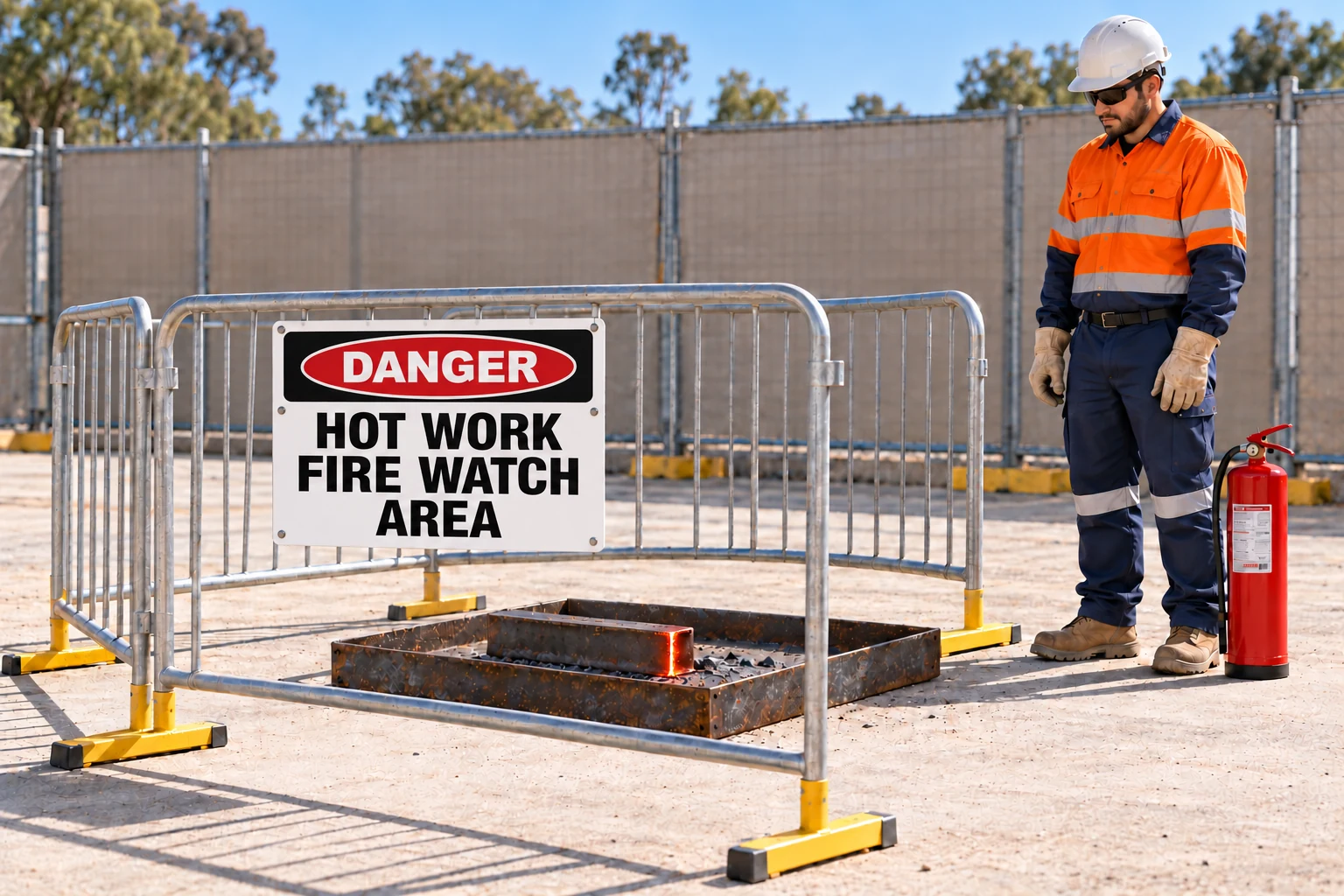
The work area remains controlled while the fire watch checks for residual heat and ignition risks. Follow the task-specific permit and close-out arrangements.
Generic teaching illustration, not certified sign artwork, a hot-work layout or equipment specification. The glow is not a temperature reading or clearance test.
OnShift educational illustration, AI-generated and visually reviewed for this preview; not a project photograph.
- SafeWork NSW · Welding processes Code of Practice
- SafeWork NSW · Demolition work Code of Practice
- National Register · CPCCDE3020 Select and use tools and equipment for hot work in the demolition industry
Interpreting a control record
A control record for a material-transfer area needs to identify the activity, location, revision and intended use. These details establish whether the document applies to the work. Its supporting information and unresolved assumptions are equally important: changing a heading does not make an unrelated record applicable.
A hazard entry must explain the route to harm. Terms such as plant or debris identify a subject but not the exposure. The record needs to establish how movement or material could reach workers, visitors, neighbouring property or an environmental receptor. Deliveries and changing work areas can alter those pathways.
The control entry distinguishes measures that are proposed from those already implemented. It identifies how each measure reduces exposure, who establishes and maintains it, and what technical information it depends on. Exclusion distances and load limits require the relevant site-specific basis; they cannot be derived from a generic form.
Verification must address the condition being relied upon. A photograph may establish the location of a sign, but it cannot establish the capacity of a structural support. A signature may record acknowledgement without verifying the assumptions behind the arrangement.
If a delivery blocks the planned route, the review must address the changed movement and exposure. The revised arrangement must be communicated and obsolete instructions withdrawn from use. Traffic arrangements, the demolition work plan, relevant safe work method statements, emergency access and briefings must remain consistent. A permit authorises a defined activity under specified conditions; it does not replace unrelated technical confirmations.