
Working at heights, confined spaces and rescue planning
Demolition changes edges, surfaces, access and rescue routes. Fall prevention, fall arrest and confined-space controls have distinct functions and support requirements.
Changing edges, fragile surfaces and scaffold interfaces
A fall hazard is not limited to the outside edge of a tall building. Openings, fragile roofs, incomplete floors, access transitions and below-ground voids can expose people to a fall. Demolition changes the surface underfoot and the barriers around it. A route that was enclosed yesterday may pass an opening today.
Start by considering whether the task can be done from a position that avoids exposure to the fall. Where exposure cannot be avoided, the work arrangement needs suitable protective measures for the actual surface, access and activity. Platforms, edge protection, covers and harness-based systems serve different functions and need appropriate design, installation and use.

Compare the exposed edge with the physical barrier. In the protected scene, the worker remains on the floor side of the edge protection.
The left scene shows an unsafe situation. This illustration explains a protective function, not a guardrail design or a method for working beside an unprotected edge.
OnShift educational illustration, AI-generated and reviewed; not a project photograph.
Open full-size illustrationFragile material may look continuous while being unable to support a person's weight. Weathering, hidden damage or the nature of the product can affect its capacity. Seeing someone cross a roof earlier does not verify the next person's route. Likewise, a loose sheet placed across an opening is not automatically a designed and secured cover.
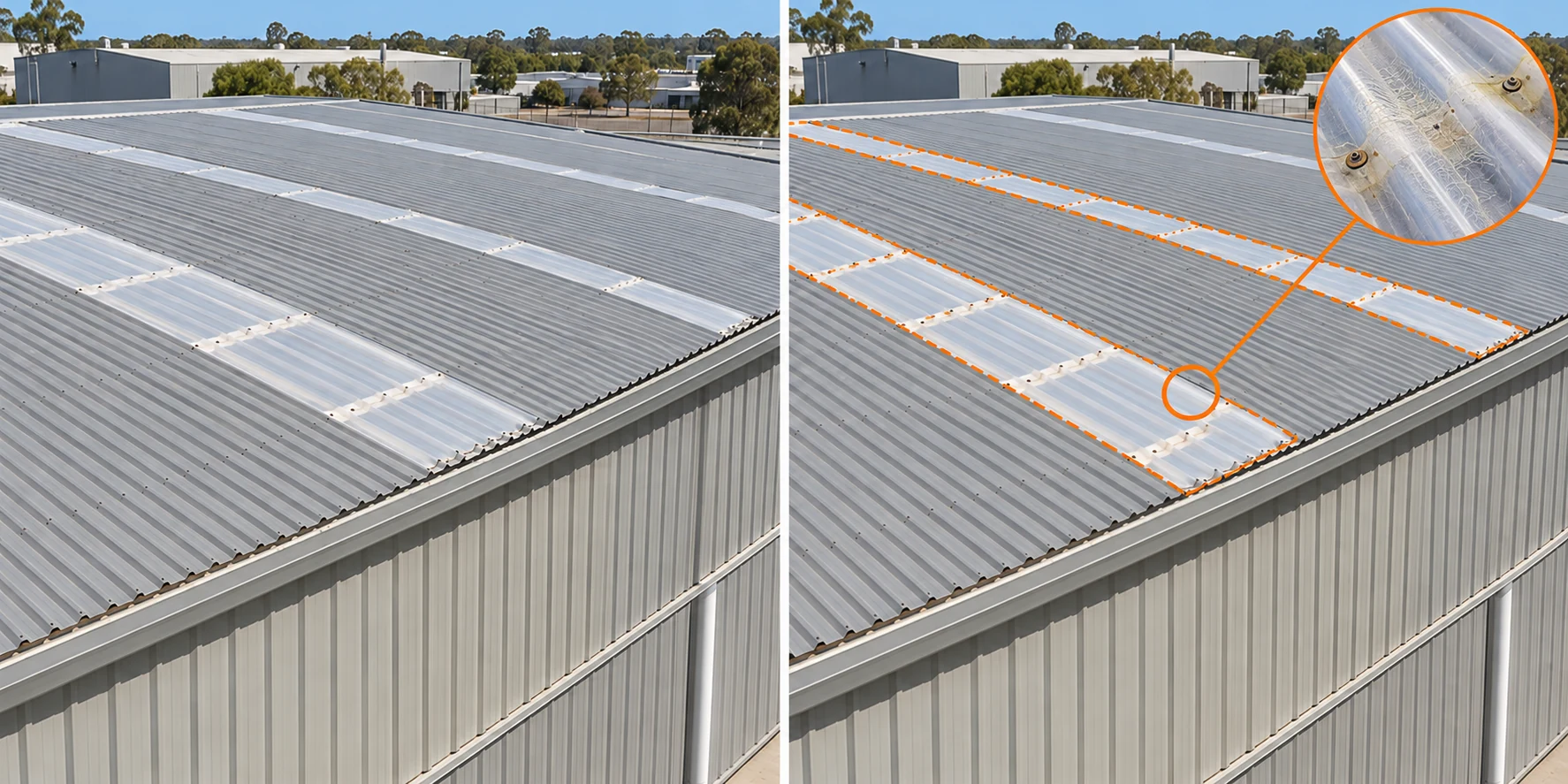
A continuous surface is not evidence that it can carry a person. Establish the material and the protected work arrangement.
The outline is a visual cue, not a diagnosis of capacity, a roof-access route or permission to walk on adjacent sheets.
OnShift educational illustration, AI-generated and visually reviewed for this preview; not a project photograph.
- SafeWork NSW · Working at heights
- SafeWork NSW · Demolition work Code of Practice
- SafeWork NSW · Scaffolding
- SafeWork NSW · Dangerous scaffold incident: safety information
- SafeWork NSW · High risk work licences
An inspection near a retained stair landing illustrates how access creates exposure. The inspection itself needs a safe approach, a protected position and a way to communicate findings. It should not be treated as exempt from planning because it takes only a minute. The same reasoning applies to delivery drivers accessing vehicles and workers reaching temporary facilities. Duration does not remove the consequence of a fall.
A scaffold provides a designed access or working-platform arrangement. It is not automatically structural shoring, a debris-storage area or a device for catching demolition material. Its intended use, loading limits, supporting surface and relationship to the building must be established. Ties and bracing contribute to stability; removing an adjacent wall can remove a support or tie location on which the scaffold depends. Adding mesh or sheeting can change wind loading even when the platform itself is unchanged.
The supervisor's document review connects the scaffold design or specified configuration with its location, use restrictions, written handover and inspection information. The design states the intended arrangement; handover records its acceptance for the identified use; later inspections address continuing condition. A tag or old handover cannot establish that an altered scaffold still matches that information. Changes to ties, platforms, bracing or containment need the appropriate competent review, alteration and inspection arrangements, not an informal request to make space.
Coordinate scaffold work with the demolition sequence and neighbouring crane or pumping activity. The scaffold crew's access, an overhead load path and a demolition exclusion zone must not be treated as independent bookings for the same space. Confirm who controls the interface and which work remains held while the arrangement changes. Relevant high risk work licensing, specialist capability and a usable handover are distinct checks.
Preventing a fall and arresting a fall are different
A restraint arrangement limits movement so that the user cannot reach the fall position. A fall-arrest arrangement acts after a fall has begun. Confusing the two can conceal essential design and rescue requirements. The presence of a harness tells you very little without knowing the complete system and its intended function.
An arrest system needs suitable anchors, compatible components and an assessed arrangement that considers the available space and surrounding hazards. It can expose a suspended person to additional harm and requires effective emergency and rescue procedures. A harness is therefore not a stand-alone solution to an edge that has appeared during demolition.
Demolition introduces a particular question: will the supporting structure and anchor remain suitable at the planned stage? A connection to an element that is later altered or removed can undermine the protection system. The designer's assumptions, installation evidence, inspection and work sequence must remain aligned. An attachment point that looks substantial is not a substitute for those checks.
Changing from a protected platform to a harness-based arrangement changes both prevention and rescue requirements. The comparison should include access, range of movement, work demands, supporting structure, rescue arrangements and the competence needed to use the system. It should not be made solely because the harness is already in the vehicle.
Interpreting a control record
A control record for a material-transfer area needs to identify the activity, location, revision and intended use. These details establish whether the document applies to the work. Its supporting information and unresolved assumptions are equally important: changing a heading does not make an unrelated record applicable.
A hazard entry must explain the route to harm. Terms such as plant or debris identify a subject but not the exposure. The record needs to establish how movement or material could reach workers, visitors, neighbouring property or an environmental receptor. Deliveries and changing work areas can alter those pathways.
The control entry distinguishes measures that are proposed from those already implemented. It identifies how each measure reduces exposure, who establishes and maintains it, and what technical information it depends on. Exclusion distances and load limits require the relevant site-specific basis; they cannot be derived from a generic form.
Verification must address the condition being relied upon. A photograph may establish the location of a sign, but it cannot establish the capacity of a structural support. A signature may record acknowledgement without verifying the assumptions behind the arrangement.
If a delivery blocks the planned route, the review must address the changed movement and exposure. The revised arrangement must be communicated and obsolete instructions withdrawn from use. Traffic arrangements, the demolition work plan, relevant safe work method statements, emergency access and briefings must remain consistent. A permit authorises a defined activity under specified conditions; it does not replace unrelated technical confirmations.
Confined space is a defined hazard category
Small and confined are not interchangeable descriptions. Under the NSW guidance, the confined-space definition concerns an enclosed or partly enclosed space not designed for human occupancy, intended to be at normal atmospheric pressure during occupancy, and involving specified risks such as unsafe oxygen, harmful contaminants, fire or explosion, or engulfment. Apply the current definition through competent assessment, not by asking only whether a person can stand up.
A pit, tank, duct or structural void can present these risks. An open top does not necessarily prevent a dangerous atmosphere, and easy entry does not guarantee easy recovery of an injured person. Some occupied rooms with poor air quality may not meet the confined-space definition but still require effective control of their hazards. A classification decision does not make other risks disappear.
Engulfment means being surrounded or overwhelmed by material, such as a flow of loose solids or liquid. It is distinct from simply having restricted movement. Connected pipes, moving material and other processes can change conditions even when the person inside is performing a quiet task.
The planning question begins with avoiding entry where possible. If entry is proposed, the necessary competent assessment, permit, isolation, atmosphere controls, communication and emergency arrangements must be established. A demolition supervisor should recognise a potential confined-space interface early enough to prevent an informal inspection becoming an unplanned entry.
Technical terms
Hazard — A source or situation with potential to cause harm.
Risk — The possibility of harm, considered with its likelihood and consequence in context.
Exposure — The opportunity for a person or receptor to come into contact with a hazard.
Consequence — The harm or loss that could result.
Control — A measure that eliminates or reduces risk.
Remaining risk — Risk considered after the specified controls have actually been applied.
Elimination — Removing the hazard or hazardous exposure from the work.
Substitution — Replacing a hazard with a less hazardous alternative.
Isolation — Separating people from a hazard.
Engineering control — A physical or designed measure that acts on a hazard or exposure pathway.
Administrative control — An arrangement such as procedures, scheduling, information or supervision.
PPE — Personal protective equipment.
RPE — Respiratory protective equipment.
SWMS — Safe work method statement; a document for relevant high-risk construction work.
DWP — Demolition work plan.
Permit — A bounded authorisation within a defined control system, not universal proof of safety.
Induction — Introduction to relevant site conditions, responsibilities and arrangements.
Pre-start — A check or briefing before work or equipment use; distinct from scheduled servicing.
Verification — Checking evidence that the required condition or control exists and works as intended.
Consultation — Sharing relevant information, hearing affected workers' views and considering them in decisions.
Load path — The connected route by which forces pass through a structure to its supports.
Compression — A pushing action within a material or member.
Tension — A pulling action within a material or member.
Bending — A response to loading that tends to curve a member.
Shear — Action tending to make parts move past one another.
Temporary works — Engineered or other temporary arrangements supporting construction or demolition needs; specialist design and control may be required.
Respirable dust — Particles small enough to reach deep into the lungs.
LEL — Lower explosive limit; the lowest flammable gas or vapour concentration in air at which flame can propagate under the relevant conditions. Percentage of LEL is not percentage gas concentration or a safe-breathing decision.
Receptor — The person, property or environmental feature potentially affected.
Change control — The process of recognising a change, reviewing affected assumptions and controls, and communicating the revised arrangement.
Air monitoring — Competently planned measurement of airborne contaminants to assess exposure and control effectiveness.
Health monitoring — Medical monitoring for health effects, carried out or supervised by an appropriately experienced doctor when required.
Entry permits and atmospheric evidence
A confined-space permit relates to a defined space, people, work and period under stated controls. The supporting assessment must reflect the actual hazards and connected systems. A permit for one tank cannot be used for a neighbouring tank because they look alike. The record should also make the end of occupancy and closure status clear.
Atmospheric information has a scope. The substance or condition measured, instrument suitability, locations, timing and activities affect what a result can establish. A reading taken before another process starts may not describe the later atmosphere. Oxygen, flammability and toxic contaminants are different measurement questions. No single informal statement such as gas checked should conceal which hazards were considered.
Ventilation and isolation must address how conditions could change. Material can enter through connected systems; work can generate contaminants; equipment can introduce ignition or movement. Respiratory protection selected for particles does not supply oxygen. These distinctions explain why a normal-looking space or a familiar respirator does not establish entry conditions.
The supervisor's review is about whether the competent process, evidence and current controls match the work. Testing, atmospheric criteria and opening access points remain subject to the appropriate specialist procedures. If the permit or supporting conditions no longer match, the affected activity must be held and reviewed through the established arrangements. Pressure to finish a quick task cannot convert an uncertain atmosphere into an acceptable one.
Interpreting a control record
A control record for a material-transfer area needs to identify the activity, location, revision and intended use. These details establish whether the document applies to the work. Its supporting information and unresolved assumptions are equally important: changing a heading does not make an unrelated record applicable.
A hazard entry must explain the route to harm. Terms such as plant or debris identify a subject but not the exposure. The record needs to establish how movement or material could reach workers, visitors, neighbouring property or an environmental receptor. Deliveries and changing work areas can alter those pathways.
The control entry distinguishes measures that are proposed from those already implemented. It identifies how each measure reduces exposure, who establishes and maintains it, and what technical information it depends on. Exclusion distances and load limits require the relevant site-specific basis; they cannot be derived from a generic form.
Verification must address the condition being relied upon. A photograph may establish the location of a sign, but it cannot establish the capacity of a structural support. A signature may record acknowledgement without verifying the assumptions behind the arrangement.
If a delivery blocks the planned route, the review must address the changed movement and exposure. The revised arrangement must be communicated and obsolete instructions withdrawn from use. Traffic arrangements, the demolition work plan, relevant safe work method statements, emergency access and briefings must remain consistent. A permit authorises a defined activity under specified conditions; it does not replace unrelated technical confirmations.
A rescue plan must describe a feasible capability
Rescue planning asks how a person could be assisted without creating additional casualties. It is different from preventing the event, and it is different from simply listing an emergency telephone number. A fall-arrest or confined-space arrangement needs a response that is appropriate to the location, hazards, access, people and equipment.
A useful planning review considers who has the relevant training and authority, whether those people are available and how they communicate. It also considers how emergency services gain access and whether the required equipment can be used in the actual space. An injured person may not be able to climb, cooperate or use the route by which they entered. The plan must not assume normal mobility throughout an emergency.
SafeWork NSW requires confined-space first-aid and rescue procedures to be established and practised. Its guidance also makes clear that the stand-by person must not enter to attempt a rescue. That boundary prevents an understandable impulse from exposing a second person to the same atmosphere or other hazard.
Rescue equipment stored behind a locked gate may be inaccessible while the key holder works elsewhere. The document may name the equipment correctly, but the capability is not available as described. A planned exercise can identify such defects without putting anyone into a hazardous situation. Exercises and specialist review must remain controlled activities.
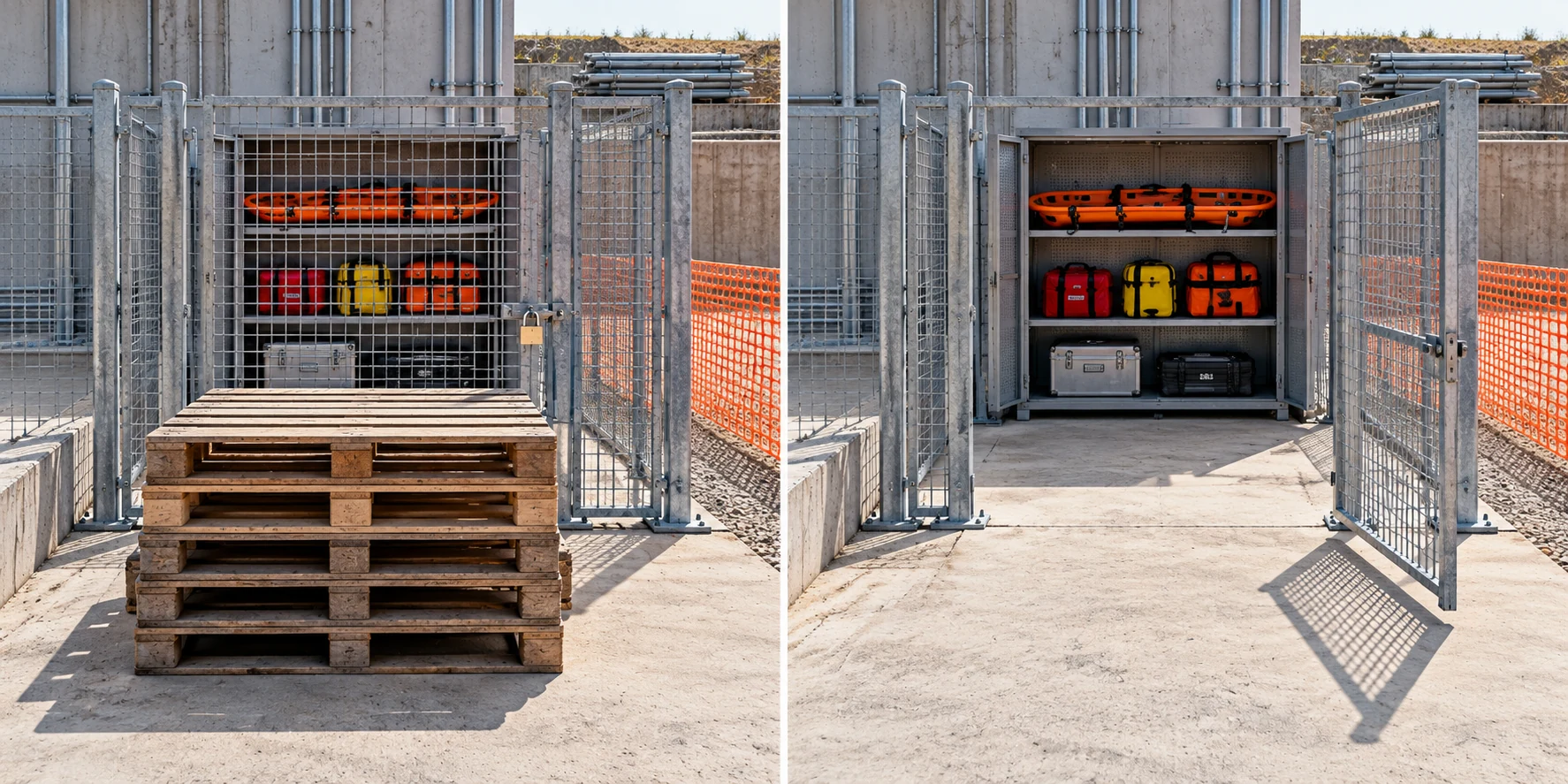
Rescue planning includes availability and access. Test whether the planned people and equipment can reach the actual location.
An accessible stretcher does not establish a workable rescue capability. No entry, rigging or rescue procedure is shown.
OnShift educational illustration, AI-generated and visually reviewed for this preview; not a project photograph.
Open full-size illustrationEmergency response and changing rescue routes
A person collapsing in a tank, a worker suspended after a fall, or an unexpected structural collapse demands an urgent response. Urgency does not remove the original hazard. Raise the alarm, call Triple Zero where emergency assistance is needed and follow the established emergency arrangements from a safe position. Do not make an unplanned entry or climb into unstable material to attempt a rescue.
Useful information for the emergency coordinator includes the location, known hazards, number of people involved, last known position and the access available. Report observations clearly and distinguish them from assumptions. Do not send someone into danger merely to improve the accuracy of the report. Maintain the agreed boundary and help emergency responders obtain the relevant site information.
Rescue arrangements need review when the site changes. Removed stairs, new openings, relocated barriers, altered services and different staffing can invalidate yesterday's assumptions. The current work plan and emergency information should describe the same access and locations. A muster point that now lies within a plant route needs reconsideration even if the emergency poster has not changed.
Avoiding exposure, preventing a fall, arresting a fall, controlling entry and providing rescue are related but distinct protections. Each depends on suitable training, technical arrangements and current site controls.