
Fitness for work, fatigue, wellbeing and worker support
Fatigue and psychosocial hazards arise from work conditions as well as individual circumstances; supervision connects risk control with appropriate support.
Fitness for work concerns the person and the task
Fitness for work concerns a person's capacity to perform the allocated work within the organisation's properly established arrangements. That means working without creating an unacceptable risk to themselves or others. It is not a judgement about a person's character. The relevant question is whether the task, conditions and person's current capacity fit together. A demanding activity, long travel, heat, illness or inadequate recovery can change that relationship.
Supervisors need to recognise concerns and act within their role. They should not diagnose a medical condition from behaviour, assume a disability means incapacity or demand unnecessary personal details. An observation such as repeated difficulty following an agreed communication is different from a conclusion about its cause. Explain the immediate work concern privately and arrange appropriate support or review through the workplace process.
A useful fitness-for-work system describes reporting routes, immediate protective action, access to competent advice, confidentiality and return-to-work arrangements. It also explains how the business manages the work factors it controls. A declaration signed at the gate cannot eliminate fatigue created by the roster or make an unsuitable task suitable. Worker responsibilities and business responsibilities need to operate together. The aim is to identify and manage risk early, not discourage people from reporting a difficulty because they fear humiliation or automatic punishment.
Fatigue and performance
Fatigue involves reduced capacity associated with factors such as inadequate sleep, extended effort and the timing or demands of work. It can affect attention, decision-making and reaction. A person may feel able to continue while their performance is impaired. Motivation, experience and a familiar routine do not remove the need for recovery. Fatigue is therefore a risk to manage, not simply a feeling for the worker to overcome.
Look at the combined work pattern. Shift timing, overtime, consecutive demands, travel, physical effort, heat, noise, monotonous monitoring and interrupted breaks can interact. A roster that looks acceptable one shift at a time may still provide inadequate recovery across several days. A last-minute schedule change can also affect contractors and people with long travel, even if the site activity itself is unchanged. Working hours and recovery arrangements depend on the current applicable requirements and risk assessment.
An invented example involves a crew repeatedly waiting for delayed transport, then being asked to recover the lost time late in the day. The immediate pressure appears to be a worker-performance problem. The underlying issue may be unreliable logistics and an unrealistic programme. Reviewing deliveries, workload and recovery opportunities addresses the source more directly than telling the crew to remain alert. Breaks and personal strategies can support controls, but cannot repair a work system that repeatedly exceeds reasonable capacity.

A respectful conversation can identify work limitations and needed support. Review workload, logistics and recovery arrangements as well as the immediate concern.
Appearance does not diagnose fatigue or a health condition. A conversation alone does not resolve the work-system risk.
OnShift educational illustration, AI-generated and visually reviewed for this preview; not a project photograph.
- SafeWork NSW · Managing the risk of fatigue at work Code of Practice
- SafeWork NSW · Designing Work to Manage Psychosocial Risks
Psychosocial hazards in work design
Psychosocial hazards arise from aspects of work that can cause psychological or physical harm. Examples include excessive demands, unclear or conflicting roles, poor support, harmful behaviour, isolation and exposure to traumatic events. These are workplace risk matters, not merely personal resilience issues. NSW's current framework requires psychosocial risks to be managed, including use of the hierarchy of controls and consideration of work design.
Imagine a supervisor receiving incompatible instructions from two managers: keep a critical access route open and use the same space for urgent storage. The supervisor lacks authority to resolve the conflict but is criticised whichever instruction is followed. That is both a coordination problem and a potential psychosocial hazard. Clear responsibility, realistic priorities and a usable escalation route address the work conditions. A wellbeing poster alone does not resolve the contradiction.
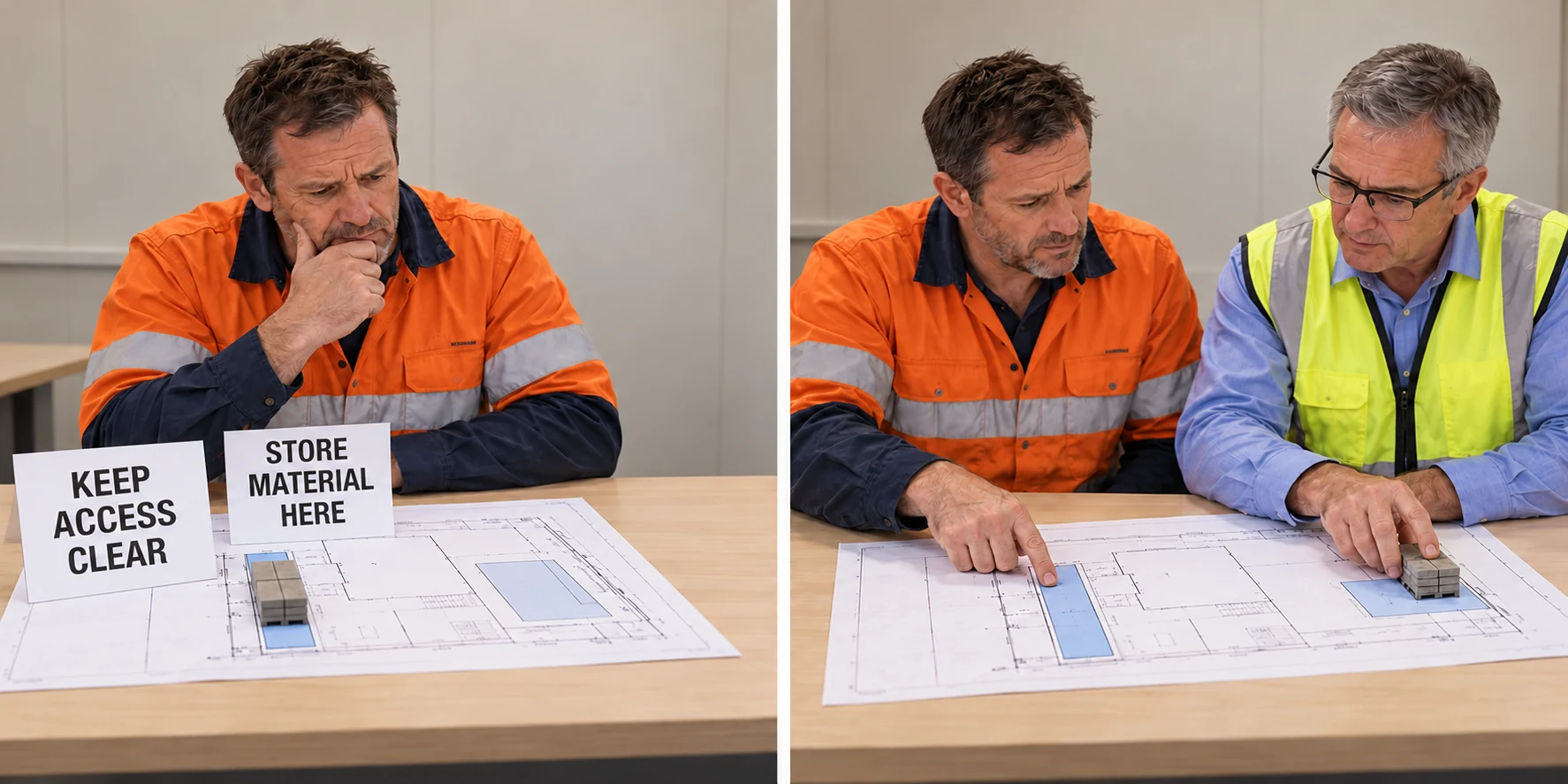
Resolve incompatible demands through clear authority, realistic priorities and consultation. Do not leave the worker to absorb the conflict.
The second view shows a planning discussion, not verified implementation or a mental-health diagnosis.
OnShift educational illustration, AI-generated and visually reviewed for this preview; not a project photograph.
- SafeWork NSW · Psychosocial hazards
- SafeWork NSW · Designing Work to Manage Psychosocial Risks
- SafeWork NSW · Duty to consult
Bullying, harassment and violence should not be normalised as the price of a demanding industry. Provide reporting routes, including a route outside the immediate reporting line where needed, and respond through the organisation's fair and confidential process. Consultation helps identify patterns, but workers should not have to disclose private health information in a group meeting. Look at work demands, relationships and support together. A psychologically safer reporting environment also helps physical safety because people are more likely to raise uncertainty before it becomes an incident.
Facilities, support and confidentiality
Support starts with ordinary working conditions: suitable amenities, access to drinking water, opportunities for recovery, workable communication and respectful supervision. These arrangements need to remain usable as the site changes. A facility shown on a plan is not helpful if the route becomes blocked or its use conflicts with the programme. Ask workers about practical barriers rather than assuming provision equals access.
Alcohol, other drugs, medication, illness and personal circumstances may raise fitness-for-work concerns, but their management requires the organisation's applicable policies, lawful processes and competent advice. Do not invent testing thresholds, make public accusations or advise someone to stop prescribed medication. Discuss the work limitation and direct medical questions to an appropriate health professional. Share only the information needed by authorised people to manage the work safely.
Mental health first aid means initial support and connection to appropriate help; it does not turn a supervisor into a clinician. Where trained support is available, workers should know how to access it. In an immediate threat to life or serious safety emergency, use emergency services and the site's emergency arrangements. Routine support conversations are different from emergency response. For a non-urgent concern, listen without interrogation, explain available support and follow through on agreed workplace actions. Do not promise absolute secrecy where urgent safety duties may require information to be shared.
Review and return-to-work arrangements
A report of fatigue or distress should lead to an examination of the relevant work conditions, not just a file about the individual. Ask whether workload, scheduling, role conflict, support or exposure to harmful events contributed. Keep conclusions evidence-based. A change in behaviour has many possible explanations, and a supervisor's observation is not a diagnosis. Immediate risk management can still proceed without deciding the medical cause.
Track whether agreed changes are implemented and useful. If breaks are scheduled but routinely lost to delivery delays, the roster record overstates the actual recovery opportunity. If a reporting channel exists but workers fear retaliation, the channel is not functioning as intended. Review patterns without publishing identifying medical details. The organisation needs enough information to improve the system while preserving personal dignity and appropriate confidentiality.
Return-to-work and ongoing work arrangements need the relevant authorised process and professional input, with task limitations translated clearly for those allocating work. The supervisor's role is to apply the agreed arrangements and report difficulties, not independently change medical restrictions. Appropriate support and changes to harmful work conditions serve different needs. Both remain part of the response.