
Clean-up, records, debrief and improvement
Close-out transfers the actual site condition, records and outstanding responsibilities to the receiving party.
The condition left at handover
The end of a shift, the end of a demolition stage and final project handover are different boundaries. Each requires a clear description of the condition left behind. Work can be paused while structures, temporary works, services or waste remain under control. Final completion requires the agreed scope and relevant acceptance processes. Do not use the same broad 'finished' label for all three.
Plan close-out from the beginning. Identify retained assets, remaining hazards, required inspections, records, temporary arrangements and the person or organisation receiving the area. A programme that ends when the last visible component is removed may omit clean-up, evidence, service status, environmental controls and handover. Those omissions create pressure to rush the final activities.
Consider a project where the main removal work is complete but a protected opening and a temporary access restriction remain. The handover should identify them, explain who controls them and state the conditions for any later change. A clean surface around the opening does not remove the hazard. The next party needs a truthful account of the actual condition. Close-out is therefore a transfer of reliable information and control responsibilities, not merely a photograph of an empty site.
Materials, equipment and demobilisation
Clean-up should preserve the identification of materials and waste. Mixing streams at the end can undo earlier segregation and complicate lawful handling. Check that material movements remain connected to the relevant characterisation, destination and records. Do not treat the final load as exempt from the arrangements used throughout the job. An uncertain material needs the appropriate review, not a convenient label.
Plant and tools also need a controlled close-out. Identify defects, restrictions, maintenance needs and the condition in which equipment is returned or stored. A machine leaving the site should not lose an unresolved fault because the hire period ended. Communicate the condition to the receiving party through the agreed process.
Demobilisation itself changes the work area. Removing barriers, temporary services, lighting or welfare facilities too early can leave people without controls while other work continues. Sequence their removal through the authorised project arrangements, retaining what is still needed. The last people on site deserve the same planning as the main crew. A resource that appears temporary may remain essential to security, access, emergency response or protection of retained work until the relevant dependency has ended.
Waste identification and traceability
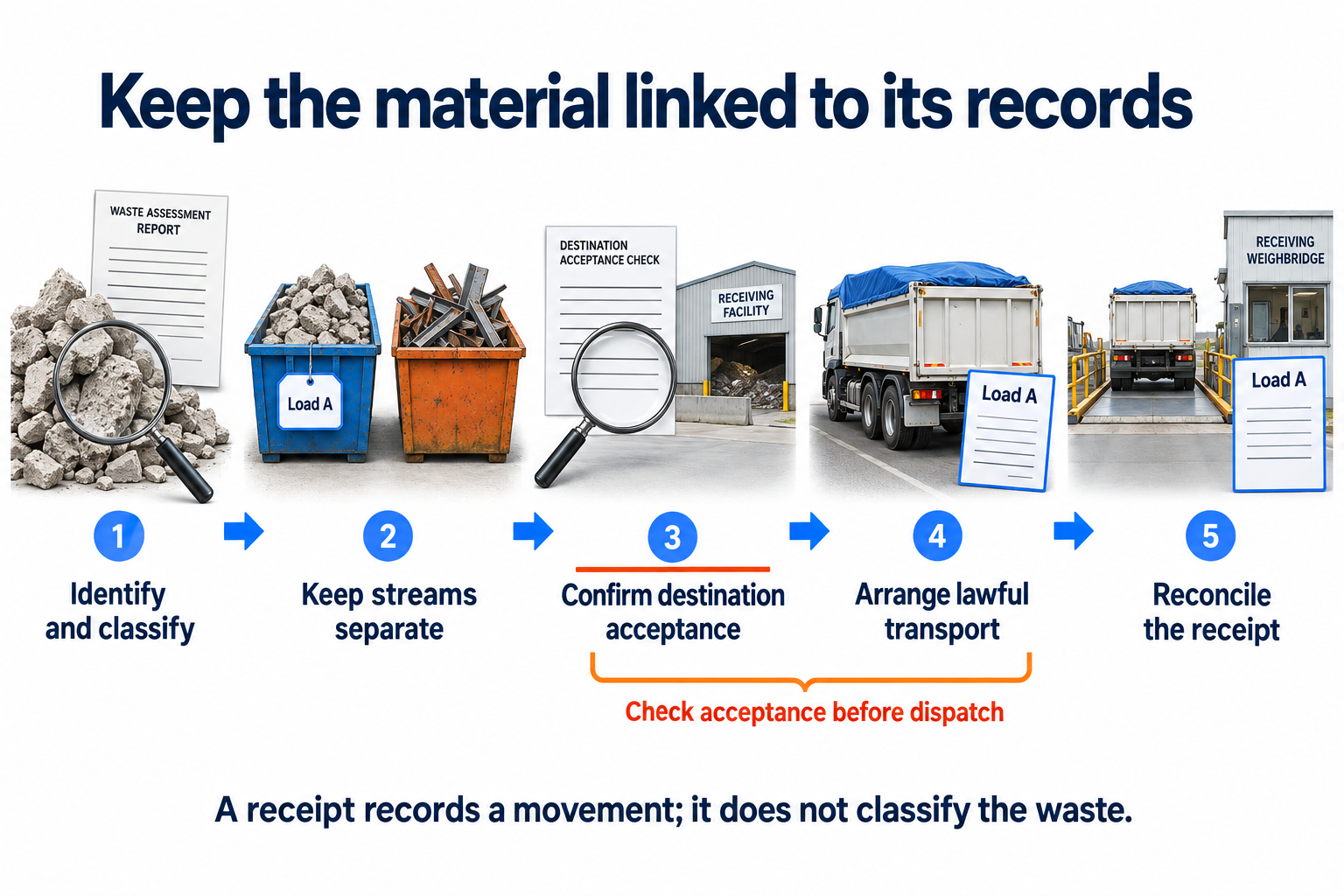
Records connect the material, transport arrangements and authorised receiving destination.
 Open full-size illustration
Waste management begins with material identification and the required characterisation or classification. Appropriate segregation preserves the identity of each stream. The load must then be connected to lawful transport arrangements and a receiving facility authorised to accept that waste. Destination suitability must be confirmed before dispatch.
Records preserve the connection between what left the site, where it went and what was received. A receipt from a facility does not establish the destination of every other load or confirm that the recorded description matches the material. An estimated quantity must remain distinguishable from a measured weighbridge result.
Classification, testing, transport and resource recovery requirements depend on the material and circumstances. If material identity or destination acceptance is unresolved, changing a label does not resolve the underlying uncertainty. The affected movement needs the appropriate review before it proceeds.
Traceability continues through segregation, stockpiling, load-out and close-out. Records must describe the physical movement accurately, including discrepancies that require reconciliation.
Handover facts and exceptions
A useful handover describes completed work, the current condition, retained or temporary arrangements, outstanding items and the location of supporting records. Relevant information may include current drawings, specialist confirmations, waste receipts, inspection results, permits, monitoring and unresolved actions. The required records depend on the contract, law and project.
Check consistency. If a diary says an area remains restricted but a completion summary calls it unrestricted, the recipient receives conflicting information. If waste quantities are summarised, distinguish estimates from measured records and explain unresolved differences. If a permit is closed, understand what that closure means within its system. It does not necessarily certify every surrounding condition.
A defects or outstanding-items list should identify the item, location, required outcome, owner and next review point. Avoid hiding significant restrictions in a general comment. Obtain the relevant recipient's acknowledgement through the authorised process, while recognising that acknowledgement and technical acceptance are different. Preserve the controlled history and required records. Handover should make it possible for another person to understand what they can rely on, what they must maintain and what still requires a decision. That is more useful than a broad assurance unsupported by the details.
Keep three things distinct at closeout: the specified condition, the observed result and the outstanding action. A requirement describes what should be achieved; a record provides the evidence of what was found. Writing “complete” cannot supply a missing measurement or disposal record.
For an informal practice example unrelated to the case results, imagine that three numbered disposal dockets were required and only two are available. Record the missing identifier and follow-up owner. Do not invent the absent docket or treat the existence of a waste requirement as proof of disposal.
Interpreting a control record
A control record for a material-transfer area needs to identify the activity, location, revision and intended use. These details establish whether the document applies to the work. Its supporting information and unresolved assumptions are equally important: changing a heading does not make an unrelated record applicable.
A hazard entry must explain the route to harm. Terms such as plant or debris identify a subject but not the exposure. The record needs to establish how movement or material could reach workers, visitors, neighbouring property or an environmental receptor. Deliveries and changing work areas can alter those pathways.
The control entry distinguishes measures that are proposed from those already implemented. It identifies how each measure reduces exposure, who establishes and maintains it, and what technical information it depends on. Exclusion distances and load limits require the relevant site-specific basis; they cannot be derived from a generic form.
Verification must address the condition being relied upon. A photograph may establish the location of a sign, but it cannot establish the capacity of a structural support. A signature may record acknowledgement without verifying the assumptions behind the arrangement.
If a delivery blocks the planned route, the review must address the changed movement and exposure. The revised arrangement must be communicated and obsolete instructions withdrawn from use. Traffic arrangements, the demolition work plan, relevant safe work method statements, emergency access and briefings must remain consistent. A permit authorises a defined activity under specified conditions; it does not replace unrelated technical confirmations.
Debriefing the actual work
A debrief examines what happened and what can be learned. It should include more than whether the schedule was met. Ask where the plan matched the work, where people had to adapt, what information arrived late and which controls were difficult to maintain. Invite the perspectives of workers and relevant contractors. Their accounts may explain a problem that was invisible in the formal progress report.
Use specific examples. A crew reports that a storage location caused repeated rehandling. Examine how the location was selected, when the issue became apparent and why it persisted. The lesson might concern planning information, container availability or coordination, rather than a generic instruction to improve housekeeping. Likewise, a successful arrangement is worth examining: what made it work, and which conditions would need to be present before using the idea elsewhere?
Keep discussion respectful and evidence-based. A debrief is not a substitute for a formal incident investigation, contractual decision or performance process. Do not pressure people to agree with the supervisor's account. Record important differences and unresolved questions. If the event was traumatic, use the appropriate support arrangements and do not compel personal disclosure. The value is an honest description of work as performed, with lessons that can be checked and acted on.
Transferring lessons between projects
A lesson is not implemented merely because it appears in a debrief report. Identify the proposed change, responsible owner, affected process and evidence needed to judge its effect. Some lessons belong in procurement, others in planning, training, maintenance or document control. Sending every issue to the next toolbox talk can miss the place where the cause can actually be changed.
Test transferability. A successful material arrangement on one project may depend on access, space, waste type or receiving capacity that another project does not have. Preserve the principle without copying the entire method. For example, the principle might be maintaining material identity through movement; the practical implementation needs review for the new site. This is how experience becomes useful without becoming an unexamined template.
Check whether actions are effective after implementation and retain the evidence. Repeated findings should reach management review, especially where supervisors cannot resolve resource or system constraints locally.