
How project documents connect
Drawings and specialist information support plans, task controls, authorisations and briefings; verification tests their relationship with actual work.
Information behind the plan
Project documents connect information with decisions. Drawings, observations, engineering information and hazardous-material findings support planning. The plan establishes the work stages and interfaces that task controls, authorisations and briefings must address. Verification compares those arrangements with actual conditions. Changed or conflicting information returns the affected decisions for review.
The first connection is often the weakest. A plan can look detailed while depending on an unverified assumption. An old drawing may omit alterations. An engineering report may exclude inaccessible areas. A hazardous-material survey may identify sampling limits. Reliable planning does not erase those qualifications. It records what is known, what remains uncertain and which work depends on resolving the uncertainty.
A document's identity helps preserve this connection. Record the source, revision, issue purpose and relevant location. If a plan merely says 'refer to engineer', the reader may not know which advice applies. A precise reference connects the decision to its basis. The same discipline supports later review when a condition changes. Without it, the team may be unable to tell whether new information invalidates the plan or was already considered.
Project plans and task controls
A demolition work plan coordinates the project approach, including scope, stages, resources, interfaces and important controls. A project risk assessment examines the overall risk picture and interactions. Specialist plans develop particular matters such as traffic, environmental management or emergency response. Their names may vary between organisations, but their purposes should remain clear.
A safe work method statement, or SWMS, addresses the relevant high-risk construction work, hazards and risk controls, including how controls are implemented, monitored and reviewed. It should fit the actual activity and conditions. It is not the whole project plan and does not replace the underlying technical information. A standard operating procedure explains an established equipment or process arrangement, but also needs to be used within its application and limitations.
A useful relationship is one of consistent detail. The project plan establishes the stage and interfaces; task information explains the relevant work within that stage. If the project plan protects a retained area while a task sheet assumes unrestricted access through it, the documents conflict. Copying more text into both documents does not solve the issue. Resolve the controlling decision and make the affected instructions agree. The work party should not have to choose which document to obey while exposed to the hazard.
Relationships between project documents
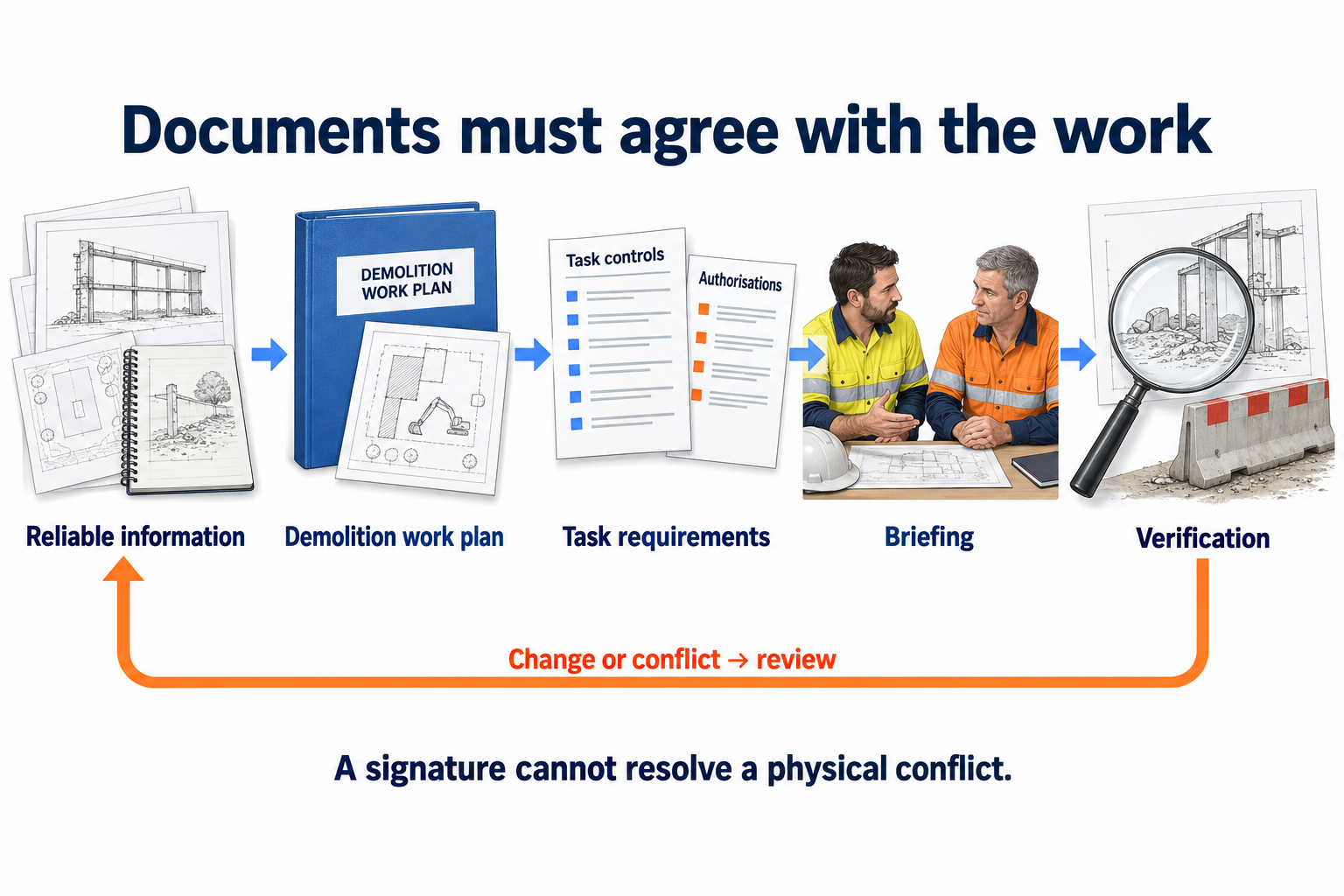
Site information connects planning, task controls, communication and verification.
 Open full-size illustration
Drawings, site observations, engineering information and hazardous-material findings establish the information used for planning. The demolition work plan coordinates the project; task controls and relevant authorisations address the work being undertaken. Briefings communicate the current arrangements, while verification establishes whether those arrangements have been implemented and remain effective.
A change or inconsistency requires the affected information and decisions to be reviewed. Documents must remain consistent with both one another and the physical conditions on site. A repeated signature cannot resolve a conflict between the plan and the work.
Permits and briefings
A permit records a bounded authorisation within a defined system. It identifies the work, location, conditions, responsibilities and status relevant to that authorisation. Its exact content and legal significance depend on the activity and the applicable arrangements. A permit should not be treated as a universal certificate of safety. The physical controls and specialist confirmations it relies on still need to exist.
A briefing communicates the current arrangement to the people affected. It should preserve important conditions rather than reduce the message to 'the permit is signed'. People need to know the relevant location, limits, interfaces, communication and stop conditions. An attendance record can show who was recorded at the briefing, but cannot alone prove understanding or practical capability.
Consider a situation where a temporary access restriction is attached to an authorisation. The permit issuer understands it, but the briefing omits it. The document chain has failed at communication even though the permit is valid within its own system. Conversely, a clear briefing cannot authorise work where the required permit or specialist release is missing. These are separate connections. A completed document supports only the decision within its scope.
Interpreting a control record
A control record for a material-transfer area needs to identify the activity, location, revision and intended use. These details establish whether the document applies to the work. Its supporting information and unresolved assumptions are equally important: changing a heading does not make an unrelated record applicable.
A hazard entry must explain the route to harm. Terms such as plant or debris identify a subject but not the exposure. The record needs to establish how movement or material could reach workers, visitors, neighbouring property or an environmental receptor. Deliveries and changing work areas can alter those pathways.
The control entry distinguishes measures that are proposed from those already implemented. It identifies how each measure reduces exposure, who establishes and maintains it, and what technical information it depends on. Exclusion distances and load limits require the relevant site-specific basis; they cannot be derived from a generic form.
Verification must address the condition being relied upon. A photograph may establish the location of a sign, but it cannot establish the capacity of a structural support. A signature may record acknowledgement without verifying the assumptions behind the arrangement.
If a delivery blocks the planned route, the review must address the changed movement and exposure. The revised arrangement must be communicated and obsolete instructions withdrawn from use. Traffic arrangements, the demolition work plan, relevant safe work method statements, emergency access and briefings must remain consistent. A permit authorises a defined activity under specified conditions; it does not replace unrelated technical confirmations.
Verification and revision
Verification asks whether the specified condition or control has been established and performs as intended. Inspection records, competent measurements, specialist confirmations and observed work can contribute different evidence. Choose the check that answers the actual question. A photograph can show the position of a sign; it cannot establish the capacity of concealed support. A signature can record a review; it cannot show that every control remained effective during a shift.
When verification reveals a change or conflict, the map returns to information and review. Suppose the planned route is now obstructed. The inspection record identifies the condition, but the response may need a revised traffic arrangement, task information and briefing. The return connection matters because documents are not produced once and then left untouched while the site changes.
A change should be traceable across the affected documents without creating uncontrolled copies of the same instruction. Reference the controlling information where practical, while ensuring the work party has usable instructions at the point of use. Update the register, distribute the revision and withdraw superseded work copies. If a material uncertainty remains, keep the affected restriction visible. Verification is not a decorative final box. It is the mechanism by which reality can challenge the plan.
Consistency between records
Diaries, registers, inspection findings, waste records and handover documents should tell a compatible account. They need not contain identical text, because each has a different purpose. They should not contradict one another about the work stage, control status or unresolved restrictions. A summary that says all work is complete while an action register retains a significant hold is not a coherent handover.
Purpose, identity, inputs, decision, evidence and limits give a record its meaning. Purpose explains why it exists. Identity establishes the version and location it concerns. Inputs show what it relies on. The decision identifies what was proposed or authorised. Evidence records what was checked or observed. Limits show what remains unconfirmed.
When records disagree, their dates, scopes and sources can help explain the difference. A later inspection may record a changed condition; two records from the same period may reveal a conflict still needing clarification. Choosing the more reassuring record or rewriting the earlier account would conceal information needed to resolve the issue.
Interpreting a control record
A control record for a material-transfer area needs to identify the activity, location, revision and intended use. These details establish whether the document applies to the work. Its supporting information and unresolved assumptions are equally important: changing a heading does not make an unrelated record applicable.
A hazard entry must explain the route to harm. Terms such as plant or debris identify a subject but not the exposure. The record needs to establish how movement or material could reach workers, visitors, neighbouring property or an environmental receptor. Deliveries and changing work areas can alter those pathways.
The control entry distinguishes measures that are proposed from those already implemented. It identifies how each measure reduces exposure, who establishes and maintains it, and what technical information it depends on. Exclusion distances and load limits require the relevant site-specific basis; they cannot be derived from a generic form.
Verification must address the condition being relied upon. A photograph may establish the location of a sign, but it cannot establish the capacity of a structural support. A signature may record acknowledgement without verifying the assumptions behind the arrangement.
If a delivery blocks the planned route, the review must address the changed movement and exposure. The revised arrangement must be communicated and obsolete instructions withdrawn from use. Traffic arrangements, the demolition work plan, relevant safe work method statements, emergency access and briefings must remain consistent. A permit authorises a defined activity under specified conditions; it does not replace unrelated technical confirmations.