
Dust, silica, airborne contaminants, noise and vibration
Airborne contaminants, noise and vibration can cause harm without immediate symptoms. Exposure assessment, source controls and suitable monitoring address their different pathways.
Exposure beyond visible dust
Some demolition hazards injure immediately; others can damage health through exposure that is easy to overlook. Dust in sunlight is visible, but the particles that matter for a particular disease may not be. Respirable particles are small enough to penetrate deeply into the lungs. A clean-looking room or a worker without symptoms is therefore not evidence that inhalation risk has been controlled.
Crystalline silica is present in materials such as concrete, mortar and many natural stones. Processes that break or abrade silica-containing material can generate respirable crystalline silica, often shortened to RCS. The material's presence and the process producing airborne particles are related but different facts. A material description does not, by itself, establish the worker's exposure during a particular task.
Silicosis is a disease in which inhaled crystalline silica damages the lungs and produces irreversible scarring. The resulting loss of lung function can make breathing severely difficult. Exposure can also cause other serious disease, including lung cancer. Prevention matters because a later medical check cannot undo the exposure or restore scarred lung tissue. Inhalation needs to be controlled before illness becomes apparent.
Exposure connects the source, release, movement and breathing zone. The breathing zone is the air near the worker's nose and mouth. The person doing the main task may not be the only person exposed. Nearby workers, cleaners, operators entering contaminated areas and people handling dusty waste can encounter material after the original activity. Settled dust can be disturbed again.
Exposure also depends on time and conditions. A brief inspection beside one activity differs from a shift involving repeated dusty tasks, but brief work is not automatically harmless. Consider the actual materials, process, duration, enclosure and controls together. The supervisor's role is to make these conditions visible in planning and to obtain suitable exposure information where required. It is not to diagnose lung disease from appearance or decide that no visible cloud means no risk.
Dust-generating processes and silica controls
Effective dust planning starts with the work that generates dust. Consider whether the hazardous process can be avoided or changed, then examine suitable engineering and isolation measures. Dust capture, appropriately designed wet methods and enclosed or filtered operating arrangements have different applications. Their effectiveness depends on the material, equipment and task, rather than the presence of a control's name on a form.
For example, extraction at a tool depends on the capture arrangement remaining effective where dust is generated. A damaged connection, unsuitable collection equipment or poorly maintained filter can undermine the system. Water that wets a nearby surface but misses the generation point may create runoff without adequately controlling exposure. Inspect the working arrangement and its maintenance information, not merely whether a hose or vacuum is on site.
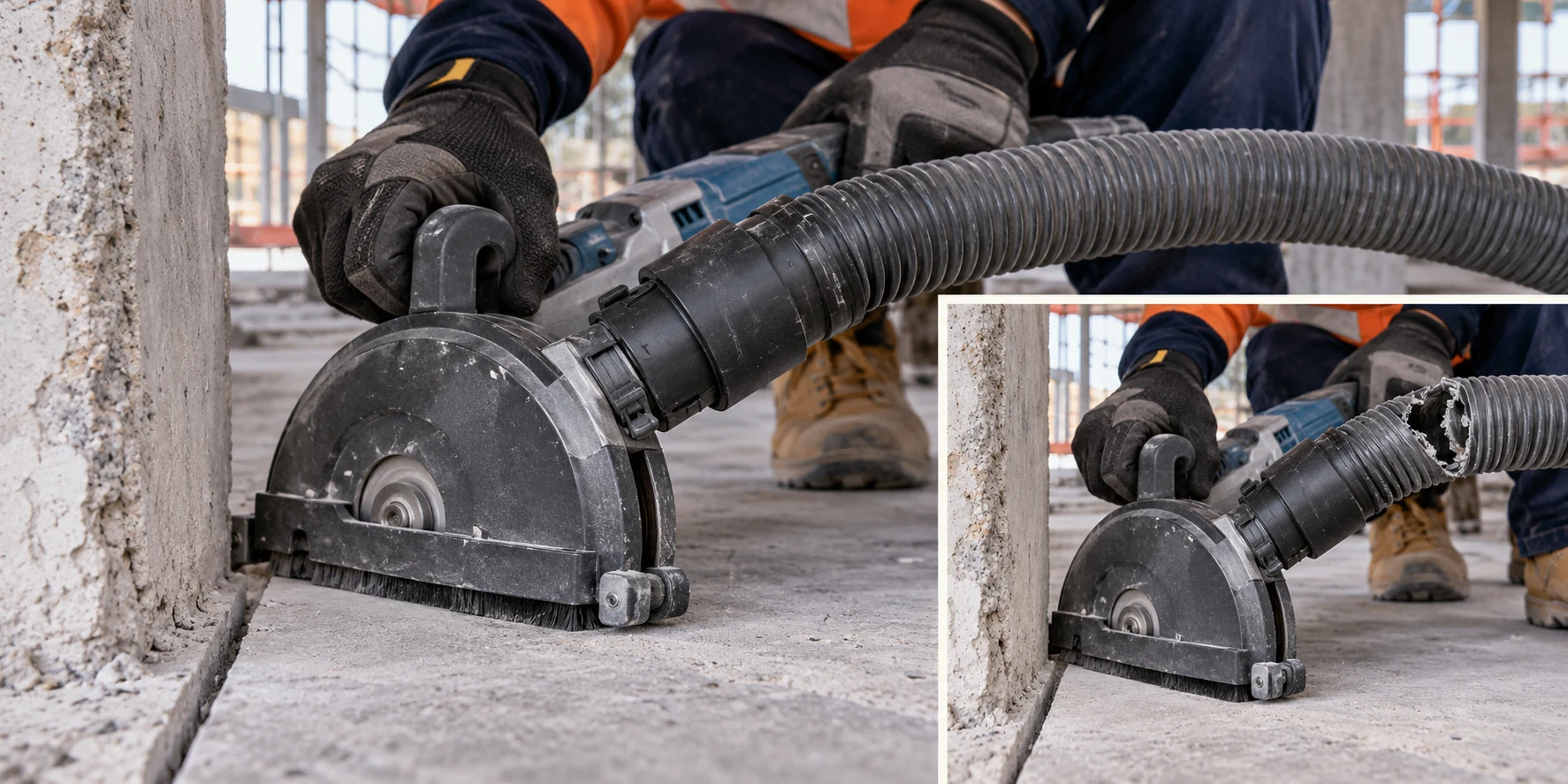
A damaged connection can undermine capture at the generation point. Check equipment suitability, condition and maintenance information.
The damaged view is a fault example. This is not an equipment recommendation, operating method or exposure measurement.
OnShift educational illustration, AI-generated and visually reviewed for this preview; not a project photograph.
- SafeWork NSW · Work safely with crystalline silica and engineered stone
- SafeWork NSW · Crystalline silica
- NSW EPA · Guidance for stormwater management: the drain is just for rain
- SafeWork NSW · Managing risks of respirable crystalline silica in the workplace Code of Practice
Clean-up is part of the exposure plan. Moving dry dust around can create another release. Select methods and equipment suited to the contaminant and the current guidance; do not assume an ordinary domestic vacuum is appropriate for hazardous dust. Dust control also interacts with electricity, slipping, visibility, water management and waste handling. Solving one pathway should not quietly create another.
Current NSW guidance requires a written assessment of whether processing a crystalline silica substance, or CSS, is high risk. Record the relevant factors considered and the conclusion; if uncertainty remains, treat the processing as high risk. Respirators and administrative controls cannot be used to discount that classification. The written reasoning explains the decision rather than merely recording a tick beside low risk.
For high-risk processing, a silica risk control plan is required before work starts. It connects the task assessments with the chosen controls, their implementation and how effectiveness will be monitored and reviewed. A qualifying safe work method statement, or SWMS, can serve instead where the processing is also high risk construction work. For that substitution, the SWMS must contain all required silica-plan information. It must be prepared before processing; merely mentioning dust does not qualify.
The written assessment records the risk determination; the plan or qualifying SWMS sets out the controls and how they will be implemented, monitored and reviewed. These documents need to describe the same tasks and conditions.
Interpreting a control record
A control record for a material-transfer area needs to identify the activity, location, revision and intended use. These details establish whether the document applies to the work. Its supporting information and unresolved assumptions are equally important: changing a heading does not make an unrelated record applicable.
A hazard entry must explain the route to harm. Terms such as plant or debris identify a subject but not the exposure. The record needs to establish how movement or material could reach workers, visitors, neighbouring property or an environmental receptor. Deliveries and changing work areas can alter those pathways.
The control entry distinguishes measures that are proposed from those already implemented. It identifies how each measure reduces exposure, who establishes and maintains it, and what technical information it depends on. Exclusion distances and load limits require the relevant site-specific basis; they cannot be derived from a generic form.
Verification must address the condition being relied upon. A photograph may establish the location of a sign, but it cannot establish the capacity of a structural support. A signature may record acknowledgement without verifying the assumptions behind the arrangement.
If a delivery blocks the planned route, the review must address the changed movement and exposure. The revised arrangement must be communicated and obsolete instructions withdrawn from use. Traffic arrangements, the demolition work plan, relevant safe work method statements, emergency access and briefings must remain consistent. A permit authorises a defined activity under specified conditions; it does not replace unrelated technical confirmations.
Air monitoring, health monitoring and respiratory protection
Air monitoring investigates airborne exposure under the sampled conditions. Health monitoring looks for effects on a person's health through an appropriate medical process. They answer different questions. A health report is not a test of a dust extraction system. A satisfactory air sample does not erase a person's previous exposure or establish that disease cannot develop later.
Read an air-monitoring report for the substance measured, sampling method, worker or location represented, duration, activities, controls and conditions. A sample from a quiet period may not represent the busiest dusty work. An area measurement and a personal breathing-zone sample are not automatically interchangeable. Interpretation belongs with the appropriately qualified professional, while the supervisor supplies accurate information about what actually occurred.
Respiratory protective equipment, or RPE, deals with remaining exposure within a suitable protection programme. Selection must suit the contaminant and task. A particulate filter does not supply oxygen and is not a universal answer to gases or vapours.
A fit test establishes whether a particular make, model, style and size of tight-fitting respirator fits the individual wearer. A competent tester uses a qualitative or quantitative method. SafeWork NSW guidance calls for testing before first use and at least annually. It also calls for testing when a different facepiece or a change affecting the face seal requires it. The record identifies the wearer, tested respirator, method, date and result; another person's successful test says nothing about this person's fit.
A fit check is the wearer's check each time that already fit-tested respirator is put on. It checks the immediate wearing arrangement, not long-term suitability. Passing a quick fit check does not replace a fit test, and a past fit test does not remove the need for today's fit check. Facial hair at the seal, damaged equipment or incompatible eye protection can defeat the intended protection. These are reasons to resolve suitability before exposure, not to rely on a familiar mask's appearance.
Consider a worker whose respirator interferes with eye protection. The solution is not to quietly remove one item. The combination needs review so that both protective functions remain effective. Training, maintenance, storage and supervision matter alongside selection. Medical information requires confidential handling; operational briefings should communicate necessary work restrictions and controls without exposing personal health details. Current monitoring, record and reporting duties must be checked through the relevant NSW guidance and the responsible professionals.
Interpreting a control record
A control record for a material-transfer area needs to identify the activity, location, revision and intended use. These details establish whether the document applies to the work. Its supporting information and unresolved assumptions are equally important: changing a heading does not make an unrelated record applicable.
A hazard entry must explain the route to harm. Terms such as plant or debris identify a subject but not the exposure. The record needs to establish how movement or material could reach workers, visitors, neighbouring property or an environmental receptor. Deliveries and changing work areas can alter those pathways.
The control entry distinguishes measures that are proposed from those already implemented. It identifies how each measure reduces exposure, who establishes and maintains it, and what technical information it depends on. Exclusion distances and load limits require the relevant site-specific basis; they cannot be derived from a generic form.
Verification must address the condition being relied upon. A photograph may establish the location of a sign, but it cannot establish the capacity of a structural support. A signature may record acknowledgement without verifying the assumptions behind the arrangement.
If a delivery blocks the planned route, the review must address the changed movement and exposure. The revised arrangement must be communicated and obsolete instructions withdrawn from use. Traffic arrangements, the demolition work plan, relevant safe work method statements, emergency access and briefings must remain consistent. A permit authorises a defined activity under specified conditions; it does not replace unrelated technical confirmations.
Dust is only one airborne hazard
Demolition can disturb coatings, residues and contaminated material, while engines, hot work and chemicals brought onto site can create additional airborne hazards. Fumes, gases and vapours are not simply other names for dust. Fume consists of very fine particles formed through processes such as heated material cooling. A gas or vapour behaves differently and may require different detection and controls.
Identify the source material and the process together. A hazardous-materials survey can identify suspect building materials within its inspection scope. A safety data sheet describes a chemical product and its hazards, handling, exposure controls and emergency information. Neither automatically measures the atmosphere created when several activities occur together. Old coatings, inaccessible cavities and residual vessel contents can require further investigation.
Engine-powered equipment near an enclosed lower level can affect the air within it. Even if the immediate task produces little dust, exhaust can affect air quality. A respirator selected for dust does not resolve that question. Similarly, ventilation that changes after a wall or temporary enclosure is altered can change how contaminants move.
Odour is not a reliable clearance method. Some harmful contaminants have poor warning properties, and people can become accustomed to smells. Do not enter a suspect space to investigate a smell or retrieve a monitor. Keep recognition separate from specialist testing and entry authority. The useful supervisory record names the suspected source, affected activity, location, people potentially exposed and the information still needed. This allows the right assessment and controls to be arranged.
Noise affects hearing and communication
Noise exposure depends on sound level, duration and the pattern of exposure, including sharp impacts. The ear does not reset whenever a worker changes tools. Several activities across a shift can contribute to the exposure picture, and nearby work may matter even when the worker's own task is quiet. Noise can also make warnings and instructions difficult to hear.
Decibels use a logarithmic scale, so ordinary arithmetic averaging of displayed sound levels is misleading. A phone reading taken at a convenient location is not automatically a suitable occupational noise assessment. The measurement method, instrument, position and representative activities matter. Distinguish a worker exposure assessment from a boundary measurement made to investigate neighbourhood disturbance. They have different purposes and criteria.
Start control thinking with quieter processes and suitable equipment, supported by maintenance and engineering measures. Sound can travel around openings or through the structure, so an enclosure needs to be designed for the actual transmission path. Scheduling and separation can reduce who is exposed, but simply sharing a noisy task among more people does not eliminate the source.
Hearing protection must be selected and used as part of the assessed arrangement, with compatibility for other equipment and necessary communication. Maximum attenuation is not automatically the best choice in every situation. If a worker cannot hear an agreed signal while correctly protected, the communication arrangement needs attention. Do not solve that conflict by removing protection. Reports of ringing ears or difficulty hearing warrant the appropriate health response and review of exposure controls, not reassurance based on the absence of pain.
Technical terms
Hazard — A source or situation with potential to cause harm.
Risk — The possibility of harm, considered with its likelihood and consequence in context.
Exposure — The opportunity for a person or receptor to come into contact with a hazard.
Consequence — The harm or loss that could result.
Control — A measure that eliminates or reduces risk.
Remaining risk — Risk considered after the specified controls have actually been applied.
Elimination — Removing the hazard or hazardous exposure from the work.
Substitution — Replacing a hazard with a less hazardous alternative.
Isolation — Separating people from a hazard.
Engineering control — A physical or designed measure that acts on a hazard or exposure pathway.
Administrative control — An arrangement such as procedures, scheduling, information or supervision.
PPE — Personal protective equipment.
RPE — Respiratory protective equipment.
SWMS — Safe work method statement; a document for relevant high-risk construction work.
DWP — Demolition work plan.
Permit — A bounded authorisation within a defined control system, not universal proof of safety.
Induction — Introduction to relevant site conditions, responsibilities and arrangements.
Pre-start — A check or briefing before work or equipment use; distinct from scheduled servicing.
Verification — Checking evidence that the required condition or control exists and works as intended.
Consultation — Sharing relevant information, hearing affected workers' views and considering them in decisions.
Load path — The connected route by which forces pass through a structure to its supports.
Compression — A pushing action within a material or member.
Tension — A pulling action within a material or member.
Bending — A response to loading that tends to curve a member.
Shear — Action tending to make parts move past one another.
Temporary works — Engineered or other temporary arrangements supporting construction or demolition needs; specialist design and control may be required.
Respirable dust — Particles small enough to reach deep into the lungs.
LEL — Lower explosive limit; the lowest flammable gas or vapour concentration in air at which flame can propagate under the relevant conditions. Percentage of LEL is not percentage gas concentration or a safe-breathing decision.
Receptor — The person, property or environmental feature potentially affected.
Change control — The process of recognising a change, reviewing affected assumptions and controls, and communicating the revised arrangement.
Air monitoring — Competently planned measurement of airborne contaminants to assess exposure and control effectiveness.
Health monitoring — Medical monitoring for health effects, carried out or supervised by an appropriately experienced doctor when required.
Vibration pathways and control review
Hand-arm vibration enters through contact with vibrating tools or controls. Whole-body vibration is transmitted through a supporting surface, such as a seat or platform. Ground-borne vibration affecting a neighbouring structure is a third assessment question. A single statement that vibration is monitored does not establish that all three are addressed.
For workers, relevant factors include the equipment, vibration magnitude, duration, maintenance, grip or posture and the supporting surface. Numbness, tingling or discomfort should be reported and assessed rather than accepted as normal proof of a hard day's work. Manufacturer information can inform selection, but actual use and conditions affect exposure. Review lower-vibration alternatives, suitable maintenance and the work arrangement with competent advice.
For adjacent structures or sensitive operations, a monitoring plan needs an appropriate baseline, instrument locations, agreed criteria and a responsible reviewer. It also needs actions when those criteria are approached or exceeded. A worker health criterion cannot be substituted for a building-damage criterion. Occupational vibration criteria and structural trigger values must suit their respective assessments. Overseas guidance values cannot be assumed to be NSW legal thresholds.
A changed tool or longer shift can alter dust generation, noise, vibration, operator fatigue and the conditions represented by monitoring at the same time. Reviewing these effects together keeps exposure information connected to the actual work. The decision and revised controls need to be recorded and communicated.