
Structural integrity, falling objects and flying debris
A partly dismantled structure has changing load paths and restraints. Its stability, loading and debris paths determine the controls needed for each stage.
A structure is a connected system
A building stays upright because its parts work together. A load path is the route through which a force reaches a support and ultimately the ground. Imagine rainwater travelling through connected gutters and pipes. Breaking one connection changes where the water goes. Structural forces are not water, but the comparison helps explain why looking at one member in isolation can be misleading.
A roof might transfer its weight through purlins to rafters, then through columns to footings. Wind needs a route too, perhaps through bracing and connections. A floor can carry people while also restraining walls against sideways movement. Removing that floor reduces weight but may remove restraint. Less material does not necessarily mean less risk. The temporary condition between planned stages deserves attention in its own right.
Structural integrity means the system can perform its required supporting and stabilising functions in the condition being considered. It is not simply the absence of cracks. Drawings, construction details, alterations, deterioration and the proposed work all affect the picture. A wall described as non-load-bearing may still support a service, restrain an adjoining element or become unstable when surrounding material disappears.
Planning a removal requires information about what depends on the item and what will support or restrain those elements afterwards. It also requires information about which reviewed design establishes that arrangement. The structural assessment must address the temporary condition between stages as well as the intended end condition.
Technical terms
Hazard — A source or situation with potential to cause harm.
Risk — The possibility of harm, considered with its likelihood and consequence in context.
Exposure — The opportunity for a person or receptor to come into contact with a hazard.
Consequence — The harm or loss that could result.
Control — A measure that eliminates or reduces risk.
Remaining risk — Risk considered after the specified controls have actually been applied.
Elimination — Removing the hazard or hazardous exposure from the work.
Substitution — Replacing a hazard with a less hazardous alternative.
Isolation — Separating people from a hazard.
Engineering control — A physical or designed measure that acts on a hazard or exposure pathway.
Administrative control — An arrangement such as procedures, scheduling, information or supervision.
PPE — Personal protective equipment.
RPE — Respiratory protective equipment.
SWMS — Safe work method statement; a document for relevant high-risk construction work.
DWP — Demolition work plan.
Permit — A bounded authorisation within a defined control system, not universal proof of safety.
Induction — Introduction to relevant site conditions, responsibilities and arrangements.
Pre-start — A check or briefing before work or equipment use; distinct from scheduled servicing.
Verification — Checking evidence that the required condition or control exists and works as intended.
Consultation — Sharing relevant information, hearing affected workers' views and considering them in decisions.
Load path — The connected route by which forces pass through a structure to its supports.
Compression — A pushing action within a material or member.
Tension — A pulling action within a material or member.
Bending — A response to loading that tends to curve a member.
Shear — Action tending to make parts move past one another.
Temporary works — Engineered or other temporary arrangements supporting construction or demolition needs; specialist design and control may be required.
Respirable dust — Particles small enough to reach deep into the lungs.
LEL — Lower explosive limit; the lowest flammable gas or vapour concentration in air at which flame can propagate under the relevant conditions. Percentage of LEL is not percentage gas concentration or a safe-breathing decision.
Receptor — The person, property or environmental feature potentially affected.
Change control — The process of recognising a change, reviewing affected assumptions and controls, and communicating the revised arrangement.
Air monitoring — Competently planned measurement of airborne contaminants to assess exposure and control effectiveness.
Health monitoring — Medical monitoring for health effects, carried out or supervised by an appropriately experienced doctor when required.
Gravity loads and lateral stability
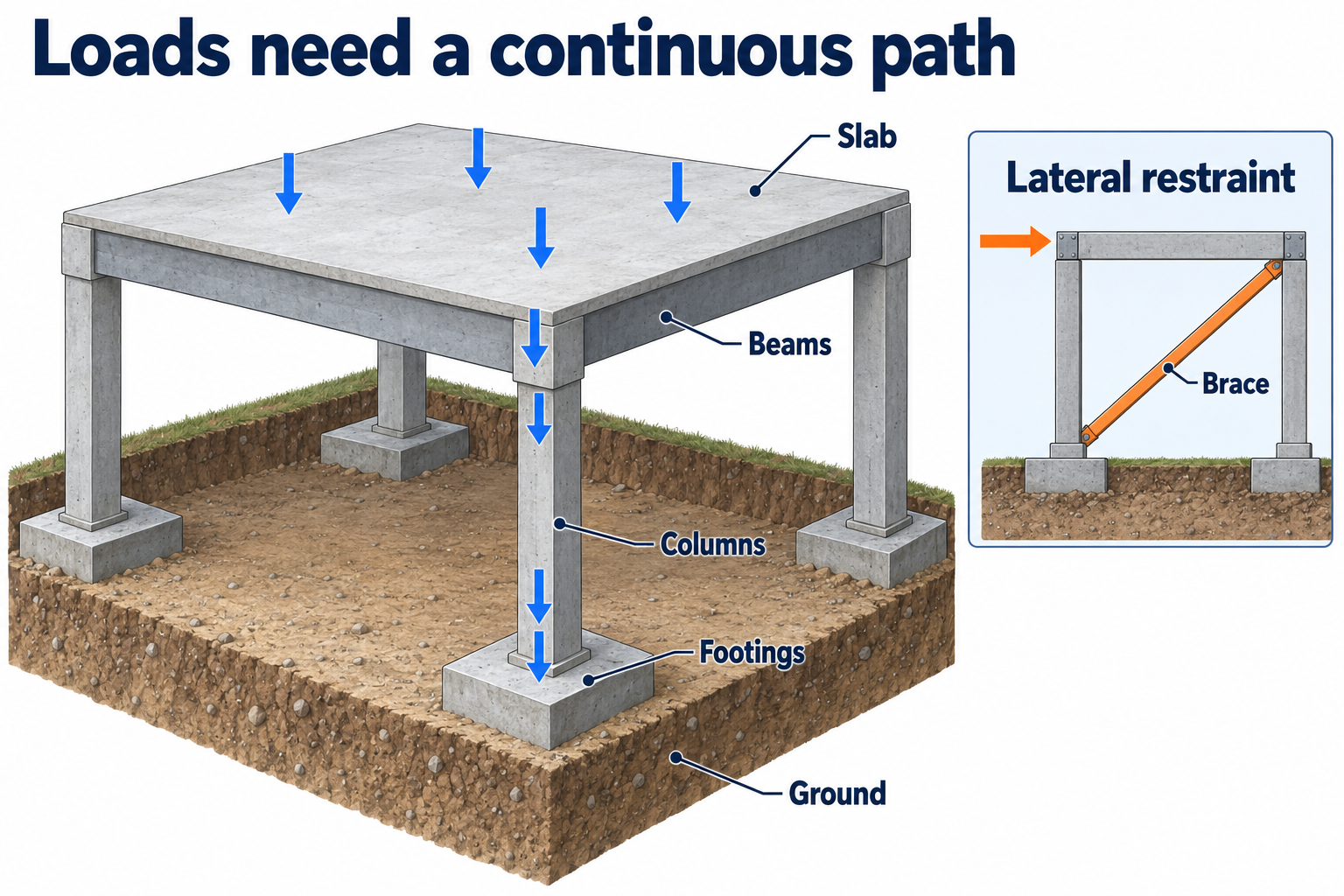
Structural elements transfer loads through connected supports and restraints.
 Open full-size illustration
Roof and floor loads pass through supporting beams or walls, then through columns or walls, into foundations and the ground. Each connection in the vertical chain represents a dependency: the receiving element must transfer the relevant action to the next support.
Lateral actions involve a different but connected set of relationships. Bracing, connections and restraints limit unwanted movement. An element that carries little gravity load can still provide essential lateral stability. Removing it may change the behaviour of the structure that remains.
Demolition alters loads, connections and restraints as work progresses. The partly dismantled structure must therefore be considered at each stage, using the current engineering information. Hidden construction, deterioration, ground conditions and temporary works may affect the assessment.
The schematic identifies load-transfer relationships, not member capacities or a removal sequence. Stage-specific structural decisions require information about the actual elements, their condition and their connections. An unresolved load path requires technical review.
Structural actions, materials and connections
Tension pulls; compression pushes; shear tends to make neighbouring parts slide; bending curves a member; torsion twists it. Real structures often experience several actions at once. A column can be compressed by weight while an off-centre load bends it. A connection may fail before the larger member reaches its apparent material strength. The actions, material and connection need to be assessed together; observation alone cannot establish their capacity.
Material behaviour matters. Masonry can be vulnerable when its supports or sideways restraints change. Reinforced concrete depends on the relationship between concrete, steel and anchorage. Steel members can lose stability when their unsupported length changes. Timber performance depends on connections, section loss and deterioration as well as its original dimensions. Prestressed elements contain deliberately introduced forces and require specialist identification and planning. Their behaviour must not be inferred from a generic reinforced-concrete sketch.
A visible bow, fresh movement at a connection, unexpected cracking or a changing gap provides information about condition. It does not tell you the remaining capacity. Conversely, a member that looks straight may have hidden corrosion, damaged bearings or an undocumented alteration. No visible movement is not proof that the next stage is acceptable.
Describe observations precisely: the element, location, direction of change, time and nearby activity. Compare them with the current inspection and engineering assumptions. Do not approach beneath suspect material to improve a photograph. A useful report can state both what was observed from a safe position and what could not be established.
Demolition creates new loading conditions
A building designed for its former use was not necessarily designed for concentrated plant loads, stacked debris or impact during demolition. A suspended floor transfers load across a span. A ground-supported slab relies on what is beneath it, which may include fill, buried structures or voids. Calling both surfaces concrete does not make their support conditions equivalent.
The same quantity of debris could be distributed across several areas or concentrated beside one opening. Its total mass is unchanged, but the local loading and its relationship to supports are different. This is why a total tonnage figure alone cannot establish where material may be stored.
Temporary works are engineered arrangements that provide support, restraint, access or protection during a limited stage. Their design assumptions, installation checks, inspection responsibilities and release conditions matter. A support that was suitable before adjacent work may need review after the structure changes. Temporary does not mean informal, and a hire label is not evidence that an arrangement suits this structure.
Planning should connect each loading restriction to the relevant drawing or reviewed instruction and the area to which it applies. It should also identify the person responsible for checking that restriction. Operators need usable boundaries, not an inaccessible report somewhere in the office. If a proposed plant substitution changes weight, reach or reactions, treat it as a potential change to the structural assumptions. It is then more than merely a purchasing decision.
Interpreting a control record
A control record for a material-transfer area needs to identify the activity, location, revision and intended use. These details establish whether the document applies to the work. Its supporting information and unresolved assumptions are equally important: changing a heading does not make an unrelated record applicable.
A hazard entry must explain the route to harm. Terms such as plant or debris identify a subject but not the exposure. The record needs to establish how movement or material could reach workers, visitors, neighbouring property or an environmental receptor. Deliveries and changing work areas can alter those pathways.
The control entry distinguishes measures that are proposed from those already implemented. It identifies how each measure reduces exposure, who establishes and maintains it, and what technical information it depends on. Exclusion distances and load limits require the relevant site-specific basis; they cannot be derived from a generic form.
Verification must address the condition being relied upon. A photograph may establish the location of a sign, but it cannot establish the capacity of a structural support. A signature may record acknowledgement without verifying the assumptions behind the arrangement.
If a delivery blocks the planned route, the review must address the changed movement and exposure. The revised arrangement must be communicated and obsolete instructions withdrawn from use. Traffic arrangements, the demolition work plan, relevant safe work method statements, emergency access and briefings must remain consistent. A permit authorises a defined activity under specified conditions; it does not replace unrelated technical confirmations.
Falling is not the only way debris travels
Falling objects move downwards under gravity, but demolition can also project fragments, release stored movement and cause pieces to bounce, roll or slide. A small fragment may travel through an opening that would not admit a large object. The protection question therefore includes where material starts, how it could move, and who or what could be reached.
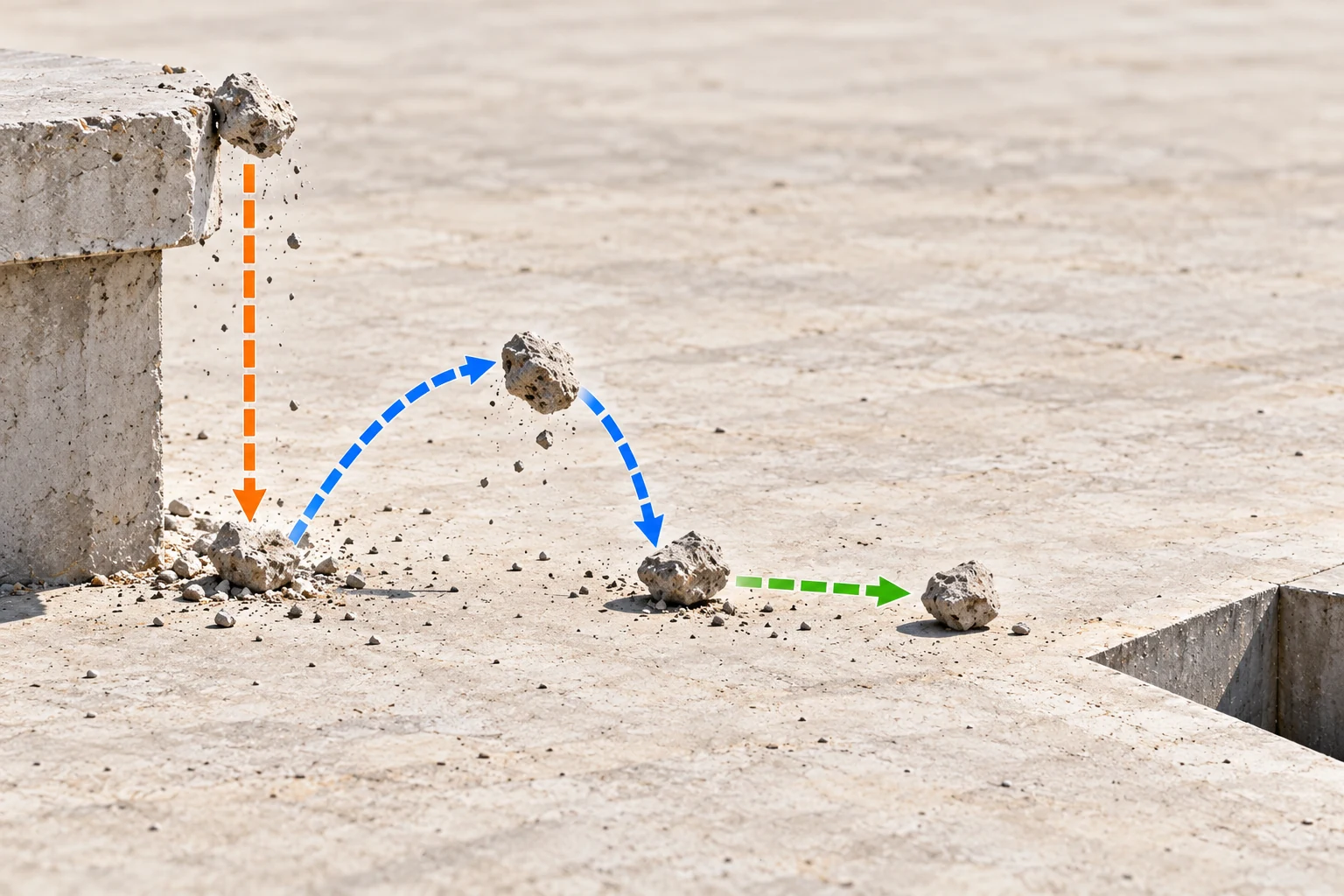
Consider more than a vertical drop. Material can reach people or places through several movement paths.
The repeated fragments represent possible movement stages, not measured trajectories, distances or an exclusion-zone calculation.
OnShift educational illustration, AI-generated and visually reviewed for this preview; not a project photograph.
Open full-size illustrationAn exclusion zone separates people from the predicted hazardous area. It must reflect the activity, structure, equipment and surrounding conditions. A fence at the property boundary cannot make a debris trajectory stop there. Nor does a painted line provide physical resistance to a vehicle or a rolling object. The planned control needs to match the mechanism, including any protection required beyond the immediate workface.
Containment, screening and overhead protection have different functions and limitations. A dust mesh is not automatically an impact barrier. Adding screening to a scaffold can change wind loading and may affect the scaffold design. A protective structure also needs an assessed support arrangement and inspection, rather than being treated as a neutral attachment.
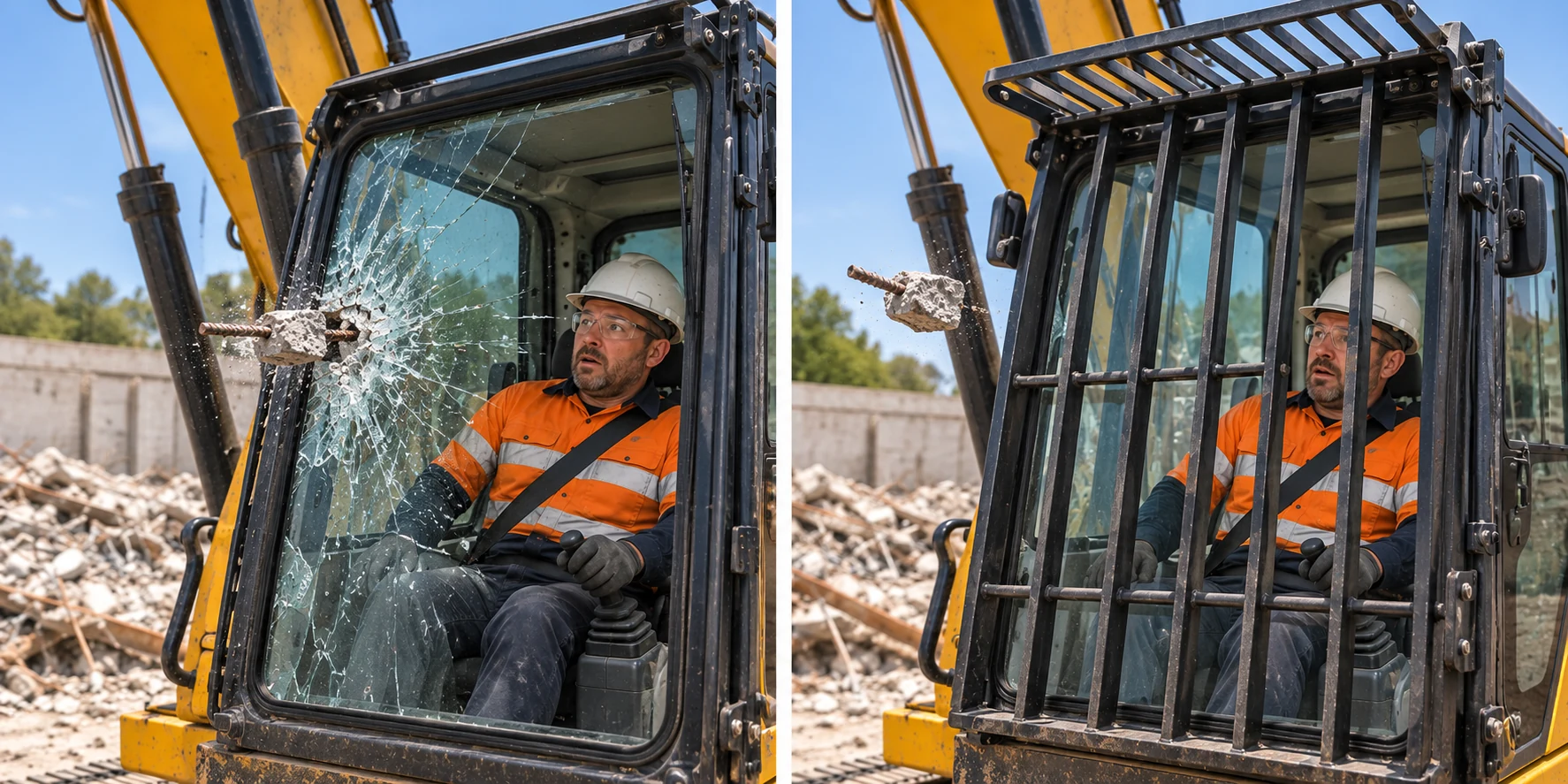
Select and verify the protection specified for the machine and task. Glazing, front protection and overhead protection are not interchangeable.
No injury is shown. The approaching fragment is not proof that this generic guard will stop it. No impact rating, bulletproof claim or equipment specification is supplied.
OnShift educational illustration, AI-generated and visually reviewed for this preview; not a project photograph.
Open full-size illustrationWork beside an occupied corridor exposes its users as well as the work party. Protecting only the worker doing the task ignores people using that corridor later. Good planning considers the material source, the route into the corridor, the integrity of any barrier and the conditions for reopening access. Personal protective equipment may address remaining exposure, but a helmet does not turn an uncontrolled overhead hazard into a safe pedestrian route.
Changed structural conditions
A useful structural inspection record links a condition to a stage. It identifies the area, current work, observations, relevant plan revision and outstanding restrictions. A generic tick beside stable conceals the basis of the judgement. A dated record describing a specific connection or retained wall gives the next supervisor something that can be checked.
Changed conditions may include unexpected construction, damaged restraint, debris in an unplanned location, water accumulation, ground movement or adverse weather. Their significance depends on the system. The practical response is to prevent further exposure and hold the affected work while the information and control arrangements are reviewed. It is not to continue until a crack becomes visibly larger.
Review also needs a release decision. Identify what information resolved the concern, which instructions changed, who authorised the revised stage, and how affected workers received it. Preserve the earlier record so that the reason for the change remains understandable. Simply replacing an old drawing with a new one can hide an important warning from the next shift.