
HSEQ systems and minimum standards
Health, safety, environment and quality management links business responsibilities and resources with actual control performance.
How HSEQ arrangements affect the work
HSEQ stands for health, safety, environment and quality. Health includes effects that may develop over time, not just immediate injury. Safety concerns prevention of harmful events and exposures. Environment concerns effects beyond the task, including air, water, land and waste. Quality concerns the agreed characteristics and condition of the delivered work. The subjects overlap, but each asks a useful question about performance.
An integrated system coordinates these questions. A material-handling arrangement may affect exposure to dust, vehicle interaction, waste segregation and damage to retained work. Managing each in a separate folder can conceal the combined problem. Integration does not mean one generic form answers everything; it means decisions in one area are checked for their effect on the others.
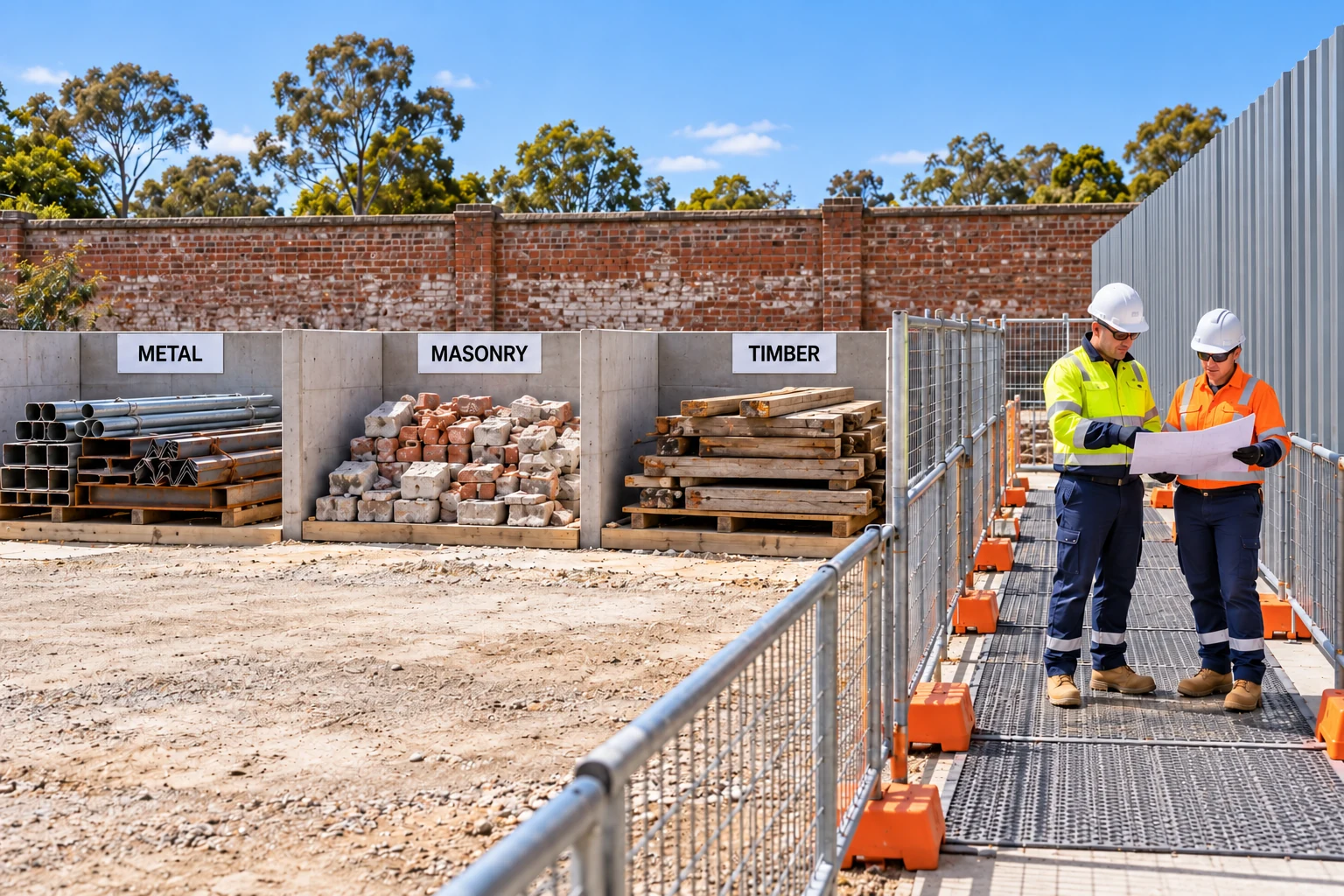
Material handling can affect access, dust, waste and retained work together. Review the arrangement as a whole.
Labels do not establish waste classification, contamination status, storage capacity or permission to reuse materials.
OnShift educational illustration, AI-generated and visually reviewed for this preview; not a project photograph.
- ISO · ISO 45001:2018 public overview
- SafeWork NSW · Demolition work Code of Practice
- SafeWork NSW · Designing Work to Manage Psychosocial Risks
The system needs commitments, responsibilities, resources, operating arrangements, checks and learning. A policy expresses direction. A procedure describes a repeatable process and its responsibilities. A project plan applies those arrangements to a particular job. A record captures what happened. Suppose the policy promises protected access, but procurement provides no suitable barriers and the programme leaves no installation time. The weakness is then in the system as well as the work area. Good supervision can identify that weakness, but cannot compensate indefinitely for missing business support.
Relationships between project documents
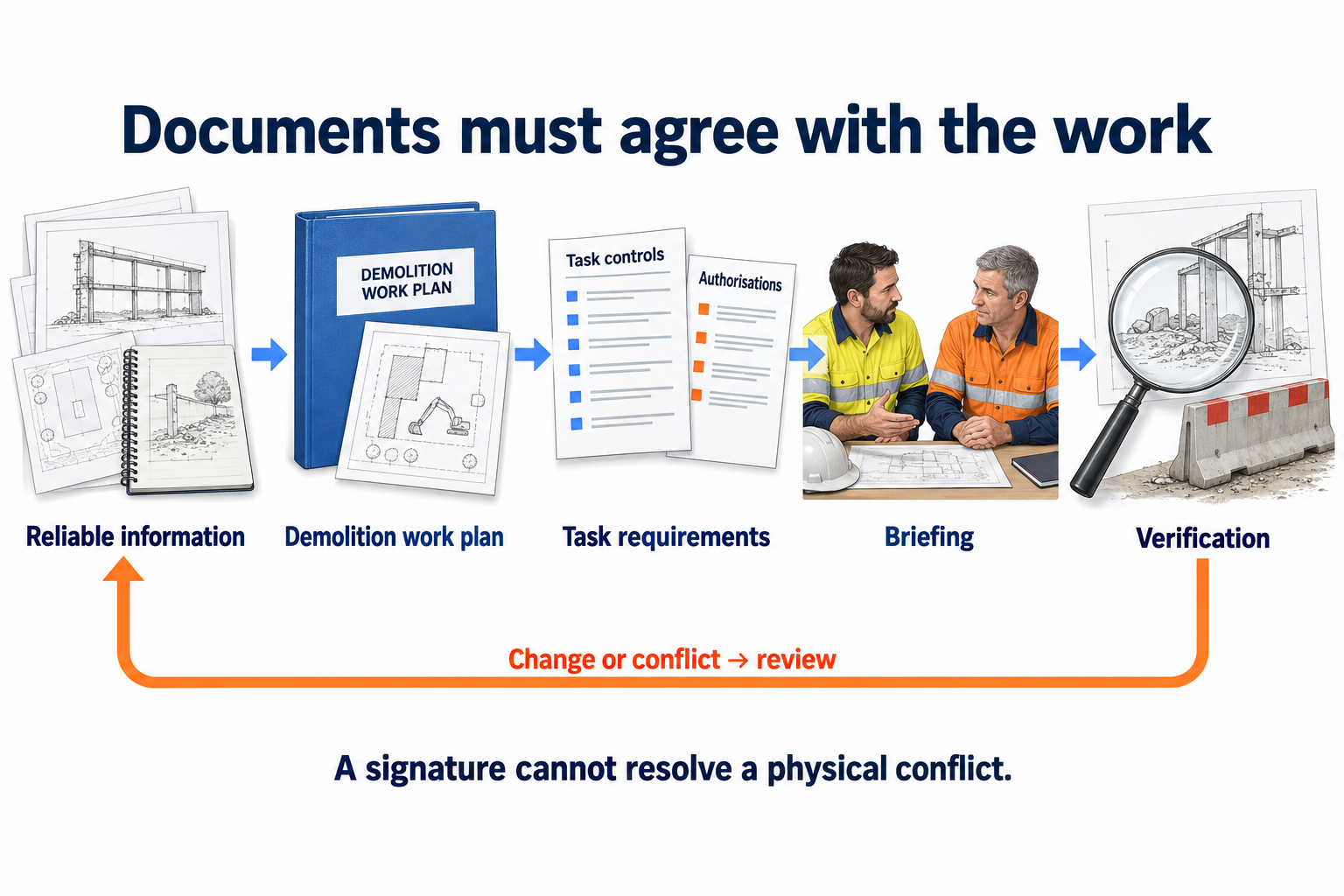
Site information connects planning, task controls, communication and verification.
 Open full-size illustration
Drawings, site observations, engineering information and hazardous-material findings establish the information used for planning. The demolition work plan coordinates the project; task controls and relevant authorisations address the work being undertaken. Briefings communicate the current arrangements, while verification establishes whether those arrangements have been implemented and remain effective.
A change or inconsistency requires the affected information and decisions to be reviewed. Documents must remain consistent with both one another and the physical conditions on site. A repeated signature cannot resolve a conflict between the plan and the work.
Company minimum standards
A company minimum standard describes the business's baseline expectations for a defined subject. A useful one identifies its purpose, scope, relevant authority, required controls, resources, responsible roles, verification and response to failure. It should also explain how project-specific requirements are added. The word minimum does not mean that a project may ignore stronger controls needed by its actual circumstances.
Read a hypothetical plant-interaction standard critically. Does it simply say people and machines must be separated, or does the system allocate responsibility for designing, establishing and maintaining that separation? Does it explain who checks it when the work area changes? Does it connect to delivery planning and visitor access? Does a defect trigger a defined response? The standard becomes useful when these responsibilities can be followed into real work.
Avoid copying another company's exceptions and numerical rules without understanding them. A restriction may reflect that company's equipment, incident history or approvals. Conversely, deleting a section because a specialist is subcontracted may remove coordination arrangements that the business still needs. Review applicability deliberately. Keep the reason for a changed requirement and the authority for the change.
Interpreting a control record
A control record for a material-transfer area needs to identify the activity, location, revision and intended use. These details establish whether the document applies to the work. Its supporting information and unresolved assumptions are equally important: changing a heading does not make an unrelated record applicable.
A hazard entry must explain the route to harm. Terms such as plant or debris identify a subject but not the exposure. The record needs to establish how movement or material could reach workers, visitors, neighbouring property or an environmental receptor. Deliveries and changing work areas can alter those pathways.
The control entry distinguishes measures that are proposed from those already implemented. It identifies how each measure reduces exposure, who establishes and maintains it, and what technical information it depends on. Exclusion distances and load limits require the relevant site-specific basis; they cannot be derived from a generic form.
Verification must address the condition being relied upon. A photograph may establish the location of a sign, but it cannot establish the capacity of a structural support. A signature may record acknowledgement without verifying the assumptions behind the arrangement.
If a delivery blocks the planned route, the review must address the changed movement and exposure. The revised arrangement must be communicated and obsolete instructions withdrawn from use. Traffic arrangements, the demolition work plan, relevant safe work method statements, emergency access and briefings must remain consistent. A permit authorises a defined activity under specified conditions; it does not replace unrelated technical confirmations.
Planning, implementation and review
Plan, do, check and act is a simple way to understand a management cycle. Plan means deciding what is needed and how success will be judged. Do means providing the resources and putting the arrangement into operation. Check means examining what actually happened. Act means using that information to correct and improve the system.
Consider repeated damage to a business's waste-container labels. Planning asks why identification matters, when labels are lost and how materials could be mixed. Doing might involve a reviewed identification arrangement, clear responsibilities and an explanation to the people using it. Checking compares container contents and records under actual work conditions. Acting may change procurement, placement or the identification method after the cause is understood. Buying the replacement does not establish whether it has solved the identification problem.
A weak cycle stops at do. It buys equipment, issues a procedure or runs a talk, then assumes success. A stronger cycle asks whether the change reduced the identified problem and whether it created another one. Feedback from workers matters because they encounter practical obstacles that an office review may miss. The business needs a way for that feedback to alter decisions.
Resources and procurement
Resources include more than people and machines. They include reliable information, specialist availability, suitable facilities, maintenance support, communication equipment, disposal capacity and time for checks. A programme that requires a specialist confirmation before work but books the specialist after the activity is due to start contains a contradiction. The supervisor should be able to expose that contradiction before it becomes pressure to bypass the dependency.
Procurement should communicate the actual duty the item or service must perform. A request for 'a barrier' gives less useful information than a defined need supported by the project's design and risk review. Selection needs to consider suitability, compatibility, serviceability, instructions and support. Price comparison is meaningful only between options that meet the required function. This principle also applies to subcontractors: a low rate does not establish the right capability, authority or availability.
Look at indirect consequences. A replacement machine may alter access needs, loads, emissions, visibility and the operator's information. A different waste destination may change classification checks and transport arrangements. A compressed schedule may increase simultaneous work and fatigue. Treat these as system changes, not merely purchasing decisions. The HSEQ system should ensure the affected people review them before the new arrangement is relied on. An administrative substitution can create a physical change on site.
Activity, condition and outcome measures
Measures can describe activity, condition or outcome. The number of toolbox talks describes activity. The proportion of critical-control checks with unresolved defects describes a condition requiring attention. An injury rate describes an outcome, with important limitations. None should be interpreted without asking how the information was collected and what it represents. A quiet reporting system may indicate few problems, or it may indicate that people do not report them.
Imagine a business celebrating that every corrective action is closed. Examination shows that closure means an email was sent, not that the physical problem was resolved. The measure rewards administrative completion while concealing recurrence. A more useful approach records the action, the evidence of implementation and a later check of effectiveness where appropriate. Repeated defects should trigger questions about planning, procurement or work design, not just repeated reminders.
Management review brings these patterns to people who can change resources and priorities. Supervisors contribute factual examples and explain the consequences of unresolved constraints. Workers contribute experience of the actual arrangements. The review should produce decisions with owners and follow-up, not simply endorse the last report. An orderly set of records or a month without injury does not establish whether the underlying controls are working.