
Roles, responsibilities, authority and escalation
Shared duties and role limits require clear task allocation, resources and routes for unresolved decisions.
Roles, authority and shared duties
A role describes a person's function. A responsibility describes what that person is expected to do. Authority describes decisions the person may make. Capability concerns whether the person has the knowledge, skills and resources for the function. These should fit together. Giving someone responsibility for a control without time, information or authority to act creates a predictable weakness.
Under the work health and safety framework, a person conducting a business or undertaking is commonly called a PCBU. Duties can be shared by businesses involved in the same work. Contracting a task to another organisation does not simply erase the original business's responsibilities. The parties need to understand their own duties and coordinate matters they influence or control. Officers have a due-diligence duty; workers have duties including reasonable care and following reasonable safety instructions. A job title alone does not determine every legal obligation.
For example, the hire company may maintain equipment, the demolition contractor may select its application and the site team may control access around it. Each can affect the same risk. An organisation chart showing separate boxes is not enough. The useful question is who supplies which information, who acts on defects and who confirms that the combined arrangement is suitable. The answer needs to work when a fault appears, not only when the contract is signed.
The supervisor's decision authority
A supervisor connects the plan with the work party. That includes explaining the intended stage, checking prerequisites, allocating tasks within capability, coordinating interfaces, observing performance and responding to change. It also includes giving management reliable information about constraints. Supervision is not simply being present while work happens, and it is not unlimited technical authority.
The supervisor may be authorised to stop an affected activity, isolate defective equipment from use through the workplace process and arrange a replacement. That does not automatically allow the supervisor to redesign the work method, alter temporary works or approve electrical isolation. The decision space should be explicit: what may be decided locally, what needs a specialist, what needs management approval and what requires a statutory authorisation.
SafeWork NSW's current named-supervisor guidance requires on-site supervision whenever licensed demolition work takes place. The supervisor must be approved and named for the demolition licence. Being available by telephone is not on-site supervision. If that supervisor must leave, the licence holder needs another appropriately approved named supervisor for that licence on site, with a handover that maintains supervision. If no such replacement is present, the affected licensed work cannot continue: stop it through the established safe process and maintain necessary controls.
An ordinary roster substitution or the most senior worker's availability does not establish approval for this regulated role. The role description must also identify who is authorised to act when a permit issuer or another key person is unavailable. An escalation route needs an authorised alternative or a clear boundary on work that cannot proceed.
Specialist scope and shared assumptions
Specialists contribute defined expertise. Structural advisers examine structural questions within their engagement. Service specialists address the systems for which they are competent and authorised. Occupational hygienists assess exposure questions. Environmental specialists may address waste classification, contamination or water matters. Licensed workers and operators perform activities within their required authorisations and training. Their advice needs to be connected, not treated as a collection of unrelated certificates.
Consider a fictional work area where equipment selection depends on both ground conditions and access. A manufacturer's document may describe the equipment, while an engineering review addresses the supporting surface. Neither alone necessarily confirms the entire arrangement. The project team must identify the interface and ensure the assumptions agree. A report's exclusions are therefore as important as its conclusions.
Ask a specialist question with enough context to be answerable. State the location, proposed activity, current information, observed discrepancy and decision that is being held. An instruction such as 'please confirm safe' invites an unhelpfully broad answer. A bounded question makes the responsibility clearer. When advice arrives, check its scope, conditions, revision and unresolved items. Do not remove those qualifications when briefing the crew. A shortened message must preserve the limits on which the advice depends.
Referral and unresolved decisions
Escalation means directing a matter beyond the current person's authority or capability to someone who can resolve it. A useful escalation states the facts, immediate protective action, affected work, missing decision and urgency. It distinguishes what has been observed from what is suspected. That structure helps the recipient understand the consequence of delay without exaggerating the claim.
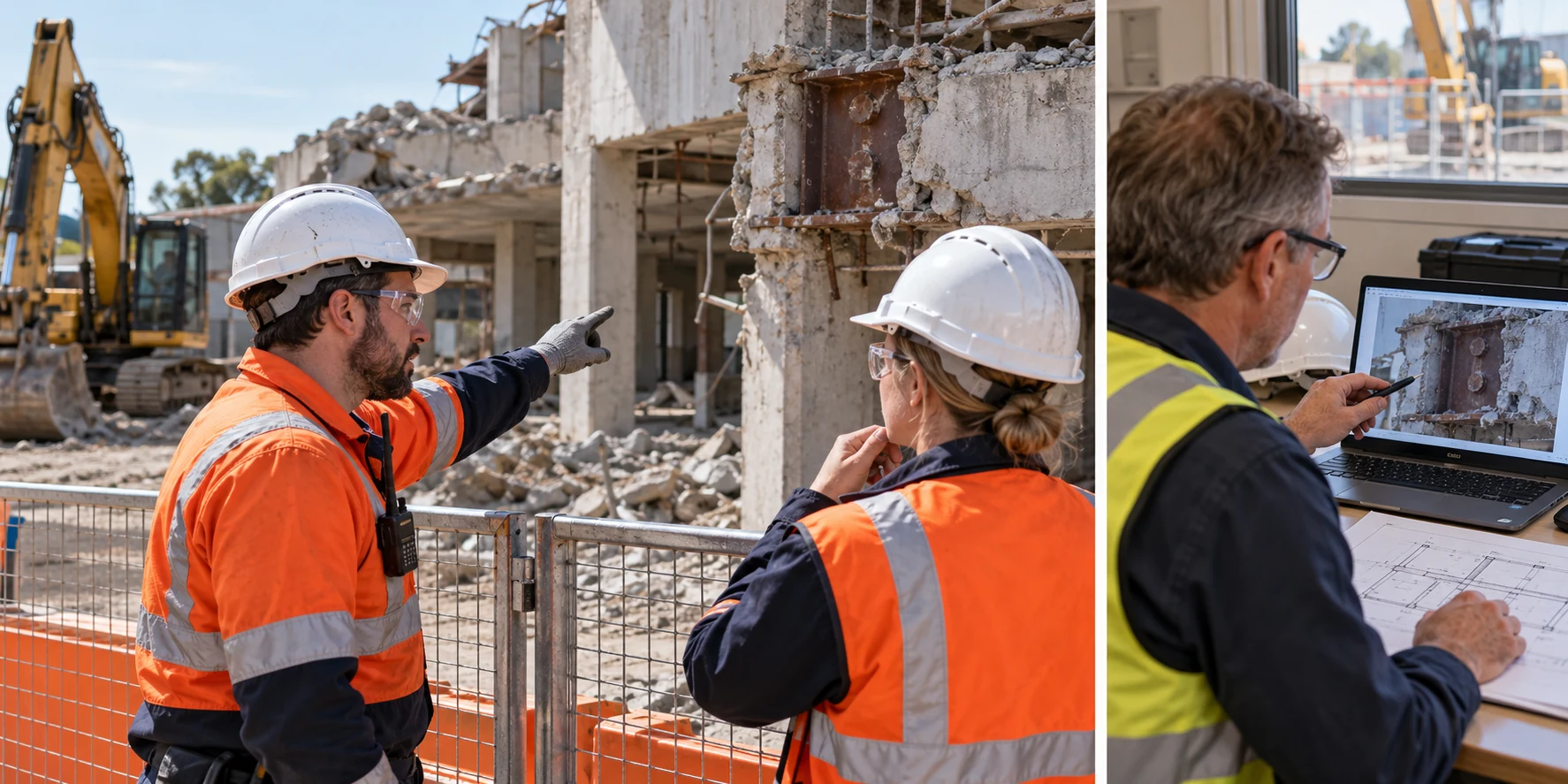
State what was observed, which work is affected and what decision is still needed. A photograph can help the specialist locate the concern.
The scene does not establish structural adequacy or depict a restart approval.
OnShift educational illustration, AI-generated and visually reviewed for this preview; not a project photograph.
Open full-size illustrationImagine a delivery arrangement that no longer matches the approved access plan. The supervisor reports where the conflict occurs, which activities are affected and what temporary restrictions are in place. The coordination team can then consider traffic, emergency access, neighbouring work and programme effects. Reporting only 'delivery problem' leaves the recipient to reconstruct the issue. Reporting 'all resolved' before the revised arrangement is verified conceals it.
Escalation is not complete when a message is sent. Confirm that the responsible person received the concern, understands the decision needed and knows which work remains held. Keep a record of the response and communicate it to affected people. If the response does not address the actual dependency, the issue remains open. A commercial instruction to recover time cannot substitute for the missing technical or safety decision. The system needs a route for unresolved conflicts, including concerns involving the immediate supervisor.
Resources, accountability and leadership
Accountability becomes practical when an action has an owner, a due point, the resources to act and a way to check the result. Assigning an action to 'the team' can leave everyone assuming someone else is doing it. Naming a person does not solve the problem if they cannot obtain the required information or equipment. Management must support the responsibility it allocates.
Leadership is visible in everyday responses. When a worker reports a fault, does the business investigate and explain the outcome, or pressure the worker to continue? When two contractors disagree, does the supervisor examine the interface or simply choose the louder voice? A respectful response encourages early information. It does not mean accepting every suggestion or avoiding difficult decisions. Explain the basis for a decision and keep safety boundaries intact.
Due diligence at officer level includes obtaining knowledge, understanding risks, providing resources and processes, responding to information and verifying that arrangements are used. A supervisor can support that process with accurate reporting but does not absorb the officer's duty by completing a checklist. Likewise, a health and safety adviser supports the business; their appointment does not transfer all responsibility to the safety department.