
Plant, people and exclusion zones
Plant suitability depends on the machine, task, supporting surface and surrounding work. Separation and reliable communication protect people throughout its operating space.
Plant suitability
Plant is the machinery and equipment used to carry out work. Suitability means more than being able to apply enough force. The machine, attachment, supporting surface, work area, material, access, environmental controls and operator capability must fit together. A plant item that performed well on an open site may be unsuitable beside an occupied building or over uncertain ground.
Separate capacity from permission. A manufacturer's rating describes performance under specified conditions. It is not approval to operate in every configuration or location. Attachments can change weight, reach, visibility and loading. The manufacturer's information and relevant technical review must address the actual combination. A supplier's informal assurance should not replace those references.
A larger machine may work from farther away, while a smaller machine may fit a restricted entrance. Neither is automatically safer. The first may require more support capacity and space; the second may put work or people closer to hazards. Compare the complete work systems, including delivery, setup, operation, servicing and removal.
A good selection record explains the proposed task, applicable limitations, supporting information and unresolved conditions. It can show why a particular attachment or access arrangement is needed alongside the manufacturer's operating information. If the selected plant is unavailable, substitution is a planning change. Matching a general machine category does not establish equivalent dimensions, behaviour or protective features.
Interpreting a control record
A control record for a material-transfer area needs to identify the activity, location, revision and intended use. These details establish whether the document applies to the work. Its supporting information and unresolved assumptions are equally important: changing a heading does not make an unrelated record applicable.
A hazard entry must explain the route to harm. Terms such as plant or debris identify a subject but not the exposure. The record needs to establish how movement or material could reach workers, visitors, neighbouring property or an environmental receptor. Deliveries and changing work areas can alter those pathways.
The control entry distinguishes measures that are proposed from those already implemented. It identifies how each measure reduces exposure, who establishes and maintains it, and what technical information it depends on. Exclusion distances and load limits require the relevant site-specific basis; they cannot be derived from a generic form.
Verification must address the condition being relied upon. A photograph may establish the location of a sign, but it cannot establish the capacity of a structural support. A signature may record acknowledgement without verifying the assumptions behind the arrangement.
If a delivery blocks the planned route, the review must address the changed movement and exposure. The revised arrangement must be communicated and obsolete instructions withdrawn from use. Traffic arrangements, the demolition work plan, relevant safe work method statements, emergency access and briefings must remain consistent. A permit authorises a defined activity under specified conditions; it does not replace unrelated technical confirmations.
Plant, people and public interfaces
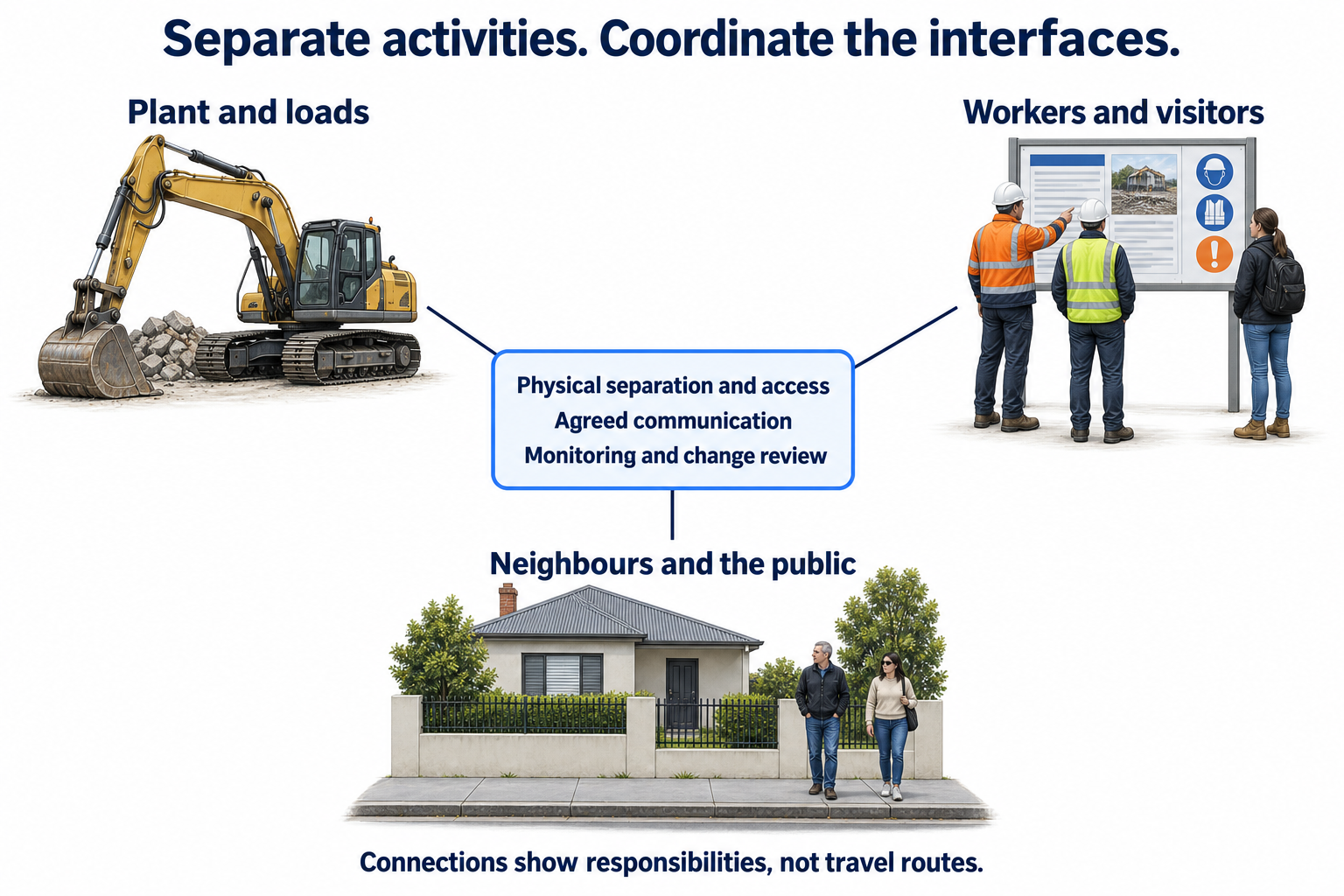
Separation depends on coordinated physical controls, access arrangements and communication.
 Open full-size illustration
Plant and loads, workers and visitors, and neighbouring properties and the public create interacting demands on a demolition site. The three groups in the diagram connect to shared controls: physical separation, access rules, communication, monitoring and review of changes. The lines represent these relationships, not movement routes.
The arrangement must also preserve emergency and authorised access. Its design depends on the work, plant, material behaviour, surrounding uses and relevant technical information. A boundary on a drawing does not itself provide a barrier, contain flying debris, verify ground capacity or protect an adjoining structure.
Deliveries, loading operations, changed pedestrian routes and open gates can create new connections between previously separated activities. Responsibility for access and communication must be clear. A sign or a spotter alone cannot establish that every exposure has been controlled.
The plant work envelope
The work envelope is the space that plant, its attachment and its load may occupy during the planned activity. A parked outline hides slewing, articulation, travel, reversing and changing attachment positions. Material being handled can extend beyond the machine and can move differently if its shape or support changes. People need separation from the hazardous operating space, not just from the tracks or tyres.
Visibility is also dynamic. A person visible at the front may disappear behind an attachment or load. Mirrors and cameras have coverage limits, and dust, glare, rain or darkness can reduce their usefulness. High-visibility clothing improves conspicuity in some conditions but does not create a line of sight through a solid object.
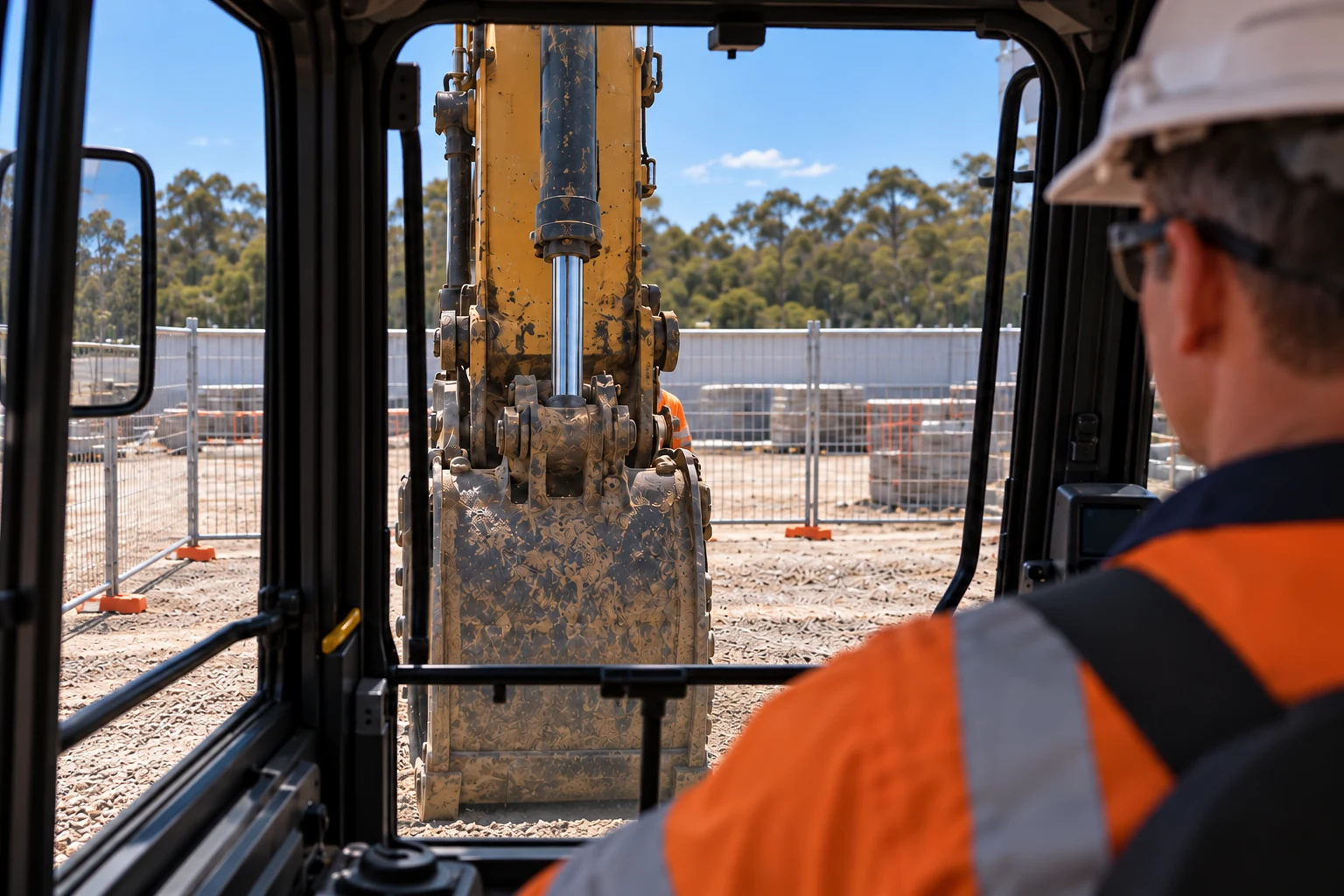
An attachment can block the operator's sightline. Use the agreed waiting and communication arrangements.
This illustrates obstructed visibility, not a safe waiting position, machine-specific blind-spot map or exclusion distance.
OnShift educational illustration, AI-generated and visually reviewed for this preview; not a project photograph.
Open full-size illustrationA delivery driver may walk towards a machine to ask where to unload. The driver may believe the operator has seen them because the cab faces their direction. The operator may be looking at another part of the task. A planned communication and access arrangement should remove the need for this approach. The workplace should tell the driver where to wait and how to request assistance without entering the operating area.
Exclusion-zone dimensions and protective arrangements depend on the assessed work. The zone must account for movement, material hazards, visibility and surrounding people, and requires review when those conditions change.
Track footprint and occupied space
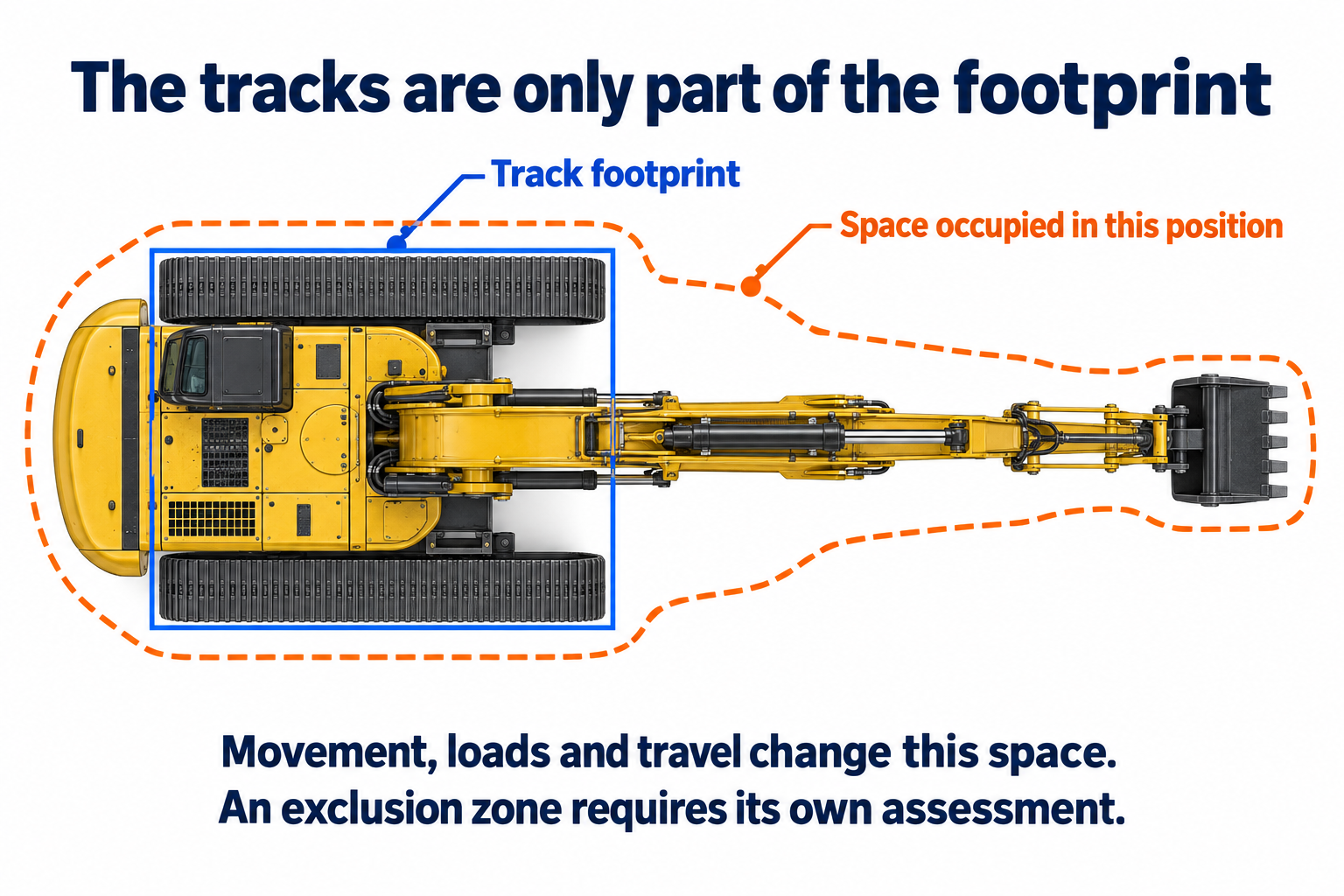
The space occupied by plant extends beyond its tracks and changes with its configuration and activity.
 Open full-size illustration
The blue rectangle identifies the track footprint. The orange outline follows the space occupied by the machine in the illustrated position, including the upper carriage, arm and bucket. Neither outline represents the space needed for every possible movement.
Slewing, articulation, travel, attachments and loads change the occupied space. Material can extend beyond the machine or move unexpectedly. The work envelope therefore needs to be understood for the planned activity, using the actual machine, configuration and surrounding conditions.
An exclusion zone is a separate control decision. It must account for the relevant movement, material hazards, visibility and people. The illustration provides no dimensions, manufacturer operating limit or recommended separation distance.
Separation in the site layout
Separation works best when the layout reduces opportunities for people and moving plant to meet. Locate pedestrian routes, offices, amenities and waiting areas with their actual users in mind. A route that ends at a loading area or requires workers to cross a reversing path has transferred the problem rather than solved it.
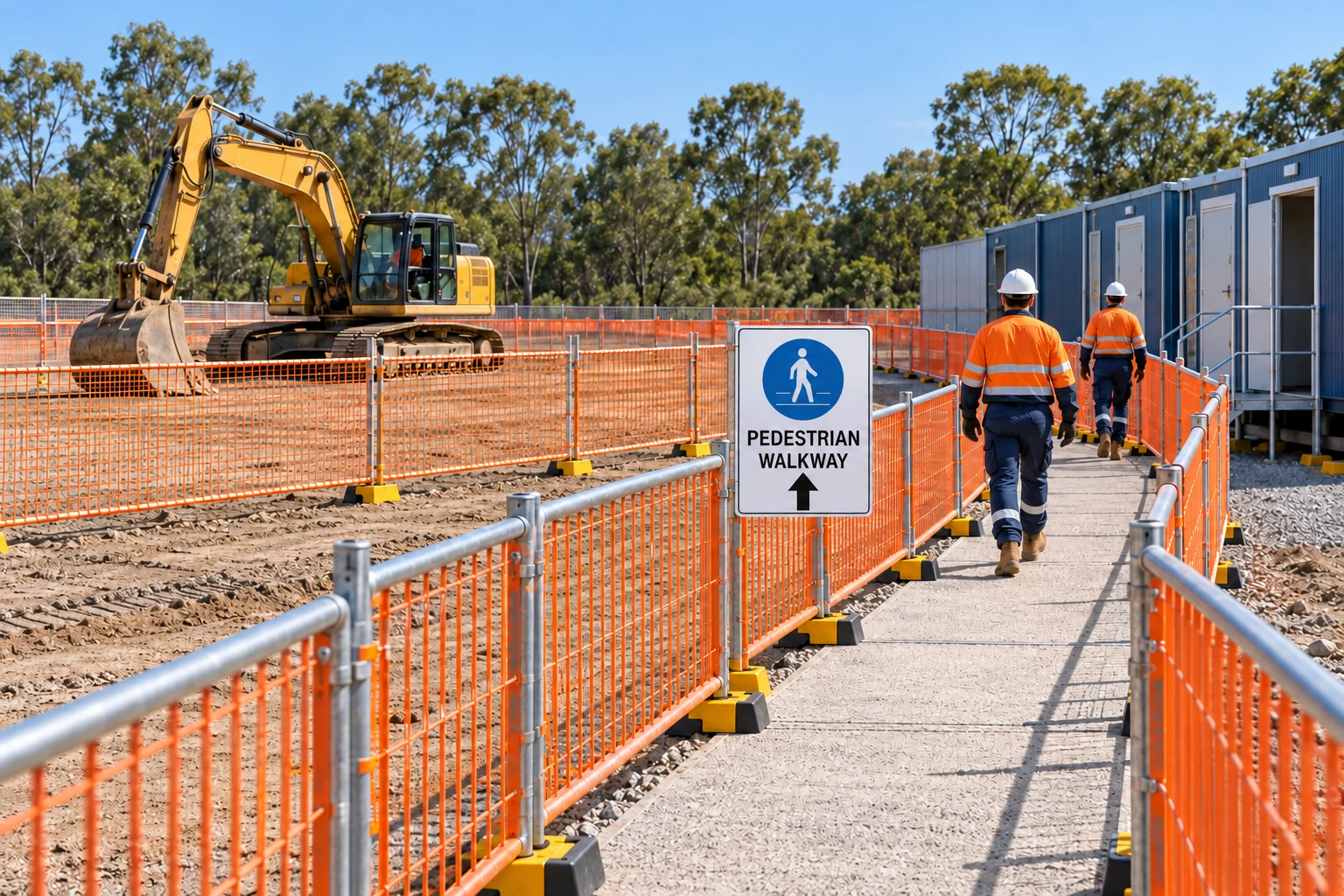
A pedestrian route needs to reach its destination without depositing people in a plant operating area.
The barriers delineate pedestrian access; no vehicle-impact rating or complete traffic-plan approval is implied.
OnShift educational illustration, AI-generated and visually reviewed for this preview; not a project photograph.
Open full-size illustrationPhysical barriers, controlled crossings and access restrictions serve different purposes. A barrier must be suitable for its intended function; light pedestrian delineation should not be described as vehicle-impact protection. A crossing needs clear arrangements for when it can be used and who controls the conflicting movement. Signs support those arrangements but cannot compensate for an unworkable layout.
A temporary change can undo separation. A stockpile may narrow the walkway, a parked vehicle may block sightlines, or a new delivery route may intersect emergency access. Ask how people will actually reach their destinations after the change. Predictable shortcuts are evidence that the layout needs attention, not simply that another warning should be issued.
The public interface also matters. Visitors may not know the site rules, and children or people with reduced mobility cannot be assumed to interpret plant signals. Keep visitor arrival and assistance arrangements clear. If the site cannot provide the planned separation during an activity, review and control that activity and access. Do not rely on every person noticing the hazard in time.
Roles and communication
Operators, spotters, traffic controllers and supervisors do not have interchangeable roles. Each needs the capability, authority, position and information required for the assigned function. A person nominated as a spotter cannot provide effective observation if another simultaneous task occupies their attention or takes them away from the agreed location.
Safety-critical communication should identify the intended recipient, convey an unambiguous message and obtain confirmation. The agreed response to lost communication matters just as much as the normal signal. Silence is not permission. Conflicting directions are not resolved by selecting the loudest voice. The planned safe interruption and re-establishment of communication must be understood before the activity.
Consider a radio message about a vehicle entering a work area. The recipient needs to know which area, which vehicle and what movement is proposed. A brief response can confirm the meaning rather than merely indicate that some sound was heard. In noisy conditions, the chosen system must remain usable alongside required hearing protection.
Pre-start discussions should connect these arrangements to the current layout, not just repeat general rules. Ask people to explain where they remain, whom they contact and what they do if conditions differ. This checks understanding without staging a hazardous demonstration. Consultation can reveal a blocked sightline or an impractical waiting position before work begins. Record resulting changes so that the next crew receives the same operating picture.
Cranes, concrete pumping and panel interfaces
Cranes lift and position suspended loads. The hazard is not confined to the machine. A load can swing, fall or crush people against another object, while inadequate support can destabilise the crane itself. Capacity depends on the actual configuration and operating radius, not simply the largest number on the crane's description. The supervision interface connects reliable load information, the proposed lift arrangement, ground and underground-service information, and the crane provider's limitations. A load chart answers a capacity question for stated conditions; a lift plan coordinates the particular operation. Neither replaces the other.
Dogging and rigging are related but distinct specialist functions. Dogging includes selecting and inspecting lifting gear, applying slinging techniques and directing a crane or hoist operator when the load is outside the operator's view. Rigging involves mechanical load-shifting arrangements used to place or secure loads and maintain the stability of structural members, as well as specified crane or hoist erection and dismantling work. The supervisor coordinates these people with the operator and affected crews, including who communicates and what happens if communication is lost. Verify the licence class against the actual work; a generic statement that someone has a rigging ticket does not establish authority for every rigging task.
Concrete pumping delivers fresh concrete through a pressurised pipeline, sometimes supported by a placing boom. It may occur beside demolition or as part of associated construction and temporary works. Pressure creates a different hazard from an ordinary delivery. Failed components can release concrete suddenly. Hose whip is rapid, uncontrolled movement of a flexible delivery hose. Boom movement, overhead electricity, supporting-ground failure and arriving concrete trucks add interacting risks. The supervisor needs the pumping contractor's task documentation, manufacturer limitations and inspection records, coordinated with positioning, access, exclusion and washout arrangements. A pump inspection record does not establish that the chosen site position can support it. Blockage clearing and pressure release require specialist procedures.
Tilt-up construction places concrete panels into their building position by lifting them. Precast panel work similarly involves elements whose lifting and temporary support conditions differ from their final structural role. A panel standing upright is not necessarily stable. During construction, the erection design addresses lifting loads and the temporarily braced condition as well as the completed structure. Panel identification, relevant drawings, concrete-strength information where applicable and documented support requirements must agree. At a demolition interface, old lifting points, connections and restraints need current technical investigation. Their presence is not evidence that they may be reused or removed.
These activities share a coordination problem without sharing one operating method. A brace may occupy a proposed access route, a pump truck may obstruct the crane's planned area, or overhead lifting may conflict with scaffold work. Resolve the overlapping space, timing and release conditions with the relevant specialists before the conflict reaches the workface. The supervisor preserves the agreed boundaries and recognises changes. A programme instruction cannot redesign a brace, increase a crane rating or authorise an improvised lifting arrangement.
Interpreting a control record
A control record for a material-transfer area needs to identify the activity, location, revision and intended use. These details establish whether the document applies to the work. Its supporting information and unresolved assumptions are equally important: changing a heading does not make an unrelated record applicable.
A hazard entry must explain the route to harm. Terms such as plant or debris identify a subject but not the exposure. The record needs to establish how movement or material could reach workers, visitors, neighbouring property or an environmental receptor. Deliveries and changing work areas can alter those pathways.
The control entry distinguishes measures that are proposed from those already implemented. It identifies how each measure reduces exposure, who establishes and maintains it, and what technical information it depends on. Exclusion distances and load limits require the relevant site-specific basis; they cannot be derived from a generic form.
Verification must address the condition being relied upon. A photograph may establish the location of a sign, but it cannot establish the capacity of a structural support. A signature may record acknowledgement without verifying the assumptions behind the arrangement.
If a delivery blocks the planned route, the review must address the changed movement and exposure. The revised arrangement must be communicated and obsolete instructions withdrawn from use. Traffic arrangements, the demolition work plan, relevant safe work method statements, emergency access and briefings must remain consistent. A permit authorises a defined activity under specified conditions; it does not replace unrelated technical confirmations.
Plant and site condition through the shift
Plant condition and operating conditions can change during the day. Pre-start information, maintenance status and defect reporting establish part of the picture. They do not remove the need to respond to a damaged guard, leaking system, unusual movement or changing ground. Defects need an identified response and release process; a note in the diary does not repair the machine.
Ground and access routes deserve attention after rain, material removal and repeated traffic. A surface may look similar while its support or traction has changed. The appropriate technical and operational arrangements must address the actual ground, including buried voids and services. Do not infer support capacity from the fact that a lighter vehicle passed earlier.
Servicing and clearing obstructions introduce different hazards from normal operation. People may approach areas normally kept clear, and stored energy may remain after the plant stops. These tasks require their own authorised procedures and isolation arrangements. Production pressure does not justify an improvised intervention inside the work envelope.