
Scope, specifications and site information
Project scope defines what changes and what remains. Specifications, drawings, investigations and authorised decisions establish the information on which planning depends.
Removal scope and retained assets
Scope describes the work included in the project and the boundaries around it. A phrase such as remove the building is rarely enough for planning. Foundations, tanks, shared walls, buried services, vegetation, retained finishes and the final ground condition may need separate decisions. A missing scope decision can become a safety, cost and programme problem at the same time.
Read the boundary in three dimensions. Removal at one level does not automatically include the structure below it or a connection through a neighbouring wall. Retained assets may depend on parts of the structure being removed. The scope must therefore connect the client's intended outcome with the technical and site information needed to achieve it.
Distinguish an inclusion, an exclusion and an unresolved item. An inclusion identifies agreed work. An exclusion identifies work outside that agreement. An unresolved item identifies a decision still needed. Treating an unresolved item as an exclusion without agreement can leave an unsafe or unusable handover; treating it as included can create unauthorised work.
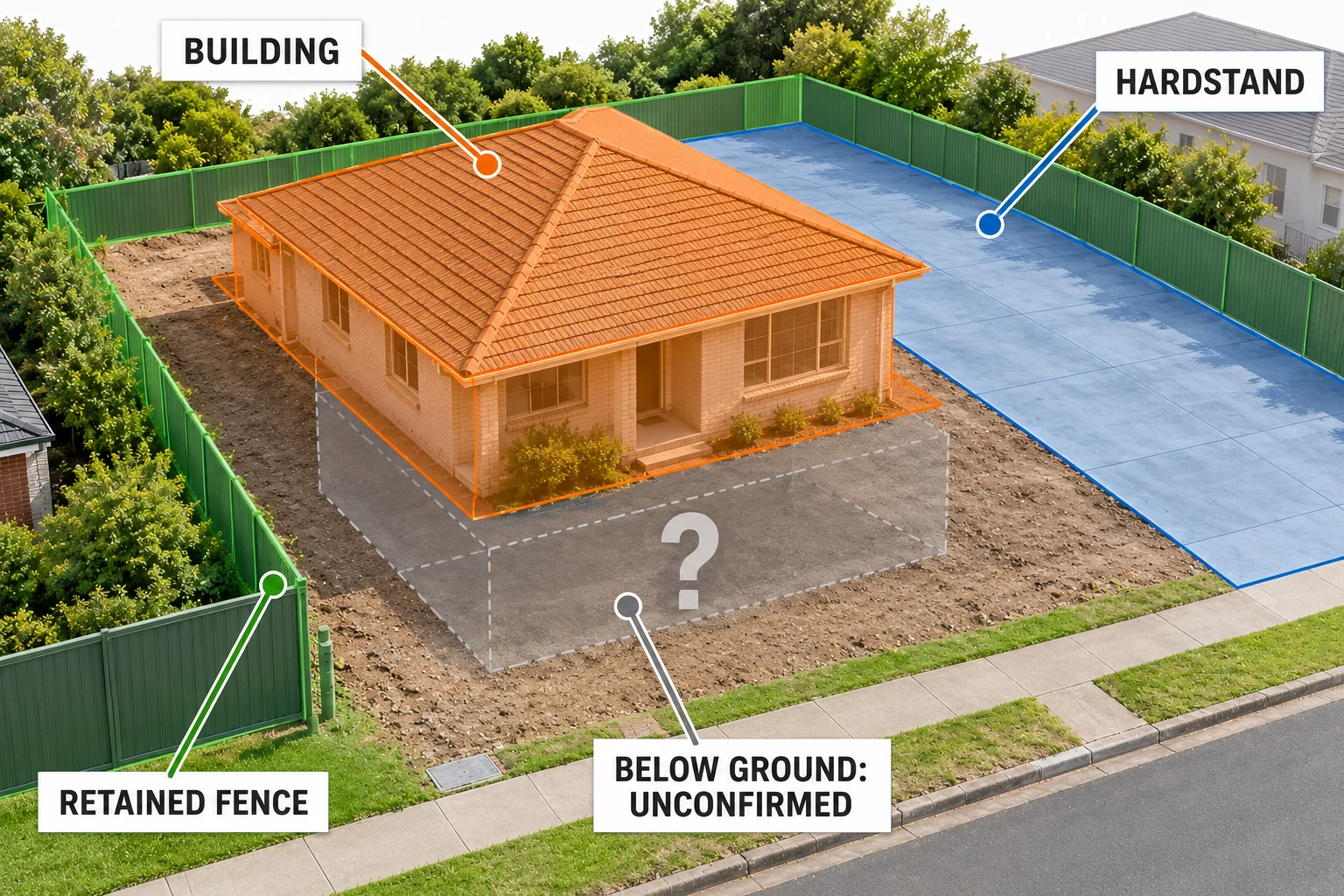
Ask what is included, what must remain and what still needs an authorised decision. Missing detail is not permission to assume.
Generic scope illustration, not a project survey or demolition plan. The below-ground volume does not locate actual footings or services.
OnShift educational illustration, AI-generated and visually reviewed for this preview; not a project photograph.
Open full-size illustrationA scope schedule says remove floor finishes while a drawing highlights the entire floor zone. The ambiguity matters because removing finishes differs from removing the structural floor. Record both references and obtain an authorised interpretation before the affected activity. Document precedence depends on the contract and the relevant technical authority; it cannot be assumed from document type alone.
The functions of project documents
Project documents perform different jobs. Drawings communicate geometry and relationships within their stated scope. Specifications describe required materials, performance, workmanship and finishes. Engineering reports address assessed technical questions. Surveys record investigated conditions. Contracts allocate obligations and commercial processes. Plans coordinate how the work will be managed.
A source document provides information or a requirement. A control document translates relevant information into arrangements for work. A record describes what happened or was checked. The same project may need all three. For example, a service drawing informs an isolation plan, and an isolation record provides evidence that authorised work occurred. Copying the drawing into the plan does not produce the isolation evidence.
A drawing labelled as built can still omit later alterations. An engineering report can be current but limited to a particular inspection area. A specification can require a condition without explaining the safe method of achieving it. Read the purpose, author, date, revision, status and limitations before extending a document's conclusion.
Information feeds into the coordinated plan and task instructions, followed by evidence of implementation and review. Each link has a different purpose. A full folder does not prove that its documents agree with one another or with the site.
The four teaching cases give these document functions a practical setting. Banksia House is a fictional residential project. Riverbend Fabrication Hall is a fictional industrial project. Their R04 drawings and initial construction records supply exercise facts, not measured conditions at a real building. Riverbend is not an as-built account of 27 Frank Street.
Cronulla uses the supplied information for 67 Gerrale Street alongside separately labelled simulated construction records. Cardwell uses a Queensland former fuel-site packet, also supplemented by labelled exercise records. In both cases, an original source, a client report and a simulated statement have different evidential roles. A plausible illustration does not turn one into another.
Before studying a case, identify the source family. A site plan locates features; a section explains a vertical relationship; a report describes what was investigated. A photograph records visible appearance at a particular moment. Read the document title, issue, legend and scope, then ask which decision that document can inform. Keep the original source separate from any notes or proposed controls you add.
Different records answer different questions
LEARNING AID A generic learning aid explains a principle. It does not establish a project fact, hidden condition, capacity, approval or work release.
 Open full-size illustration
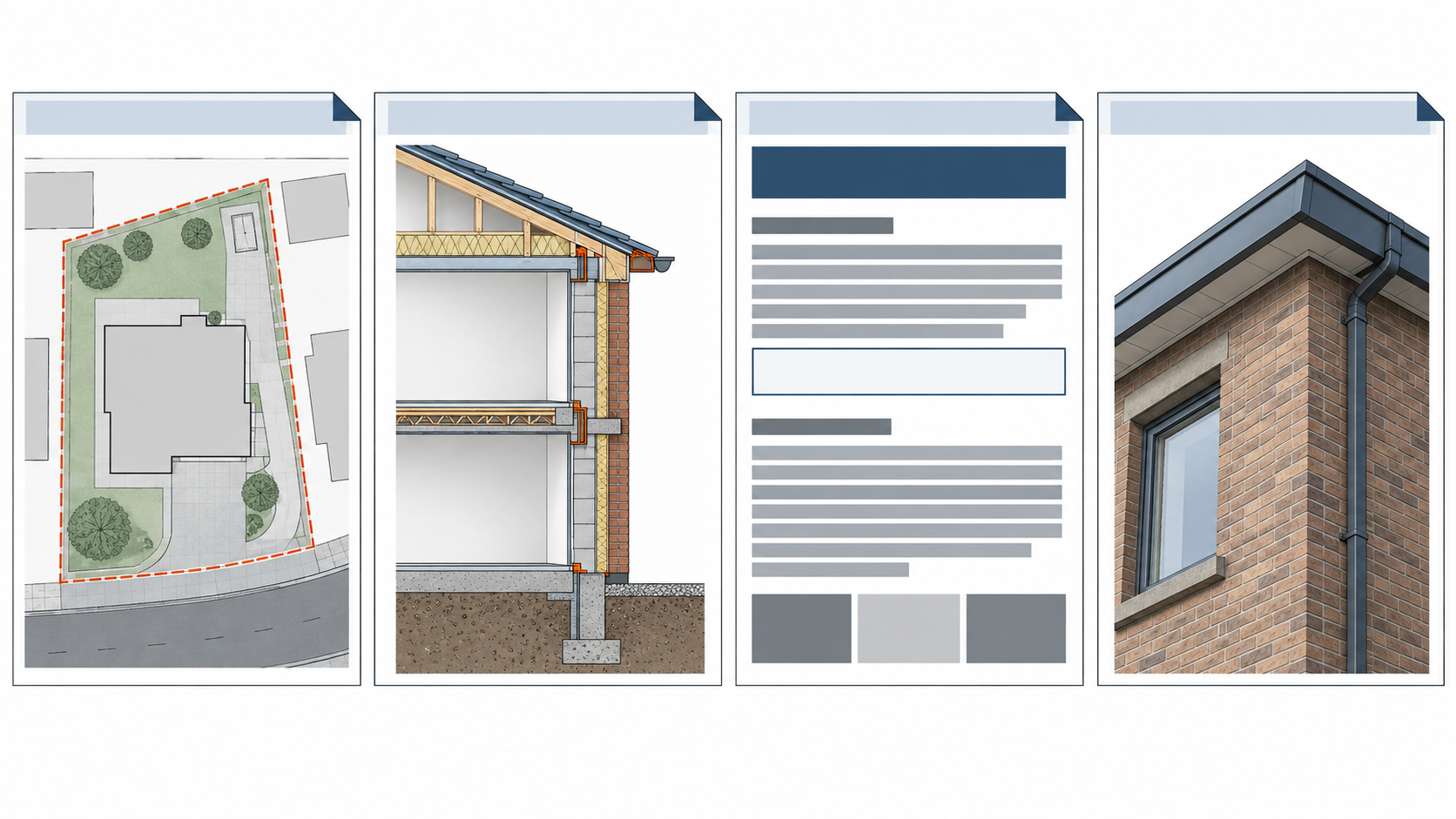
Four anonymous record types, left to right: site plan, section, report and exterior photograph. Each answers a different question. Check its purpose, issue and limits before using it; the picture does not rank their authority.
A generic learning aid explains a principle. It does not establish a project fact, hidden condition, capacity, approval or work release.
This visual is draft case-study teaching material. Reading it is not an inspection, a measurement or evidence of performance.
Specifications and technical design
A specification can describe what must remain after the work. Examples include a protected surface, a retained connection, a finished level, a cleanliness condition or an inspection requirement. It may define tolerances, meaning permitted variation from a stated requirement. A tolerance is not permission to leave a structural hazard or damage a neighbouring asset.
Check whether a dimension is nominal, measured or required at handover. Check whether the specification refers to an existing or proposed condition. A finished level can differ from the structural level below it. A material description can identify a product without establishing its current condition or hazardous constituents. Small language differences can change the planning question.
A specification may refer to an Australian Standard, including AS 2601 for demolition. The title alone does not provide its requirements. Decisions that depend on the standard need access to the applicable authorised content; general regulator guidance cannot supply an unverified clause requirement.
A requirement to protect a retained facade and leave an agreed interface describes an outcome. It does not choose the supporting arrangement, removal sequence or inspection criteria on its own. The work plan must draw on the necessary engineering and other inputs. Keeping outcome, technical design and operating arrangement separate prevents an apparently simple contractual sentence from becoming an unsupported demolition instruction.
Interpreting a control record
A control record for a material-transfer area needs to identify the activity, location, revision and intended use. These details establish whether the document applies to the work. Its supporting information and unresolved assumptions are equally important: changing a heading does not make an unrelated record applicable.
A hazard entry must explain the route to harm. Terms such as plant or debris identify a subject but not the exposure. The record needs to establish how movement or material could reach workers, visitors, neighbouring property or an environmental receptor. Deliveries and changing work areas can alter those pathways.
The control entry distinguishes measures that are proposed from those already implemented. It identifies how each measure reduces exposure, who establishes and maintains it, and what technical information it depends on. Exclusion distances and load limits require the relevant site-specific basis; they cannot be derived from a generic form.
Verification must address the condition being relied upon. A photograph may establish the location of a sign, but it cannot establish the capacity of a structural support. A signature may record acknowledgement without verifying the assumptions behind the arrangement.
If a delivery blocks the planned route, the review must address the changed movement and exposure. The revised arrangement must be communicated and obsolete instructions withdrawn from use. Traffic arrangements, the demolition work plan, relevant safe work method statements, emergency access and briefings must remain consistent. A permit authorises a defined activity under specified conditions; it does not replace unrelated technical confirmations.
Facts, assumptions and unknowns
A fact should have a defensible source. An assumption is a proposition used provisionally for planning. An unknown is information not yet established. These categories help a team work honestly with incomplete information without allowing uncertainty to disappear as documents are copied.
A surveyed dimension has a different basis from a visual estimate. A service marked isolated in an old drawing has a different basis from a current work-specific isolation record. An inaccessible area remains unknown even when adjacent areas have been investigated. Repeating an assumption in a programme, work plan and briefing does not turn it into a verified fact.
An information register can identify the item, source reference, status, responsible person, required response date and affected activity. The important connection is between the missing information and the work that depends on it. A list of unanswered questions is less useful if nobody can tell which questions hold the next stage.
An estimated slab thickness is used to prepare a preliminary waste allowance. That may be a reasonable labelled estimate for early logistics. It must not silently become a verified structural dimension or a final mass for a lifting decision. Record the intended use and uncertainty of the estimate. The same information may be adequate for one planning purpose and inadequate for another, depending on the consequences of error.
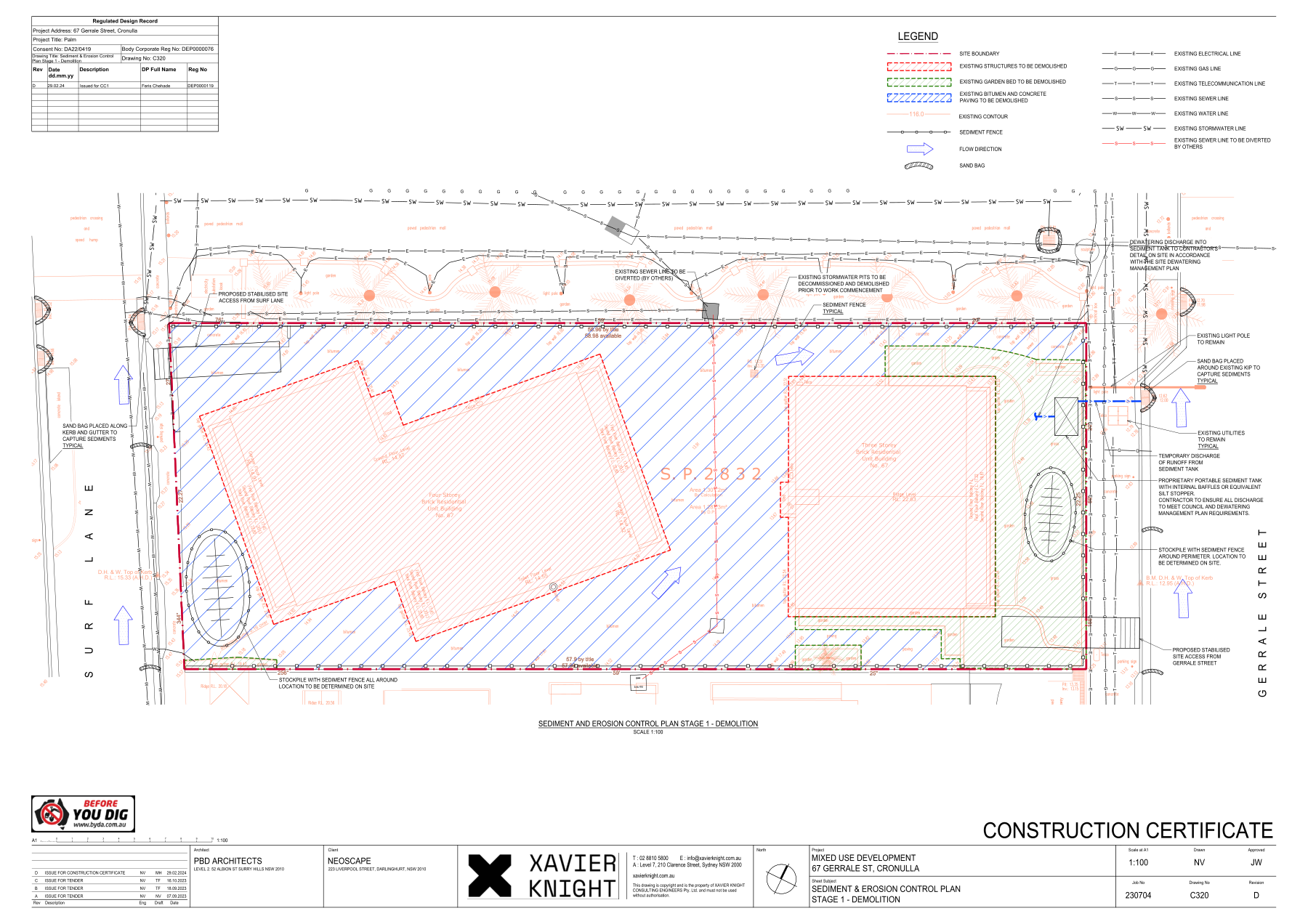
For Cronulla, begin with drawing C320, revision D, on PDF viewer page 10 of the supplied plans. The source index identifies C321 on page 11 as excavation information and C350 on page 12 as controls. Compare them with the cover and their own notes. Different stages can appear in one combined PDF. Proposed excavation or basement works do not establish a basement in the building being demolished.
The client reports that the existing building had no basement and used monolithic strip footings. That report identifies a foundation type, not its depth, width, reinforcement or allowable ground pressure. The exercise's structural construction statements are separately stipulated. Do not infer a timber intermediate floor, concealed wall material or whole-building reinforcement system solely from the photographs.
A useful reading note preserves both the finding and its limit. For example: “The client reports strip footings; their dimensions and bearing conditions are not established.” The next question concerns the missing information needed for a particular decision. It is not an invitation to draw a typical depth and treat it as measured.
Interpreting a control record
A control record for a material-transfer area needs to identify the activity, location, revision and intended use. These details establish whether the document applies to the work. Its supporting information and unresolved assumptions are equally important: changing a heading does not make an unrelated record applicable.
A hazard entry must explain the route to harm. Terms such as plant or debris identify a subject but not the exposure. The record needs to establish how movement or material could reach workers, visitors, neighbouring property or an environmental receptor. Deliveries and changing work areas can alter those pathways.
The control entry distinguishes measures that are proposed from those already implemented. It identifies how each measure reduces exposure, who establishes and maintains it, and what technical information it depends on. Exclusion distances and load limits require the relevant site-specific basis; they cannot be derived from a generic form.
Verification must address the condition being relied upon. A photograph may establish the location of a sign, but it cannot establish the capacity of a structural support. A signature may record acknowledgement without verifying the assumptions behind the arrangement.
If a delivery blocks the planned route, the review must address the changed movement and exposure. The revised arrangement must be communicated and obsolete instructions withdrawn from use. Traffic arrangements, the demolition work plan, relevant safe work method statements, emergency access and briefings must remain consistent. A permit authorises a defined activity under specified conditions; it does not replace unrelated technical confirmations.
Unaltered C320 source overview
ORIGINAL / HISTORICAL SOURCE — SEE CAPTION A real-project image or an identified simulation aid. Use only for the stated observation; do not infer hidden construction, service position or approval.
 Open full-size illustration
Unaltered C320 source overview
A real-project image or an identified simulation aid. Use only for the stated observation; do not infer hidden construction, service position or approval.
This visual is draft case-study teaching material. Reading it is not an inspection, a measurement or evidence of performance.
Discrepancies and decision authority
A request for information, often called an RFI, is a structured way to resolve a gap or conflict. It should identify the location, relevant documents and revisions, the competing information, the effect on work and the decision required. A useful question is specific enough for the responsible person to answer without guessing what prompted it.
Authority matters. A commercial representative may authorise a variation but not a structural design. An engineer may resolve a technical condition without agreeing the contract price. A supervisor may hold unsafe work without having authority to approve an alternative method. These functions should cooperate without being collapsed into one signature.
When a response is received, check what it actually resolves. Update the affected plan or instruction through the controlled process, preserve the original query and response, and communicate the change. An answer stored in an email inbox does not help an operator still using the superseded drawing. If the answer leaves a condition outstanding, keep that condition visible.