
Audits, inspections, incident investigation and continuous improvement
Inspections examine conditions, audits compare evidence with criteria, and investigations examine events and their causes.
Inspection, audit and investigation
An inspection examines conditions or activities at a particular time. An audit compares evidence against stated criteria within a defined scope. An investigation examines an event and its contributing circumstances. They can inform one another, but they do different jobs. Understanding the difference helps a supervisor ask a useful question instead of collecting a generic checklist.
An inspection might reveal that a storage area is obstructing access. An audit might examine whether the business's storage-planning and inspection process consistently protects access across the sampled work. An investigation might examine how a particular obstruction contributed to an incident. The same location can therefore appear in three enquiries with different purposes. One completed inspection does not prove the whole system works, and an audit does not remove the need to respond to a current hazard.
Define the purpose before gathering information. Are you checking the present condition, the operation of a process or the explanation of an event? Identify who has the competence to perform the enquiry and what specialist input is needed. A visual inspection by a supervisor cannot certify hidden structural capacity. Equally, a specialist report about one structural matter does not audit every workplace process. Good enquiry begins with an honest scope and produces findings that stay inside it.
Audit criteria and sampling
An audit needs criteria: the requirements against which the evidence will be compared. These may include current legal obligations, applicable approvals, company procedures and project instructions. Keep their authority distinct. A preferred practice is not automatically a legal requirement. A superseded procedure should not be used as the current criterion without explaining the reason.
Plan the scope, period, locations, people and records to examine. Sampling is usually necessary because a reviewer cannot observe every activity at every moment. Record the sample's limits. If three induction records are examined, that is evidence about those records and the process information tested. It is not proof that every worker was correctly inducted. Choose samples that can expose variation, such as different shifts, contractors or work stages, rather than only the neatest records.
Combine observation, records and discussion. Suppose a register says all access changes were briefed. Check selected issue records, speak with affected people and compare current work copies. These sources may agree, or they may reveal that one contractor never received the revision. That discrepancy is more informative than a tick against 'register present'. Do not disturb hazards to obtain evidence. Where a check requires specialist access or testing, record the limitation and arrange the proper process rather than extending an ordinary audit into uncontrolled work.
Evidence, findings and priority
A useful finding connects the criterion, evidence, gap and consequence. 'Poor safety culture' is too broad to direct a specific correction. A more useful finding states that the current access plan requires a designated route. It records that a dated observation found the route obstructed at a named area. It explains that the obstruction creates an unresolved interaction with moving vehicles. The finding gives the recipient something to verify and address.
Distinguish a confirmed nonconformity from an observation, improvement opportunity or evidence gap. A nonconformity means an identified requirement has not been met, within the evidence examined. Missing evidence may prevent a conclusion without proving every underlying activity failed. An improvement suggestion may be valuable even where no requirement breach has been established. Accurate classification prevents both exaggeration and false reassurance.
Prioritise by the risk and urgency of the actual condition, not by how easy the action is to close. Immediate exposure must be controlled through the site's arrangements; writing the report should not delay protective action. For other actions, identify an owner, due point, interim controls and the evidence expected for closure. If an action depends on a specialist or management resource, make that dependency visible. A due date without a workable means of completion is only an aspiration.
Interpreting a control record
A control record for a material-transfer area needs to identify the activity, location, revision and intended use. These details establish whether the document applies to the work. Its supporting information and unresolved assumptions are equally important: changing a heading does not make an unrelated record applicable.
A hazard entry must explain the route to harm. Terms such as plant or debris identify a subject but not the exposure. The record needs to establish how movement or material could reach workers, visitors, neighbouring property or an environmental receptor. Deliveries and changing work areas can alter those pathways.
The control entry distinguishes measures that are proposed from those already implemented. It identifies how each measure reduces exposure, who establishes and maintains it, and what technical information it depends on. Exclusion distances and load limits require the relevant site-specific basis; they cannot be derived from a generic form.
Verification must address the condition being relied upon. A photograph may establish the location of a sign, but it cannot establish the capacity of a structural support. A signature may record acknowledgement without verifying the assumptions behind the arrangement.
If a delivery blocks the planned route, the review must address the changed movement and exposure. The revised arrangement must be communicated and obsolete instructions withdrawn from use. Traffic arrangements, the demolition work plan, relevant safe work method statements, emergency access and briefings must remain consistent. A permit authorises a defined activity under specified conditions; it does not replace unrelated technical confirmations.
Incident timelines and contributing causes
After an event, immediate safety, notification and scene-preservation duties come before an ordinary internal investigation. Once evidence can lawfully and safely be examined, build a factual timeline. Distinguish direct observations, records, reported information and assumptions. Preserve original versions and record the source of each account. Do not tidy away inconvenient evidence or rewrite a permit to match what later happened.
An investigation should examine both the immediate event and the conditions that made it possible. An invented example involves a person using an unofficial route. The immediate behaviour matters. But the enquiry should also ask why the authorised route was unavailable, whether instructions conflicted, what supervisors knew and how the layout was reviewed. 'Worker error' may describe the last visible action without explaining why the system permitted repeated exposure.
Avoid treating the first plausible story as the cause. Test explanations against timing, physical evidence and other accounts. More than one factor may contribute. A damaged control, poor handover and unrealistic schedule can interact. Seek specialist input where technical causes are uncertain. Investigation is not a disciplinary verdict delivered before facts are examined. Its preventive value lies in identifying changes that address the mechanism of recurrence, while preserving fair processes and appropriate confidentiality.
Correction, corrective action and effectiveness
A correction deals with the immediate problem. Corrective action addresses the cause so the problem is less likely to recur. Replacing an unreadable sign is a correction. Changing the arrangement that repeatedly damages it, then checking whether identification remains effective, may address a cause. The distinction prevents a business from repeatedly repairing the same symptom while celebrating each repair as improvement.
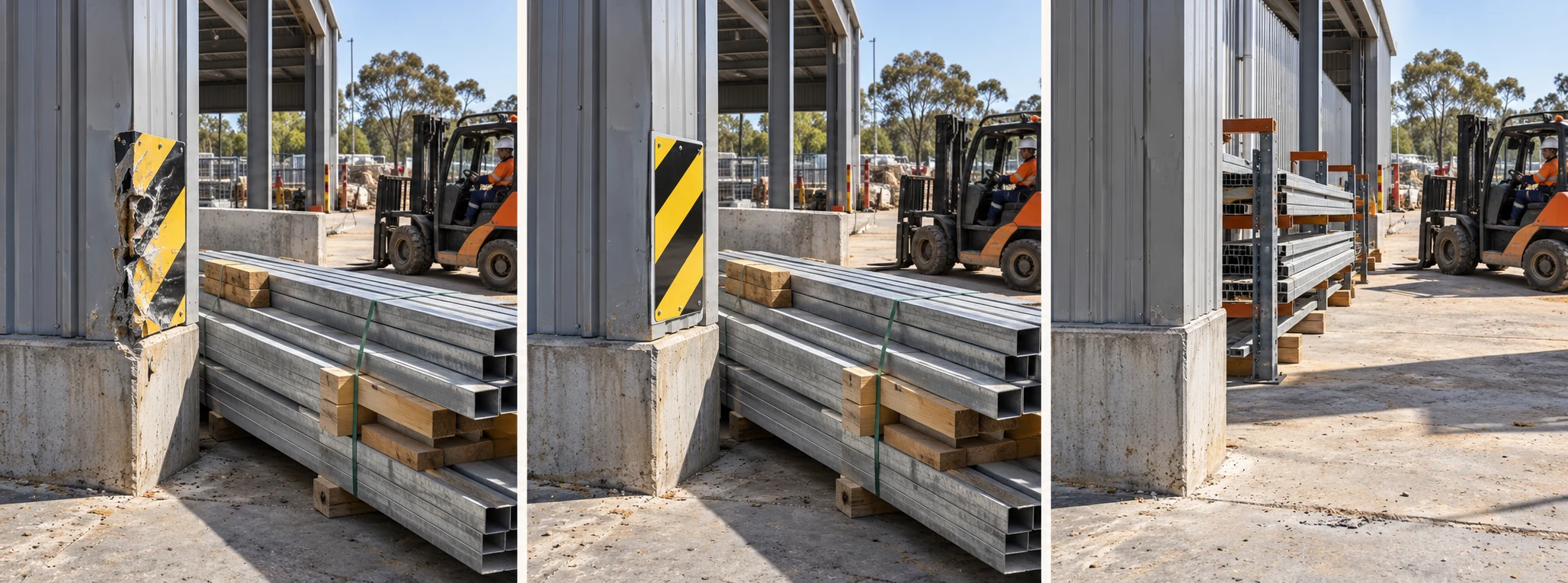
Replacing a damaged item addresses the immediate defect. Review what caused the damage and whether a changed arrangement prevents recurrence.
The last view is a question for review, not proof that shelving or a protector provides vehicle-impact protection.
OnShift educational illustration, AI-generated and visually reviewed for this preview; not a project photograph.
- SafeWork NSW · Investigating and reporting incidents
- SafeWork NSW · Workplace inspections
- ISO · ISO 45001:2018 public overview
Closure should match the action's purpose. A purchase receipt can show that equipment was bought; it cannot show that it was installed, understood or effective. A revised procedure can show new wording; it cannot show that people received it. Decide what evidence will demonstrate implementation and what later check will test effectiveness. If the action fails that check or creates another significant problem, reopen the issue or develop a better response.
Look across projects for patterns: recurring faults, repeated document conflicts, delayed specialist input or controls that are routinely bypassed. These may require changes to planning, procurement, training or management priorities. Share learning in a form that protects personal information and explains the mechanism, not just the event's drama. The resulting changes need to address the cause identified and be checked in use.
Responding to changed conditions
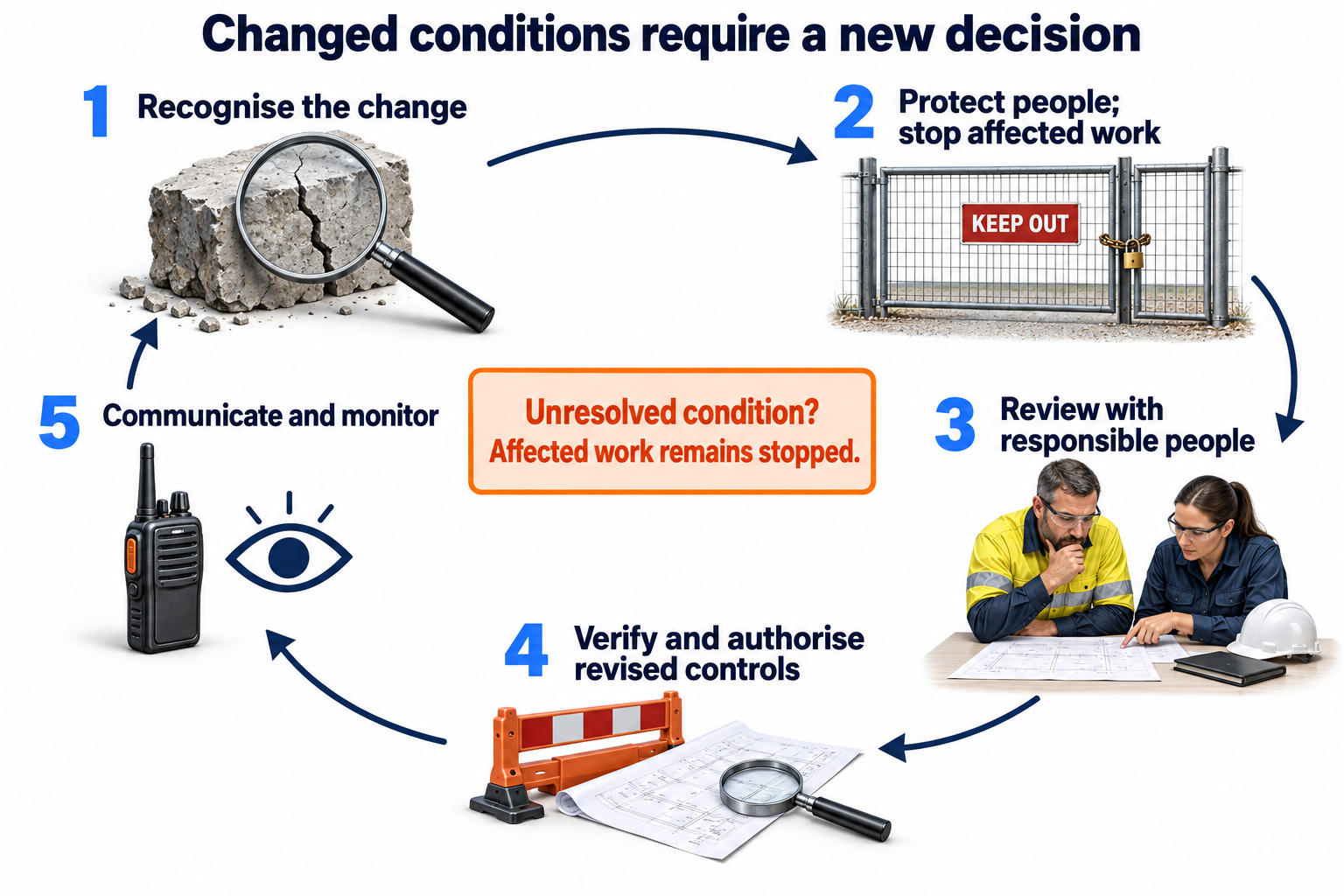
A change requires review of the assumptions and controls governing affected work.
 Open full-size illustration
A changed condition can invalidate the assumptions supporting a work stage. Protecting people and stopping affected work limits further exposure while the responsible people review the change. Revised controls require the appropriate technical input, verification and authorisation before affected work resumes.
The revised arrangement must reach everyone whose work depends on it. Monitoring then establishes whether it remains effective. An unresolved condition is not cleared by the continued existence of an earlier plan. Emergency response follows the site's emergency arrangements and the authority responsible for the incident.