
Law, standards and project controls
Legal duties, approved codes, technical standards and project instructions have different purposes and can apply together.
Sources of authority
A demolition business works within several connected authority systems. Law establishes duties and prohibitions. Regulatory approvals and licence conditions apply to defined activities and parties. Approved codes address recognised ways of managing hazards and risks. Technical standards can establish requirements where applicable through law, approvals, design or contract. Company systems assign internal responsibilities, while project controls apply relevant information to actual work. None of these layers can be understood merely by counting documents.
The National Construction Code, or NCC, provides technical requirements for buildings and plumbing. State and territory law gives these requirements legal effect. Its building provisions are the Building Code of Australia, or BCA. This building-regulation role is distinct from demolition WHS codes and Australian Standard 2601.
For retained or altered work, the project team must confirm the applicable NCC edition, NSW variations, approvals and design requirements. They must confirm these with the relevant building surveyor or certifier and designers. Do not assume either that every existing building must meet the newest edition or that retaining part of a building removes the need for review. NCC requirements do not supply a demolition method or replace applicable WHS controls and authorised standards information.
A useful question is: what claim am I using this source to support? An engineering report may address a structural stage, but it does not settle every environmental condition. A company procedure may require a review, but the completed review still needs the right inputs and reviewer. Distinguishing the claim prevents an authority from being stretched beyond its purpose.
Do not treat the layers as a contest won by the most recent email. More than one obligation can apply at once. A contract cannot remove a statutory duty, and meeting a contract's handover description does not prove that residual hazards have been controlled. When requirements appear inconsistent, identify the exact provisions, affected work and responsible decision-makers. The aim is a coherent authorised arrangement, not a convenient document selected after the event.
Current NSW law and approved codes
The Work Health and Safety Act 2011 and Work Health and Safety Regulation 2025 are the current NSW workplace health and safety framework. Older templates may refer to the 2017 Regulation. Their familiar headings do not establish that their legal references, responsibilities or operational instructions remain applicable. Currency review concerns the requirements themselves, not just the date printed on the form.
From one July twenty twenty-six, the NSW duty concerning approved codes applies to a person conducting a business or undertaking. They must comply with applicable approved codes or manage the hazards and risks in a different way. That alternative must provide an equivalent or higher standard of health and safety. Approved codes should therefore not be described as merely optional reading. Equivalence is a substantive safety proposition, not a supervisor's preference for a quicker method.
The demolition code available through SafeWork NSW is dated August twenty nineteen. Its age does not by itself mean it has been withdrawn. Read its demolition guidance alongside current law and the current approved-code register. Similarly, do not assume that a model code published nationally has the same approval status in every jurisdiction. These distinctions matter when a business works across state boundaries. Check the jurisdiction, instrument, version, commencement and scope of the particular claim.
Reasonably practicable risk control
Reasonably practicable is not a synonym for affordable, customary or convenient. The concept considers the likelihood and seriousness of harm. It considers what is known or ought reasonably to be known about the hazard and controls. It also considers the availability and suitability of ways to eliminate or minimise risk. Cost is considered in that context, including whether it is grossly disproportionate to the risk. A low tender price does not determine the level of protection a job needs.
Consider a company selecting a location for material handling. One option makes scheduling easy but creates repeated interaction between pedestrians and plant. Another requires a revised arrangement that reduces the interaction. A useful analysis compares the actual exposure and the available control options. Saying 'we have always managed with a warning sign' does not examine suitability or performance. Nor does a numerical risk score answer whether a stronger feasible control should be used.
Keep the reasoning visible. Record the hazard mechanism, the options considered, the constraints supported by evidence and the basis for the selected arrangement. If a technical assumption is missing, identify it rather than treating the absence of information as proof that a control is unnecessary. The decision needs evidence about exposure and control suitability as well as cost.
Technical and management standards
A standard can contain detailed technical requirements that cannot be reconstructed from its title. Australian Standard 2601 is relevant to demolition. Its applicable edition and provisions need to be read from the authorised text and considered in the project's technical review. A general explanation of demolition does not establish an exact clause requirement or its application to a particular structure.
The same care applies to management-system standards. ISO 45001 concerns occupational health and safety management systems. Discussing leadership, planning and improvement does not establish certification or conformity with its requirements. A business may use a management cycle without holding certification; a certificate, where present, also needs to be understood within its stated scope. Do not treat a logo on a company document as evidence that every project control is effective.
Company minimum standards translate business expectations into repeatable requirements. They may be more restrictive than a general baseline. But internal permission to depart from a company rule cannot waive law or alter an engineered design. Project plans then apply the system to actual conditions. The chain should be traceable: what requirement applies, how it is implemented, who owns it and what confirms its performance. That chain is more useful than a bibliography that nobody connects to the work.
Conflicting requirements and applicability
Suppose a scope note says a boundary element remains, a sketch appears to show removal and a subcontractor's work sheet assumes access through that location. These are not three equally valid choices. Identify the precise conflict and hold the affected assumption open. A request for information should locate the issue, cite the competing documents and revisions, explain the consequence and identify the response needed from the authorised people. It should not quietly turn a guess into an instruction.
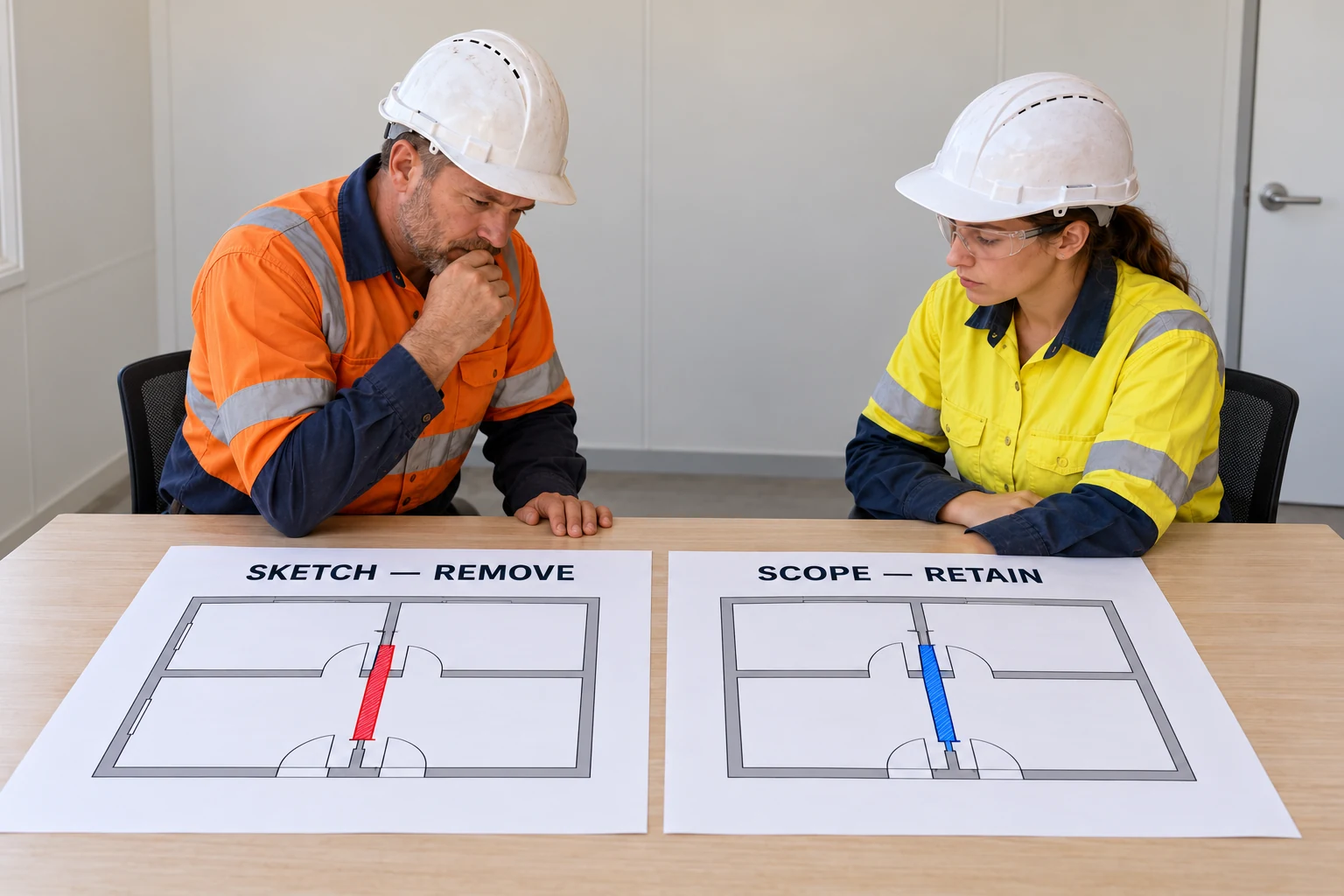
Identify the conflicting documents and the affected work. Refer the question to the authorised people before relying on either instruction.
These simplified teaching sketches are not construction drawings or evidence of an authorised decision.
OnShift educational illustration, AI-generated and visually reviewed for this preview; not a project photograph.
- SafeWork NSW · Demolition work Code of Practice
- SafeWork NSW · Duty to consult
- SafeWork NSW · Current legislation
When a requirement is marked not applicable, record the reason and the trigger that would change that decision. For instance, a task may genuinely be outside a contractor's scope, while coordination duties at the interface remain. Subcontracting a specialist activity does not make every related hazard disappear from the demolition business's system. The business still needs to understand where its own work depends on the specialist's information and controls.
An unresolved conflict needs a precise description of the competing sources and the work affected. The supervisor can identify the unsupported assumption and refer it to the relevant authority without providing a legal interpretation or certifying a design.
Interpreting a control record
A control record for a material-transfer area needs to identify the activity, location, revision and intended use. These details establish whether the document applies to the work. Its supporting information and unresolved assumptions are equally important: changing a heading does not make an unrelated record applicable.
A hazard entry must explain the route to harm. Terms such as plant or debris identify a subject but not the exposure. The record needs to establish how movement or material could reach workers, visitors, neighbouring property or an environmental receptor. Deliveries and changing work areas can alter those pathways.
The control entry distinguishes measures that are proposed from those already implemented. It identifies how each measure reduces exposure, who establishes and maintains it, and what technical information it depends on. Exclusion distances and load limits require the relevant site-specific basis; they cannot be derived from a generic form.
Verification must address the condition being relied upon. A photograph may establish the location of a sign, but it cannot establish the capacity of a structural support. A signature may record acknowledgement without verifying the assumptions behind the arrangement.
If a delivery blocks the planned route, the review must address the changed movement and exposure. The revised arrangement must be communicated and obsolete instructions withdrawn from use. Traffic arrangements, the demolition work plan, relevant safe work method statements, emergency access and briefings must remain consistent. A permit authorises a defined activity under specified conditions; it does not replace unrelated technical confirmations.