
Clear technical communication
Precise communication connects the subject, cause, evidence and limits of a decision.
Purpose before detail
Plain language preserves technical meaning in words that another person can follow. A permit, for example, records a defined authorisation within stated conditions. Its purpose is clearer when the explanation identifies the work and conditions it concerns, followed by the limits of that authority.
A definition gives meaning; an explanation gives a reason or relationship; a comparison identifies similarities and differences. In a technical discussion, confusing these purposes can leave the real question unanswered. Listing hazards does not explain what a permit authorises.
A direct statement followed by a reason and a relevant example gives the listener a clear subject. Qualifications then explain where the statement applies. Excess detail can obscure a missing fact as easily as vague wording can.
Cause and effect
The word dangerous identifies a concern without explaining how harm could occur. A more useful description of a congested entrance identifies the interaction. Waiting vehicles restrict visibility, and people may enter the movement area while looking for another route.
Cause and effect also explain a control's purpose. A sign communicates a restriction; it does not physically prevent entry. Physical separation and administrative information therefore serve different functions. A control description needs to say whether the measure removes the activity, separates people, changes the physical arrangement or supports behaviour.
An observation should identify the location, interaction and people affected without adding unverified dimensions or an assumed cause. The information needed to select a real control remains part of the technical decision.
Facts, conclusions and uncertainty
'The drawing and the visible condition differ' reports a discrepancy. 'The structure is about to collapse' makes a much larger technical claim. A useful report identifies the difference, the work that depends on it and the review needed to resolve it. It neither predicts failure without evidence nor gives an unsupported assurance.
A legal or technical threshold may depend on jurisdiction, activity, material, licence class or current wording. Where a threshold matters, the question needs to identify the applicable official source or specialist criterion. A remembered number cannot resolve an uncertain requirement.
Memory and records also need to remain distinct. A supervisor might remember that work stopped without remembering the exact time. Preserving that uncertainty prevents an approximate account becoming a false timestamp as it is repeated.
Meaning shared by the work party
Abbreviations are useful once their meaning is clear. Safe work method statement becomes SWMS, and work health and safety becomes WHS. When two documents are being compared, naming each document avoids an ambiguous 'it' that could refer to either one.
Confirmation needs to concern meaning. A person may repeat an instruction without understanding which boundary it applies to or why it matters. Explaining the connection between the restriction and the hazard can reveal a misunderstanding that an acknowledgement alone misses.
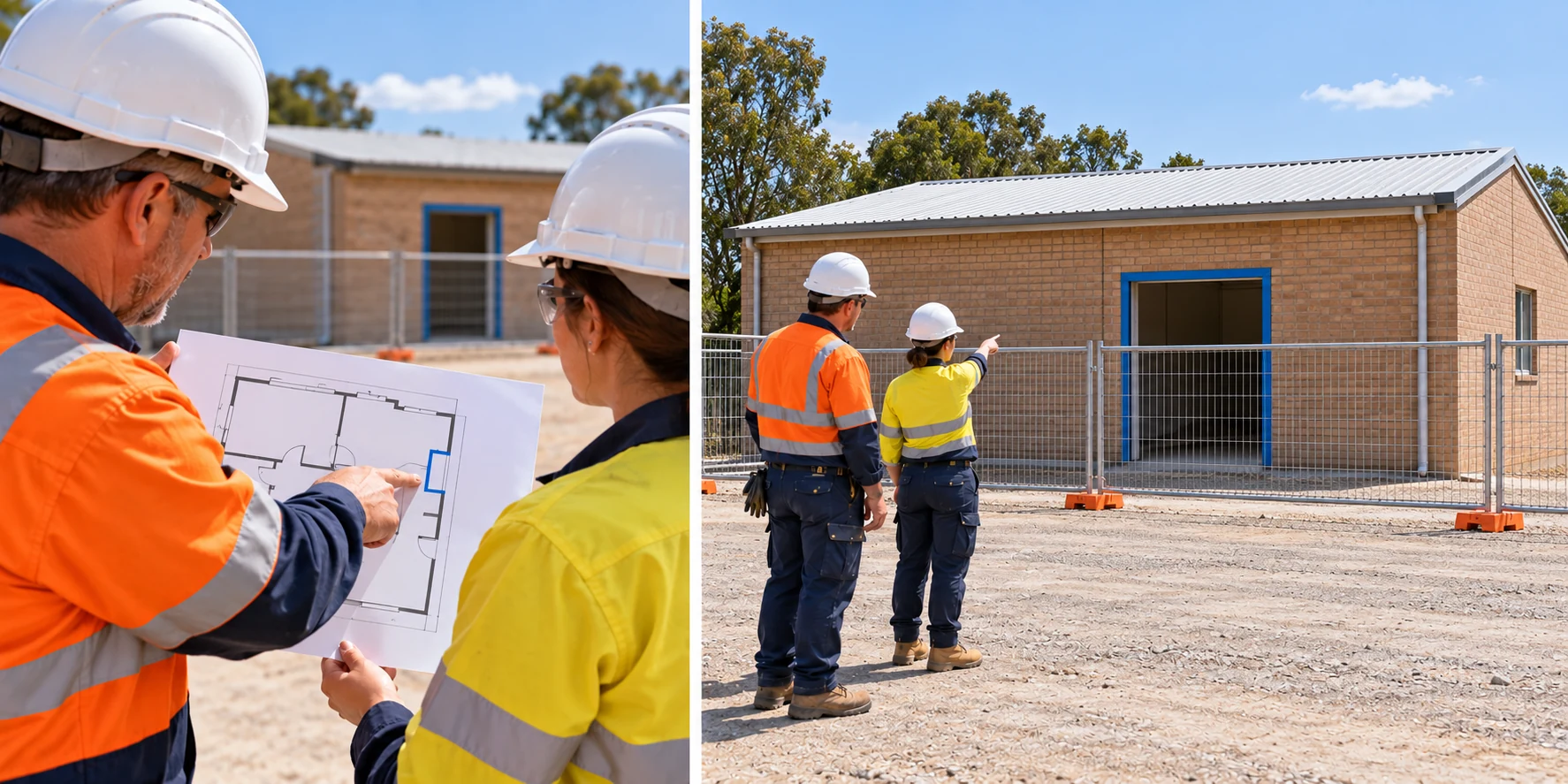
Confirm the actual location and the restriction that applies there. Repeating an instruction is not the same as understanding its boundary.
The drawing is fictional and supplies no work authority, measurements or construction detail.
OnShift educational illustration, AI-generated and visually reviewed for this preview; not a project photograph.
Open full-size illustrationClear communication also preserves conditions. A specialist's advice may apply only to a stated work stage or depend on an inspection still to occur. Omitting those qualifications changes the message. The work party needs the instruction and its limits together.
Technical terms
Hazard — A source or situation with potential to cause harm.
Risk — The possibility of harm, considered with its likelihood and consequence in context.
Exposure — The opportunity for a person or receptor to come into contact with a hazard.
Consequence — The harm or loss that could result.
Control — A measure that eliminates or reduces risk.
Remaining risk — Risk considered after the specified controls have actually been applied.
Elimination — Removing the hazard or hazardous exposure from the work.
Substitution — Replacing a hazard with a less hazardous alternative.
Isolation — Separating people from a hazard.
Engineering control — A physical or designed measure that acts on a hazard or exposure pathway.
Administrative control — An arrangement such as procedures, scheduling, information or supervision.
PPE — Personal protective equipment.
RPE — Respiratory protective equipment.
SWMS — Safe work method statement; a document for relevant high-risk construction work.
DWP — Demolition work plan.
Permit — A bounded authorisation within a defined control system, not universal proof of safety.
Induction — Introduction to relevant site conditions, responsibilities and arrangements.
Pre-start — A check or briefing before work or equipment use; distinct from scheduled servicing.
Verification — Checking evidence that the required condition or control exists and works as intended.
Consultation — Sharing relevant information, hearing affected workers' views and considering them in decisions.
Load path — The connected route by which forces pass through a structure to its supports.
Compression — A pushing action within a material or member.
Tension — A pulling action within a material or member.
Bending — A response to loading that tends to curve a member.
Shear — Action tending to make parts move past one another.
Temporary works — Engineered or other temporary arrangements supporting construction or demolition needs; specialist design and control may be required.
Respirable dust — Particles small enough to reach deep into the lungs.
LEL — Lower explosive limit; the lowest flammable gas or vapour concentration in air at which flame can propagate under the relevant conditions. Percentage of LEL is not percentage gas concentration or a safe-breathing decision.
Receptor — The person, property or environmental feature potentially affected.
Change control — The process of recognising a change, reviewing affected assumptions and controls, and communicating the revised arrangement.
Air monitoring — Competently planned measurement of airborne contaminants to assess exposure and control effectiveness.
Health monitoring — Medical monitoring for health effects, carried out or supervised by an appropriately experienced doctor when required.