
Services, isolation and hazardous energy
Service records describe connected systems; verified isolation establishes a defined energy boundary. Stored energy, alternative supplies and shared control can affect that boundary.
Services as connected systems
Services bring electricity, gas, water, communications, drainage and other functions into and through a site. Some serve the structure being removed; others pass through it to retained operations. A drawing edge is not a physical disconnection. The first planning task is to establish which systems exist, whom they serve and where the proposed work intersects them.
Information can come from asset owners, available service records, site drawings, labels and appropriately arranged locating investigations. Each has limits. A plan may show an approximate route without an accurate depth. A label may describe an earlier configuration. An apparently redundant pipe may remain connected elsewhere. Record the source and uncertainty rather than combining all information into a single unqualified claim that services are known.
Overhead lines need attention throughout the plant's possible movement, including attachments and loads. Underground services can be affected by excavation, ground penetration, loading or collapse, not only deliberate digging. Protection and separation requirements must come from the current service-owner and work-near-services arrangements for that situation. Do not borrow a remembered distance from another voltage, network or task.
Removing a structure adjoining a retained workshop may affect the workshop's electrical supply, fire protection or sewer connection. The demolition boundary should identify what is removed, what remains active and how the retained function will be protected. Exposure, disconnection and testing of services require the relevant authorised specialist arrangements.
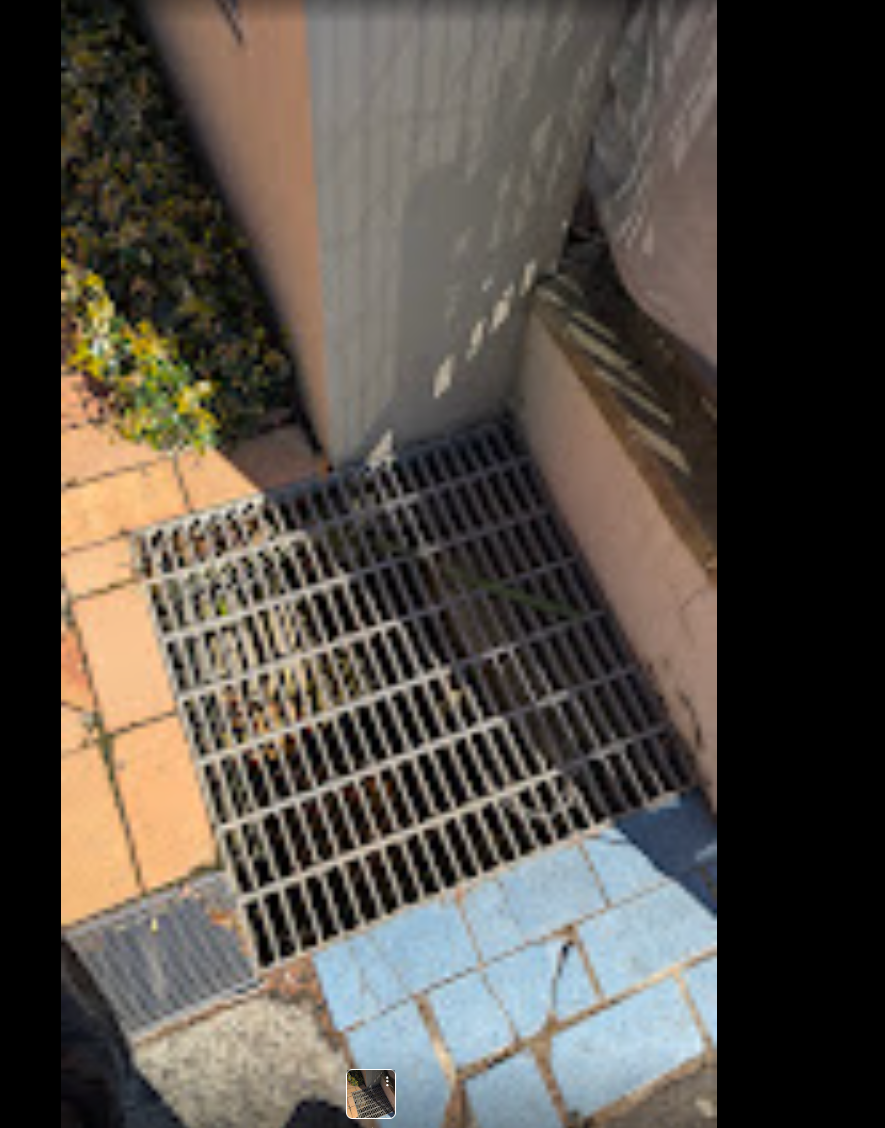
The Cronulla photo register identifies C-P03 as a reported heritage sewer location. The image records a grate and surrounding surfaces. It does not verify a heritage listing, construction date, underground route or depth. Keep that reported identity attached to the observation while seeking the relevant asset and protection information.
At Cardwell, the historical fuel layout is another kind of service information. It can help form questions about the recorded installation, but it is not a current surveyed service-clearance drawing. Comparing source purpose and location prevents a surface feature or old diagram from becoming an assumed safe work boundary.
Reported heritage sewer location
REPORTED LOCATION — HERITAGE DETAILS UNVERIFIED A real-project image or an identified simulation aid. Use only for the stated observation; do not infer hidden construction, service position or approval.
 Open full-size illustration
C-P03 – Reported heritage sewer location; listing, age, extent and depth are not verified by this photograph.
A real-project image or an identified simulation aid. Use only for the stated observation; do not infer hidden construction, service position or approval.
This visual is draft case-study teaching material. Reading it is not an inspection, a measurement or evidence of performance.
Stopped equipment can still contain energy
Hazardous energy is energy capable of causing injury if released or transferred unexpectedly. Electricity is one form. Others include pressure in hydraulic or pneumatic systems, mechanical movement, suspended weight, springs, heat and chemical energy. A machine can be silent while one or more of these sources remain present.
Switching a control to off is different from isolating an energy source. An operating switch may leave supply available elsewhere, permit an automatic restart or have no effect on stored pressure. An emergency stop is designed for its emergency control function; it must not be assumed to provide the required isolation for maintenance or dismantling. Isolation is part of a planned system performed and verified by people with the appropriate capability and authority.
Alternative supplies complicate the picture. Batteries, solar equipment, generators and uninterruptible power systems can introduce energy even when the usual supply is absent. Multiple businesses may control different parts of the system. The person arranging demolition needs a complete enough picture to identify those interfaces, rather than relying on an assurance that the meter has been removed.
A raised attachment on a stationary machine still holds gravitational energy after the engine stops. Similarly, a disconnected line can retain material or pressure. The isolation arrangement must address what remains, how it could be released and how people are protected.
Isolation scope and evidence
An isolation record should make its boundary understandable. Look for the asset or circuit identified, location, work covered, responsible authorised person, relevant date and time, verification information and any retained live parts or restrictions. A certificate describing one board or one service does not automatically cover the whole site. The essential task is to match the record to the activity that relies on it.
Distinguish three statements. Planned for isolation describes future work. Isolated describes an action and needs supporting detail. Verified for the specified work describes a checked condition within stated limits. These are not interchangeable status labels. An email booking a service visit is not evidence that the visit occurred or that the work area has been released.
An isolation record refers to the former office tenancy while the demolition scope includes an attached store. A shared boundary on a drawing does not prove the same isolation covers both. The discrepancy should identify the two areas, the documents involved and the dependent work being held. This gives the responsible specialist a precise question to resolve.
Physical identification and communication must agree with the records. If a tag, asset number or site configuration does not match the documentation, the uncertainty remains. Supervisory checking means confirming that the relevant authorised work and evidence exist. It does not mean personally probing a conductor, opening a pressure system or removing another person's lock to see whether the paperwork is correct.
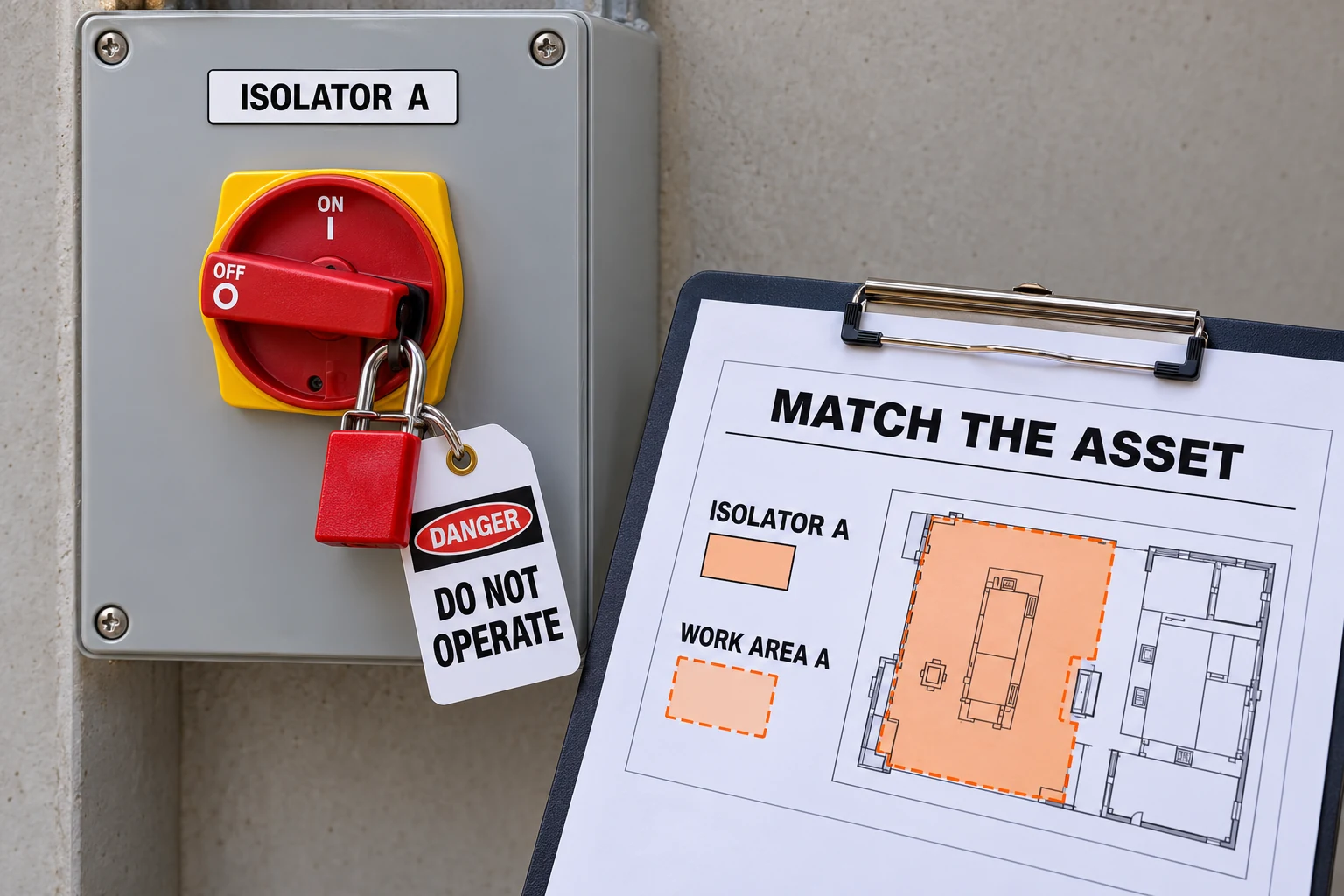
Match the equipment, work area and restrictions to the authorised isolation evidence. Resolve any discrepancy before relying on the record.
A lock, tag or picture does not prove isolation or absence of energy. This is not a test procedure or completed isolation certificate.
OnShift educational illustration, AI-generated and visually reviewed for this preview; not a project photograph.
- SafeWork NSW · Power lines
- SafeWork NSW · Plant, machinery and equipment
- SafeWork NSW · Demolition work Code of Practice
Interpreting a control record
A control record for a material-transfer area needs to identify the activity, location, revision and intended use. These details establish whether the document applies to the work. Its supporting information and unresolved assumptions are equally important: changing a heading does not make an unrelated record applicable.
A hazard entry must explain the route to harm. Terms such as plant or debris identify a subject but not the exposure. The record needs to establish how movement or material could reach workers, visitors, neighbouring property or an environmental receptor. Deliveries and changing work areas can alter those pathways.
The control entry distinguishes measures that are proposed from those already implemented. It identifies how each measure reduces exposure, who establishes and maintains it, and what technical information it depends on. Exclusion distances and load limits require the relevant site-specific basis; they cannot be derived from a generic form.
Verification must address the condition being relied upon. A photograph may establish the location of a sign, but it cannot establish the capacity of a structural support. A signature may record acknowledgement without verifying the assumptions behind the arrangement.
If a delivery blocks the planned route, the review must address the changed movement and exposure. The revised arrangement must be communicated and obsolete instructions withdrawn from use. Traffic arrangements, the demolition work plan, relevant safe work method statements, emergency access and briefings must remain consistent. A permit authorises a defined activity under specified conditions; it does not replace unrelated technical confirmations.
Unexpected services
An unidentified cable, pipe, valve, tank connection or unusual discharge is new information, not an invitation to test it by disturbing it. Prevent further exposure, keep people outside the affected area and use the site's escalation and emergency arrangements. Where there is immediate danger, emergency services and the relevant service authority may need involvement through the established response.
An odour, hissing sound, damaged cable sheath or unexpected equipment movement can indicate a serious problem. But the absence of those signs does not prove safety. Some hazardous atmospheres are not reliably detected by smell, and electrical parts may remain energised without visible indication. Recognition should lead to an appropriately controlled investigation, not improvised diagnosis.
The resulting record should distinguish what was actually seen from what was inferred. Cable exposed beside the marked trench is an observation. Abandoned cable is a conclusion requiring evidence. Preserve the location reference, relevant activity and photographs taken without additional exposure, then track the matter to a reviewed decision.
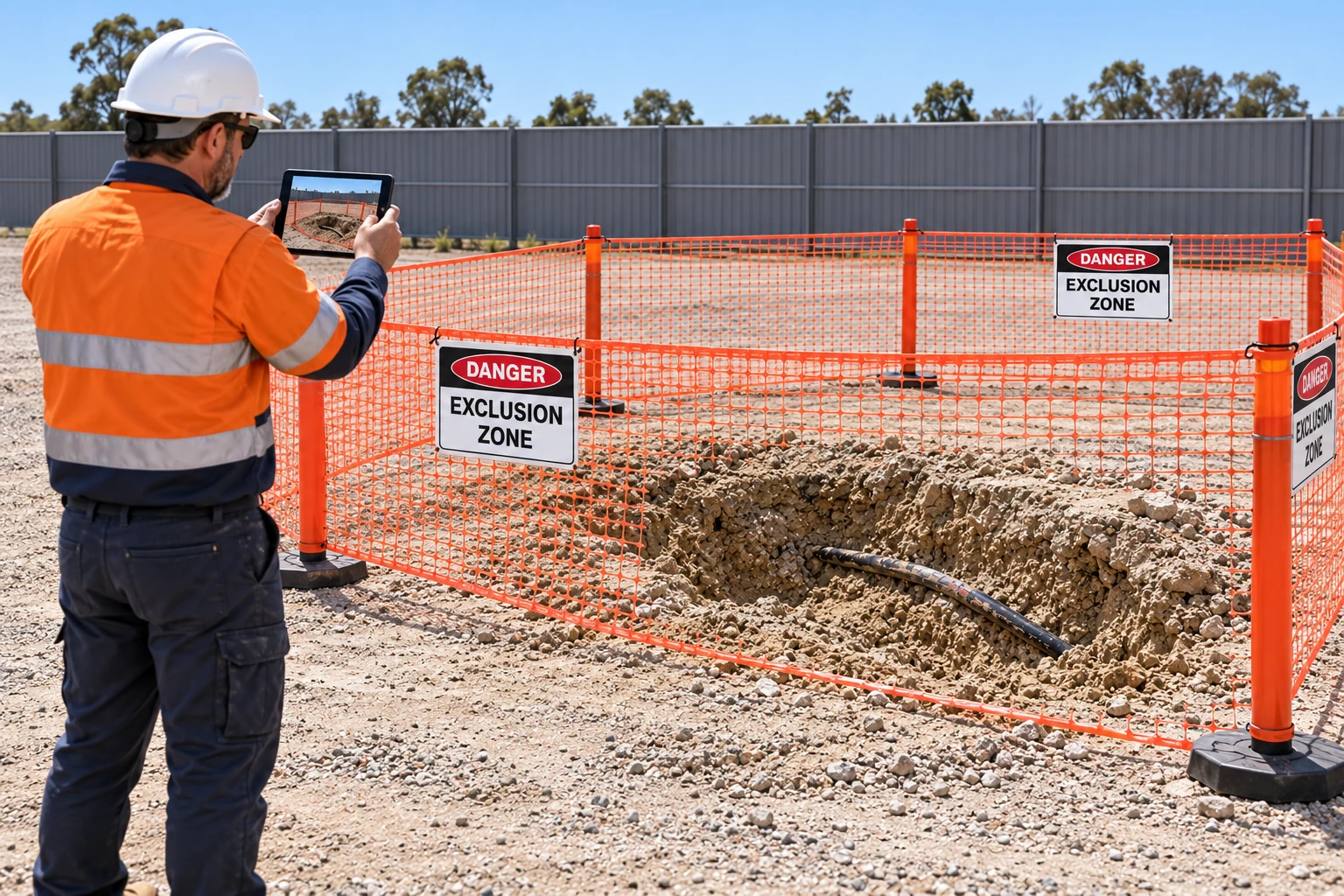
Keep the observation separate from the conclusion. Exposed cable does not mean abandoned cable or isolated cable.
The image does not establish energy state, service ownership, a safe distance or a method of investigation.
OnShift educational illustration, AI-generated and visually reviewed for this preview; not a project photograph.
Open full-size illustrationIsolation, testing, disconnection, reconnection and rescue from energised systems have specific technical, licensing and emergency requirements. Identifying an unexpected service does not establish its energy state or authority to work on it.