
Materials, stockpiles, salvage, recycling and load-out
Removed material retains its identity and hazards. Segregation protects recovery, stockpiles change loading and access, and transport records link each material stream to its receiving destination.
Removed material still has an identity
Material does not become an anonymous pile when it leaves a structure. Its composition, previous use, contamination, condition and intended destination still matter. Concrete, brick, timber, metals, glass, plasterboard, insulation and mixed residues behave differently in handling and may require different recovery or disposal arrangements. A clean appearance is not evidence that a material is free of hazardous contamination.
Reuse means using an item again for an intended purpose. Recycling generally involves processing material into another usable form. Disposal is a different destination. These words describe intended pathways, not an automatic legal classification or a guarantee of suitability. A salvaged beam may have commercial value but still need a competent condition and suitability assessment before any structural reuse. Recovered material is not made acceptable simply by describing it as a resource.
The identification process connects the hazardous-material information, demolition scope and waste plan. An unexpected coating, residue or concealed material can change the pathway. Mixing uncertain material into an otherwise separated stream may increase the quantity that needs investigation and destroy useful provenance. Keeping the uncertainty identifiable is often more important than maintaining production speed.
In New South Wales, the EPA explains that waste must go to a place that can lawfully accept it. It also explains that the waste owner and transporter have responsibilities. The relevant acceptance conditions depend on the actual waste and destination. Material identity must remain connected to its classification, controls and movement records; an intended recovery pathway does not establish a resource-recovery exemption.
Waste identification and traceability
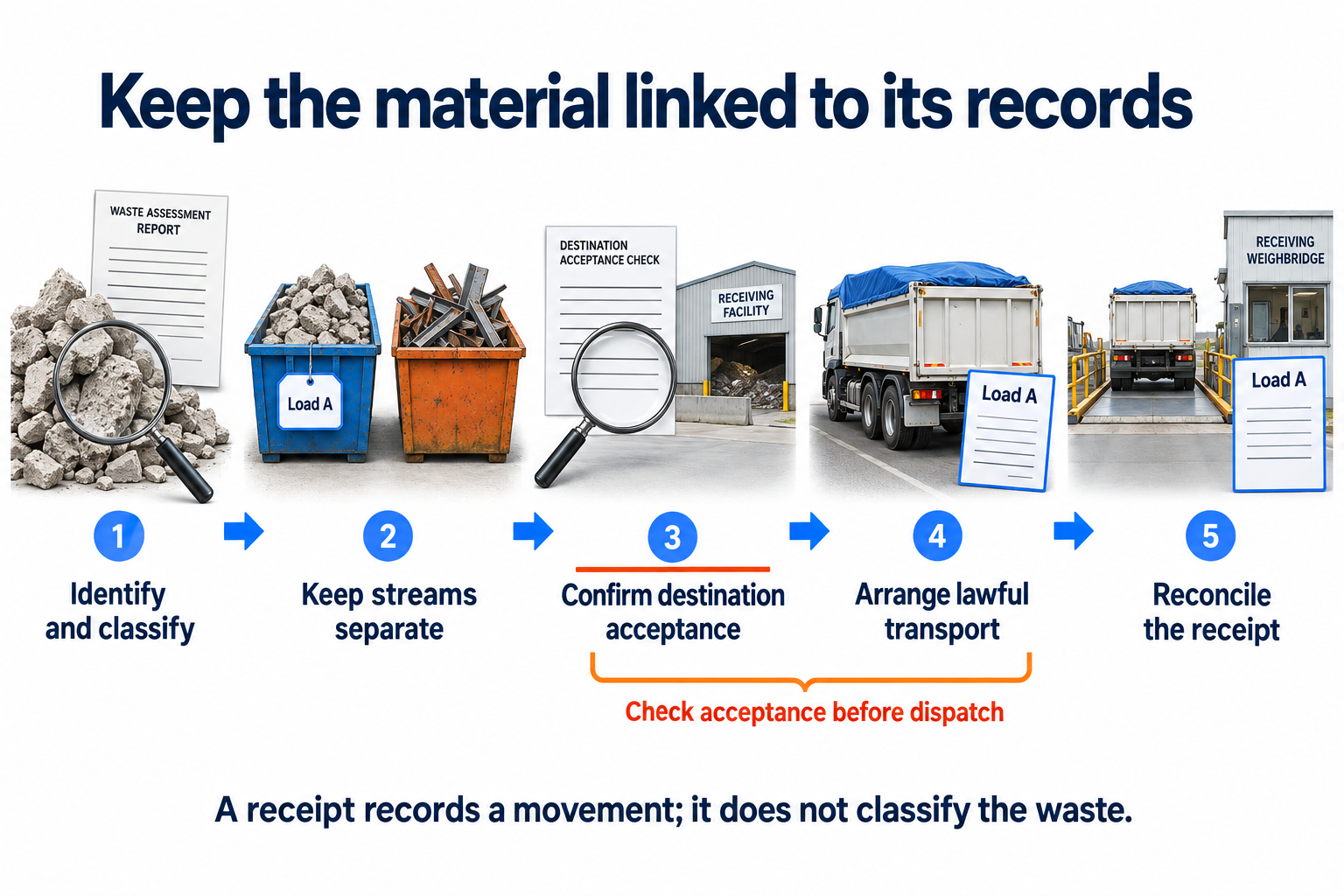
Records connect the material, transport arrangements and authorised receiving destination.
 Open full-size illustration
Waste management begins with material identification and the required characterisation or classification. Appropriate segregation preserves the identity of each stream. The load must then be connected to lawful transport arrangements and a receiving facility authorised to accept that waste. Destination suitability must be confirmed before dispatch.
Records preserve the connection between what left the site, where it went and what was received. A receipt from a facility does not establish the destination of every other load or confirm that the recorded description matches the material. An estimated quantity must remain distinguishable from a measured weighbridge result.
Classification, testing, transport and resource recovery requirements depend on the material and circumstances. If material identity or destination acceptance is unresolved, changing a label does not resolve the underlying uncertainty. The affected movement needs the appropriate review before it proceeds.
Traceability continues through segregation, stockpiling, load-out and close-out. Records must describe the physical movement accurately, including discrepancies that require reconciliation.
A stockpile is a load and a changing work area
A stockpile adds weight to whatever supports it. On a suspended floor, that weight must travel through the slab, beams, columns and foundations. On the ground, it can affect bearing, settlement and nearby excavations or retaining structures. A location that looks empty is not necessarily available for storage. It may conceal a basement, service trench or ground condition relevant to loading.
The same quantity of material can create different effects depending on its footprint and position. Spreading a load and concentrating it are not equivalent. A pile beside an edge can affect a different part of a structural system from a pile elsewhere. Depositing material can also produce impact, while a wall beside a pile may receive lateral pressure that it was not intended to resist. Permissible storage loading and pile height depend on the actual supporting system and its assessment.
Storage also changes movement. A pile can obstruct sightlines, narrow a vehicle route, force pedestrians into plant areas or block access to an isolation point. Loose edges can spread beyond the planned footprint. Sharp projections, unstable items and irregular surfaces create handling hazards even when the total load is acceptable.
The stockpile arrangement therefore belongs in the coordinated demolition and materials-handling plan. It needs an identified material stream, suitable support, controlled access, environmental controls and a removal strategy. If transport stops, the plan's assumptions may change before the nominal storage area appears full. Available storage depends on the support beneath the material and the activities that must remain possible around it.
Segregation protects recovery and controls exposure
Separation works best when it follows a known material plan rather than being left to sorting a mixed pile later. Ferrous metals and non-ferrous metals may have different recovery streams. Clean masonry and concrete may follow different acceptance arrangements from coated or contaminated fragments. Timber may differ by treatment, coating and condition. Glass, plasterboard and insulation require attention to breakage, dust and the receiving facility's requirements.
A site's hazards and the actual receiving facilities determine the separation arrangement. Material that is acceptable to one processor may be rejected by another. A contract description or a colour-coded container cannot replace that confirmation. Clear identification also helps prevent a load being mixed by a person who did not attend the original briefing.
Salvage introduces handling and condition questions. An item intended for reuse may need protection from impact, contamination and weather. Its connections and removal method affect whether it can be recovered without creating an unacceptable exposure. Preserving an item's resale value does not justify departing from structural or hazardous-material controls. Condition information should follow the item rather than disappearing once it leaves the work face.
For example, a set of metal panels is selected for recovery. Some are visibly coated and others have unidentified residue on their hidden faces. Treating the whole set as clean scrap would hide a material difference. The coated and residue-bearing panels need to remain identifiable while their condition and the applicable handling and acceptance pathway are resolved. Making their surfaces look clean would not establish their classification.
Volume and mass answer different questions
A container has a volume, while a vehicle and its supporting route also have mass and loading constraints. Filling the available space does not prove that a load is acceptable. Dense material can reach a mass constraint before a container looks full. Awkward pieces can create distribution or restraint problems even when their total mass appears modest.
For example, eight cubic metres of already loose, homogeneous material has an assumed bulk density of zero point six five tonnes per cubic metre. Multiplying eight by zero point six five gives five point two tonnes. The cubic-metre units cancel, leaving tonnes. The result depends on the assumed volume and density. It establishes neither the mass of an unmeasured load nor a vehicle's permitted loading.
Actual mixed material can contain voids, moisture and constituents with different densities. The intact volume calculated from a drawing is not the same as loose volume after demolition. Neither a guessed bulking factor nor an unverified average density establishes the load. Appropriate quantity and mass information must be obtained through the project's controlled arrangements and the receiving and transport systems.
Load-out also involves interaction between moving plant, transport vehicles and people. The plan must address separation, visibility, vehicle positioning, communication, ground support and the controlled transfer of material. Load distribution, restraint, vehicle suitability and applicable transport requirements need competent attention. A calculated mass alone does not establish a suitable loading arrangement.
Close the material trail at the destination
A useful material record links origin, description or classification, quantity, transporter and destination. Depending on the material and applicable requirements, supporting evidence can include classification information, movement records, weighbridge dockets and receiving confirmation. The important relationship is that the records describe the same load, rather than being a collection of unrelated receipts.
A disposal invoice alone may not establish what was transported or whether the nominated place could accept it. The destination's acceptance needs to fit the particular waste. The EPA's guidance emphasises lawful disposal and checking contractors; outsourcing transport does not make the waste owner's responsibilities disappear. The site's records should make it possible to follow a material stream from its identified source to its actual receiving point.
Reconciliation means comparing what was expected, what left and what was received, then investigating meaningful differences. Estimates and measured quantities will not always match exactly, but an unexplained destination, inconsistent waste description or missing receipt is not merely a clerical inconvenience. It can indicate a break in the material trail.
Suppose a load is rejected because its contents do not match the agreed description. The task is to maintain control and traceability while the classification, destination and handling arrangement are resolved. Quietly renaming it or sending it somewhere else would not solve the underlying uncertainty. Feedback should also reach the work face so that the cause of the mismatch is corrected. The material's identity and movement record need to remain linked to the receiving confirmation for that load.