
Traffic, public protection and neighbouring properties
Vehicles, pedestrians and neighbouring occupants can share access and exposure pathways. Public protection depends on coordinated movement, suitable barriers and evidence about actual conditions.
Exposure beyond the site boundary
A demolition site interacts with people who have not chosen to take part in its work. Neighbours, pedestrians, delivery drivers, building occupants and road users can be affected by vehicles, debris, dust, noise, vibration and changes to access. Public protection begins by identifying those people and the pathways by which work could affect them.
The property boundary establishes a land relationship, not the distance a fragment, sound or contaminant can travel. A site fence can control some access but does not automatically provide impact protection, acoustic isolation or dust containment. Its actual function needs to be understood. Where the planned hazard extends beyond the available controlled area, the work arrangement needs review.
Consider an occupied premises sharing a driveway. Its occupants may arrive at different times, receive unexpected deliveries or need emergency access. A demolition plan that assumes the driveway is empty during ordinary business hours has an unsupported premise. The appropriate arrangement must coordinate those uses and identify how exceptions are handled.
The receptor description identifies who or what is nearby, when it is present, how it moves and what makes it sensitive. A childcare entrance, medical practice, bus stop and fragile retained wall raise different planning questions. This information informs traffic, engineering and environmental planning, including the required approvals and restrictions.
Plant, people and public interfaces
Separation depends on coordinated physical controls, access arrangements and communication.
 Open full-size illustration
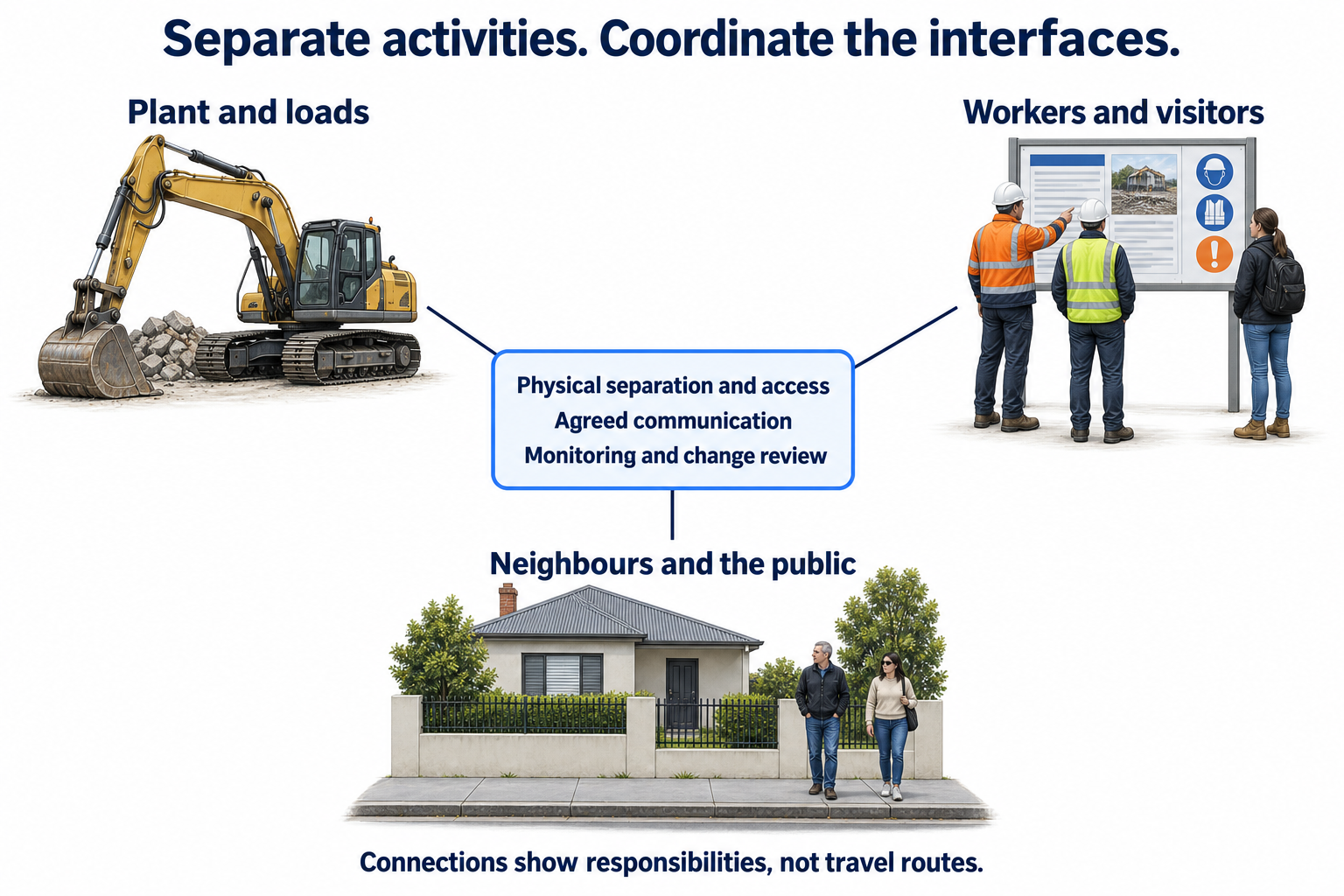
Plant and loads, workers and visitors, and neighbouring properties and the public create interacting demands on a demolition site. The three groups in the diagram connect to shared controls: physical separation, access rules, communication, monitoring and review of changes. The lines represent these relationships, not movement routes.
The arrangement must also preserve emergency and authorised access. Its design depends on the work, plant, material behaviour, surrounding uses and relevant technical information. A boundary on a drawing does not itself provide a barrier, contain flying debris, verify ground capacity or protect an adjoining structure.
Deliveries, loading operations, changed pedestrian routes and open gates can create new connections between previously separated activities. Responsibility for access and communication must be clear. A sign or a spotter alone cannot establish that every exposure has been controlled.
Street and balconies
ORIGINAL / HISTORICAL SOURCE — SEE CAPTION A real-project image or an identified simulation aid. Use only for the stated observation; do not infer hidden construction, service position or approval.
 Open full-size illustration
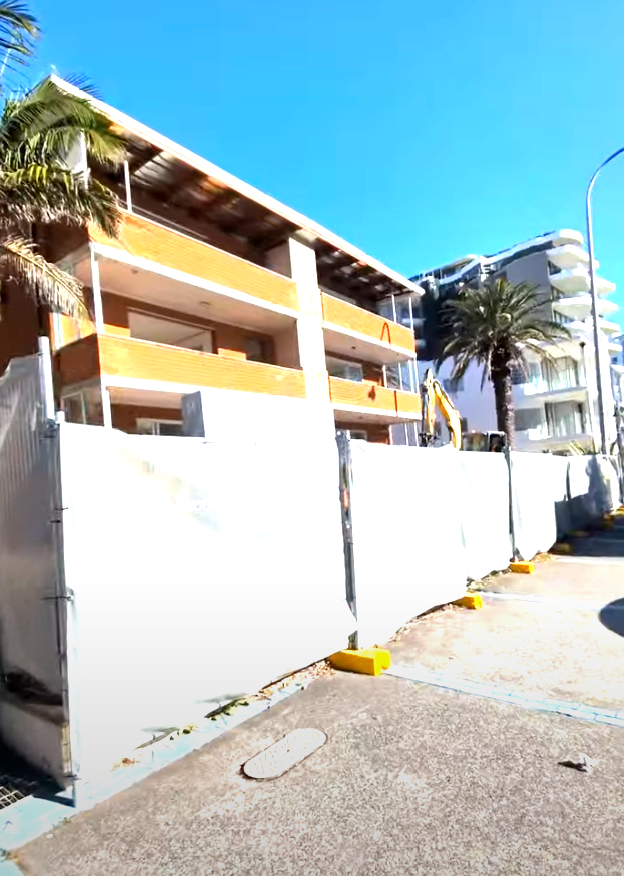
C-P01 – Street and balconies; date and exact viewpoint unverified. Visible context is not hidden-structure or capacity evidence.
A real-project image or an identified simulation aid. Use only for the stated observation; do not infer hidden construction, service position or approval.
This visual is draft case-study teaching material. Reading it is not an inspection, a measurement or evidence of performance.
Vehicle movements from arrival to departure
Traffic planning covers the complete vehicle movement. A vehicle approaches, waits if necessary, enters, travels to its destination, loads or unloads and departs. Each transition can create conflict with pedestrians, plant or other vehicles. Planning only the unloading position misses the queue outside the gate and the driver's route to the office.
Vehicle size, turning needs, sightlines, gradients, surface condition and overhead restrictions influence the layout. Prefer arrangements that avoid unnecessary reversing and reduce crossings, subject to competent planning for the actual site. A driver cannot be expected to infer a safe route from a collection of disconnected signs.
Waiting is part of the system too. If deliveries arrive faster than the site can receive them, vehicles accumulate somewhere. That place may be a public road, a footpath interface or an emergency route unless a suitable arrangement has been made. Booking systems should reflect loading capacity and realistic travel uncertainty, not merely the desired production rate.
A controlled delivery slot can avoid simultaneous access by several contractors. The benefit is reduced conflict, but the slot is only useful if suppliers receive it, unexpected arrivals have instructions and the receiving person is available. Traffic management within the site and any measures affecting public roads or footpaths must be coordinated through the appropriate authorities and approvals. A private site instruction does not itself authorise a road closure.
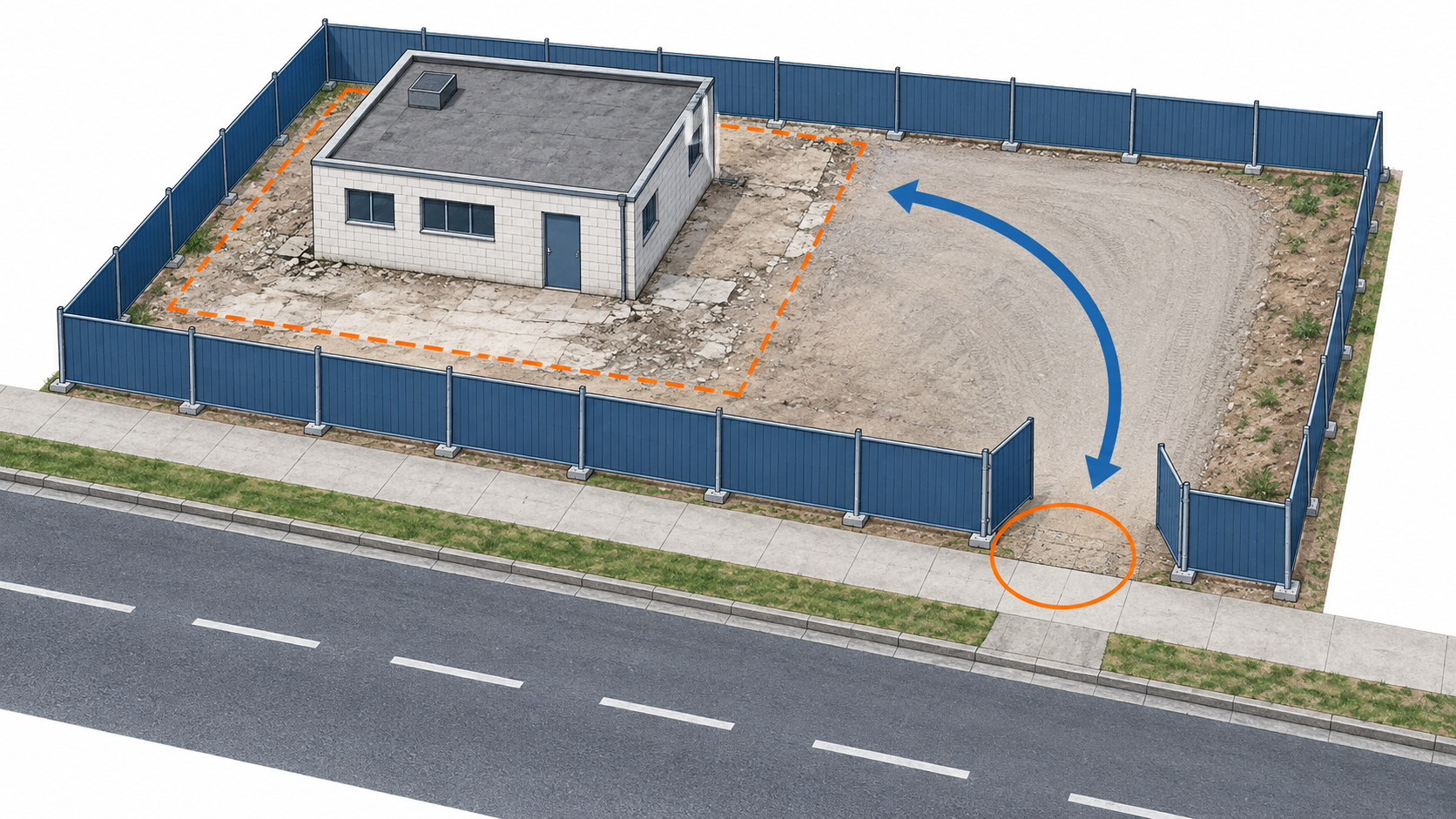
Cardwell's available internal space can support a proposal to keep loading within the lot. That preference still needs testing against the actual survey, entry and exit, vehicle movement and ground conditions. A gate can cross a pedestrian or road interface even when the loading activity is inside the fence. The generic interface illustration LA-14 makes that relationship visible without prescribing a clearance distance.
The road-access documents in the packet concern their own approved or proposed works. Read those conditions separately from a demolition access proposal. Do not infer that Queensland project permissions authorise work in New South Wales, or that internal loading removes every traffic-management question.
Site access and surrounding movement
LEARNING AID A generic learning aid explains a principle. It does not establish a project fact, hidden condition, capacity, approval or work release.
 Open full-size illustration
A fenced site contains a marked work area and an indicative internal movement route. The gate crosses a public footpath beside the road; the circle identifies an interface to review. No route, separation distance or public-protection arrangement is approved by this diagram.
A generic learning aid explains a principle. It does not establish a project fact, hidden condition, capacity, approval or work release.
This visual is draft case-study teaching material. Reading it is not an inspection, a measurement or evidence of performance.
Public and visitor access
Public users cannot be assumed to understand construction signals or recognise a demolition exclusion zone. A pedestrian route should be legible, continuous and suitable for its users, including people with mobility or vision limitations. Sending someone around an obstruction is not enough if the alternative leads into traffic or ends without a safe connection.
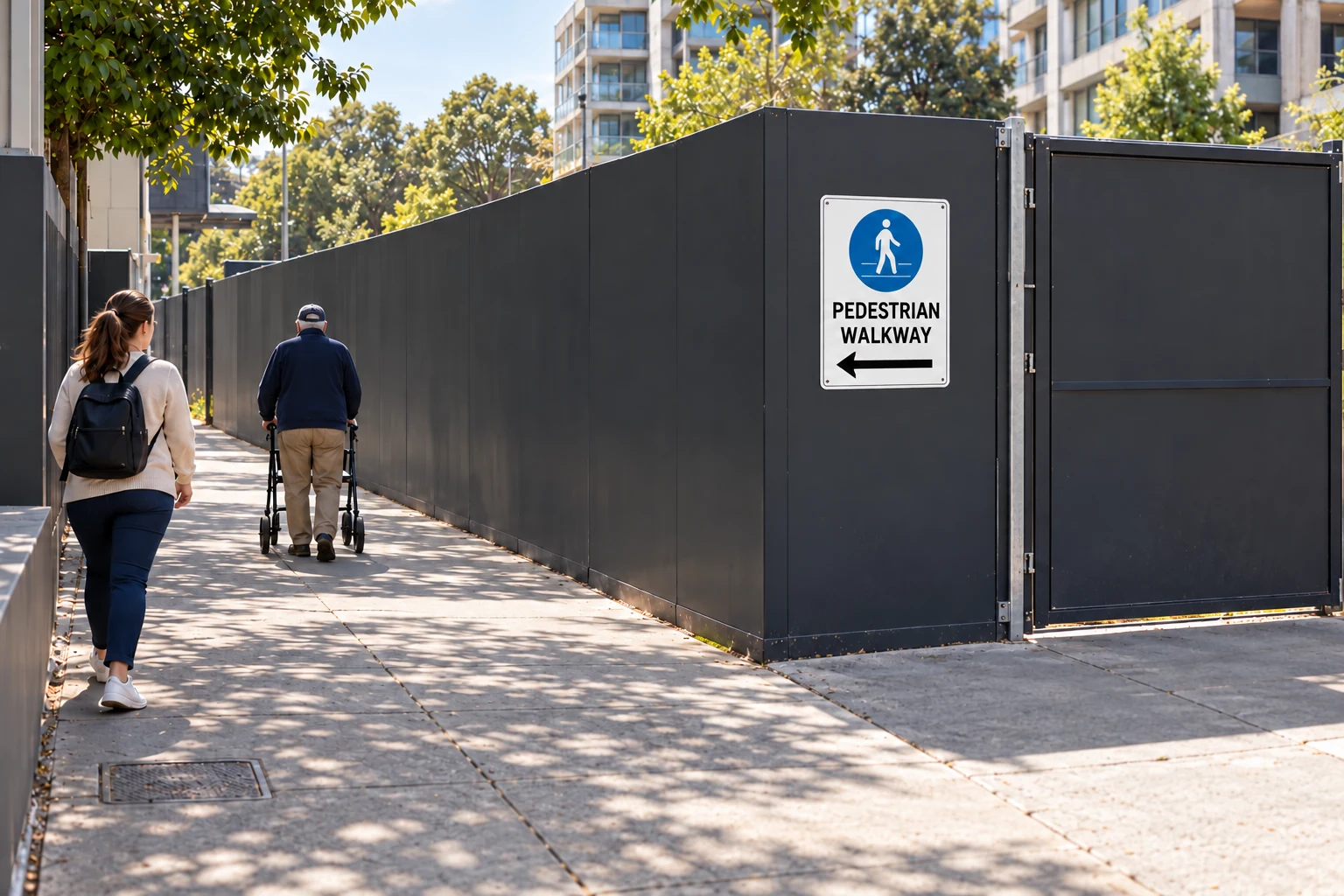
Look along the whole journey for obstructions, confusing directions and unsafe interfaces.
This generic scene does not establish accessibility compliance or an approved public-road traffic-control layout.
OnShift educational illustration, AI-generated and visually reviewed for this preview; not a project photograph.
- SafeWork NSW · Plant, machinery and equipment
- SafeWork NSW · Emergency plans
- SafeWork NSW · Demolition work Code of Practice
Site visitors need a clear arrival point and assistance arrangements. Delivery drivers need to know whether they remain in a designated place or contact a nominated person. Workers need safe routes to amenities and parking. These different movements should be considered together so that protecting one route does not create another conflict.
Temporary works and barriers need inspection because the environment changes. Wind, impact, material storage or a relocated gate may reduce their effectiveness. Signs that are obscured, contradictory or left over from an earlier stage can confuse even experienced workers. The current arrangement should communicate one understandable route and boundary.
Moving a gate to improve truck access can affect other uses. That change may move the pedestrian crossing, obscure a neighbour's entrance and alter the emergency meeting point. It is therefore a traffic and emergency change as well as a fencing change. Review the linked plans, communicate the new arrangement and inspect it in use. Where a measure affects public infrastructure or access rights, obtain the relevant decision through the authorised process. Do not rely on a convenient temporary arrangement becoming permanent by habit.
Condition records and monitoring answer different questions
A dilapidation report records observed condition at a stated time. It may describe cracks, finishes, alignment and other visible features, with location references and photographs. It helps establish a baseline for later comparison. It is not automatically an assessment of structural capacity, an approval of the demolition method or a guarantee that no damage will occur.
A useful baseline identifies inspection limits. Areas not accessed or concealed by finishes remain unknown. Photographs need enough context to locate the feature later; a close-up without direction or reference can be difficult to interpret. Preserve dates, authorship and the original record rather than replacing earlier images when conditions change.
Monitoring measures selected changes or exposures. For vibration, movement, dust or noise, the plan needs an appropriate method, locations, criteria and response arrangements. An instrument collecting data is not a complete control unless someone reviews the data and acts when required. Criteria must come from the relevant competent assessment and project conditions, not an unrelated template.
A neighbour may report a newly noticed crack. Record the report, check immediate safety concerns and compare relevant baseline and monitoring information through the appropriate review. Do not promise either that demolition caused it or that it was certainly pre-existing without evidence. A careful distinction between observation, interpretation and decision protects the quality of the investigation and makes communication more credible.
Interpreting a control record
A control record for a material-transfer area needs to identify the activity, location, revision and intended use. These details establish whether the document applies to the work. Its supporting information and unresolved assumptions are equally important: changing a heading does not make an unrelated record applicable.
A hazard entry must explain the route to harm. Terms such as plant or debris identify a subject but not the exposure. The record needs to establish how movement or material could reach workers, visitors, neighbouring property or an environmental receptor. Deliveries and changing work areas can alter those pathways.
The control entry distinguishes measures that are proposed from those already implemented. It identifies how each measure reduces exposure, who establishes and maintains it, and what technical information it depends on. Exclusion distances and load limits require the relevant site-specific basis; they cannot be derived from a generic form.
Verification must address the condition being relied upon. A photograph may establish the location of a sign, but it cannot establish the capacity of a structural support. A signature may record acknowledgement without verifying the assumptions behind the arrangement.
If a delivery blocks the planned route, the review must address the changed movement and exposure. The revised arrangement must be communicated and obsolete instructions withdrawn from use. Traffic arrangements, the demolition work plan, relevant safe work method statements, emergency access and briefings must remain consistent. A permit authorises a defined activity under specified conditions; it does not replace unrelated technical confirmations.
Community communication and complaints
Good community communication explains the planned work, relevant timing, contact arrangements and how concerns will be handled. It should be accurate about uncertainty. Do not promise no noise, no dust or no disruption when the project cannot establish those outcomes. Explain the controls and the process for responding to a changed condition instead.
A complaint is not automatically proof of a control failure, but it is information that deserves a traceable response. Record the location, time, description and any immediate risk. Compare it with the work occurring, weather, traffic and monitoring where relevant. A report of dust at an air intake may reveal a pathway that was absent from the original plan.
Close the communication loop. Identify who investigates, what temporary action is needed, when a response is due and how the outcome is communicated. Keep personal details in the appropriate private records. A public notice does not need to expose a complainant's identity or medical information.
A complaint can identify a receptor, time or pathway that monitoring has not represented. A reading within its criterion does not settle a report about a different exposure. The complaint, work records and monitoring need to be examined together.