
Hazardous materials and asbestos interfaces
Material identity, condition and disturbance determine exposure. Surveys, specialist removal and clearance each establish different facts within defined areas and limits.
The hazard depends on the material and its disturbance
Hazardous materials can be part of the building, left from its former use or brought onto the demolition site. Examples may include asbestos-containing products, hazardous coatings, chemical residues and contaminated soil. Identifying a material is important, but the planned disturbance also matters. A stable surface and a process that breaks or heats it can present different exposure pathways.
Asbestos-containing material is often shortened to ACM. Its appearance alone cannot reliably establish whether asbestos is present. A product that resembles a familiar non-asbestos material may still require competent identification. An old sheet cannot be recorded as confirmed asbestos without supporting evidence. Identified, assumed and not yet investigated are different information states. Assumed and confirmed asbestos may both require protective treatment, but their supporting evidence differs.
The risk picture includes people beyond the main work party. Dust or residues can be transferred on equipment, clothing, waste or vehicle routes if controls fail. Storage and removal arrangements should therefore be coordinated with the site's other activities, including access, amenities and emergency routes.
Planning connects the material to be disturbed with what is known about it and the investigation or specialist work needed before that disturbance. Treating all material as ordinary debris overlooks specific hazards. A broad hazardous-material label is also insufficient unless the relevant controls and evidence are identified.
Lead, PCBs and synthetic mineral fibres
Lead, polychlorinated biphenyls and synthetic mineral fibres have different release mechanisms and evidence needs. Their presence in an individual building requires investigation; a broad hazardous-materials label does not establish which substances are present.
Lead can occur in old coatings, plumbing, flashing and other building components. Disturbing a lead-containing coating can release dust; heating lead-containing material can create hazardous fume. The important distinction is between knowing a product contains lead and understanding how the proposed work could expose people. Coating investigations, material test results and relevant product information should identify what was examined and where. A recent paint finish does not establish the composition of underlying layers. Identification informs the task controls, hygiene arrangements and specialist review; it does not authorise abrasive removal or hot work.
Polychlorinated biphenyls, abbreviated PCBs, are hazardous chemicals associated with some older electrical equipment, including capacitors and transformers. Damaged equipment or leaking contents can create chemical exposure during dismantling or clean-up. Not every old electrical item contains PCBs. Equipment identification, asset records, manufacturer information and the hazardous-materials investigation help establish the contents and limitations of the available evidence. Electrical isolation addresses an energy hazard, not the identity or condition of the contents. Required handling and destination evidence remain separate questions. A suspect leak therefore needs the site's hazardous-material response and competent investigation, not an improvised wipe-down by the demolition crew.
Synthetic mineral fibres, or SMF, is an older term associated with man-made vitreous fibres used in insulation, including thermal, acoustic and fire-related products. Glass, rock and slag fibre products are examples. Disturbance can release fibres that irritate skin, eyes and the upper respiratory tract. SafeWork NSW's guidance for low-biopersistence insulation does not cover every fibre product: refractory ceramic fibres and some special-purpose fibres are outside that guidance. Low biopersistence describes fibres that the body can break down more readily; it is not a declaration that all insulation dust is harmless.
For these materials, connect the survey location and condition with the specific product or equipment information. An SDS explains a supplied product; it cannot prove the identity of unknown legacy insulation or an unlabelled electrical component. Missing identification remains an investigation gap.
Interpreting a control record
A control record for a material-transfer area needs to identify the activity, location, revision and intended use. These details establish whether the document applies to the work. Its supporting information and unresolved assumptions are equally important: changing a heading does not make an unrelated record applicable.
A hazard entry must explain the route to harm. Terms such as plant or debris identify a subject but not the exposure. The record needs to establish how movement or material could reach workers, visitors, neighbouring property or an environmental receptor. Deliveries and changing work areas can alter those pathways.
The control entry distinguishes measures that are proposed from those already implemented. It identifies how each measure reduces exposure, who establishes and maintains it, and what technical information it depends on. Exclusion distances and load limits require the relevant site-specific basis; they cannot be derived from a generic form.
Verification must address the condition being relied upon. A photograph may establish the location of a sign, but it cannot establish the capacity of a structural support. A signature may record acknowledgement without verifying the assumptions behind the arrangement.
If a delivery blocks the planned route, the review must address the changed movement and exposure. The revised arrangement must be communicated and obsolete instructions withdrawn from use. Traffic arrangements, the demolition work plan, relevant safe work method statements, emergency access and briefings must remain consistent. A permit authorises a defined activity under specified conditions; it does not replace unrelated technical confirmations.
Surveys, registers and safety data sheets
A hazardous-materials survey reports what was investigated, where, by whom and with what limitations. An asbestos register records identified or assumed asbestos and relevant location and condition information. A safety data sheet, or SDS, describes a chemical product and its hazards and precautions. These documents can inform one another, but none replaces the others.
Read a survey's scope before reading its conclusion. Was the inspection appropriate to the proposed demolition? Which areas were inaccessible? Were concealed spaces investigated, and which materials were sampled or assumed? A finding of no asbestos in sampled material does not automatically extend to every unsampled or inaccessible location.
Current SafeWork NSW demolition guidance requires the asbestos information to be checked before demolition and competent inspection where the register is unavailable. The arrangements for asbestos removal must be resolved before the dependent demolition work. Where access to concealed material itself requires disturbance, that interface needs specifically planned competent control; it is not permission for uncontrolled exploratory demolition.
A survey may exclude a locked plant room. A later scope drawing includes that room, but the report has not changed. The room remains an information gap even if every other page is marked reviewed. Record its location, the proposed disturbance and the work held pending investigation. The strongest document review keeps the limitations visible rather than turning a qualified conclusion into a site-wide assurance.
The Cardwell asbestos audit, UP060, is an example of a report that must be read with its scope. Find the building or area, the item entry, the basis of identification and any inaccessible locations. Read the finding together with its limitations. A positive identification concerns the described item; an exclusion is not a negative result.
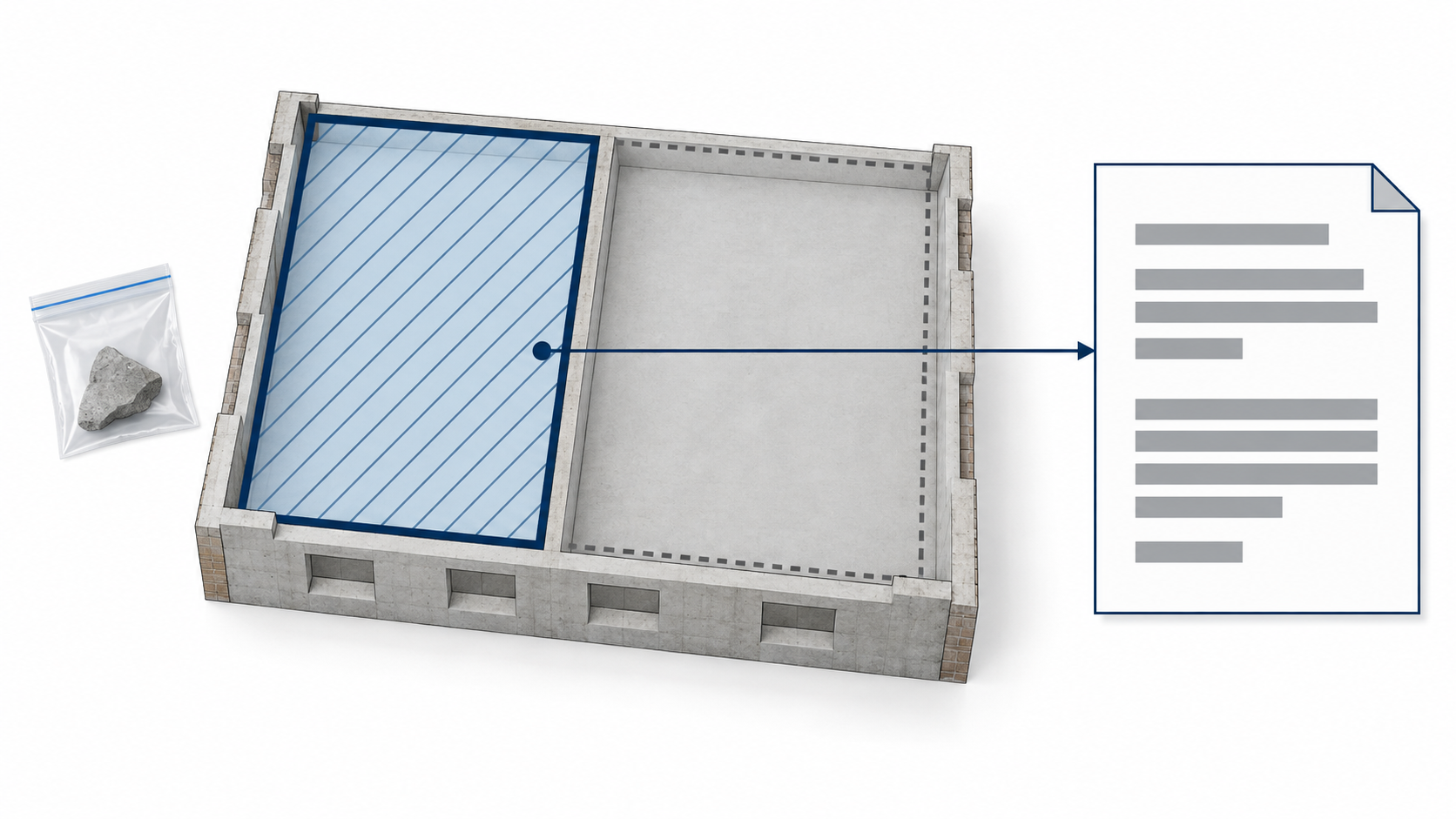
LA-13 represents this relationship with an inspected area and a separate area outside the illustrated scope. It does not identify a material or laboratory result. The actual audit supplies those details. Building appearance or an assumed construction decade cannot substitute for the report.
Interpreting a control record
A control record for a material-transfer area needs to identify the activity, location, revision and intended use. These details establish whether the document applies to the work. Its supporting information and unresolved assumptions are equally important: changing a heading does not make an unrelated record applicable.
A hazard entry must explain the route to harm. Terms such as plant or debris identify a subject but not the exposure. The record needs to establish how movement or material could reach workers, visitors, neighbouring property or an environmental receptor. Deliveries and changing work areas can alter those pathways.
The control entry distinguishes measures that are proposed from those already implemented. It identifies how each measure reduces exposure, who establishes and maintains it, and what technical information it depends on. Exclusion distances and load limits require the relevant site-specific basis; they cannot be derived from a generic form.
Verification must address the condition being relied upon. A photograph may establish the location of a sign, but it cannot establish the capacity of a structural support. A signature may record acknowledgement without verifying the assumptions behind the arrangement.
If a delivery blocks the planned route, the review must address the changed movement and exposure. The revised arrangement must be communicated and obsolete instructions withdrawn from use. Traffic arrangements, the demolition work plan, relevant safe work method statements, emergency access and briefings must remain consistent. A permit authorises a defined activity under specified conditions; it does not replace unrelated technical confirmations.
Inspection scope and its limits
LEARNING AID A generic learning aid explains a principle. It does not establish a project fact, hidden condition, capacity, approval or work release.
 Open full-size illustration
The hatched area represents the described inspection scope and is linked to a report. The separate plain area remains outside that illustrated scope. The sample icon does not identify a material or result. Read the actual report for exclusions, inaccessible areas and limitations.
A generic learning aid explains a principle. It does not establish a project fact, hidden condition, capacity, approval or work release.
This visual is draft case-study teaching material. Reading it is not an inspection, a measurement or evidence of performance.
Specialist removal still needs site coordination
A specialist contractor brings a defined capability and scope. The demolition project must still coordinate access, work boundaries, timing, connected activities, emergency arrangements and the evidence needed before other work resumes. Engaging a subcontractor does not make those interfaces disappear.
Check the contractor's relevant licence and capability against the actual work through the authorised process. Distinguish the removal scope, the removal-control documentation, the demolition plan and the work party's instructions. Each should describe compatible boundaries. A contractor may be authorised for a particular class of work without being engaged to remove every hazardous material on the site.
A removal area beside the only planned waste route creates a conflict between specialist work and material transport. The demolition crew's transport cannot simply continue through the area on the assumption that the specialists will manage around it. The project needs a coordinated arrangement that preserves the removal controls and the transport requirements. Any changed route must also be checked against plant separation and emergency access.
Timing should include investigation, required notifications, specialist work, relevant monitoring and clearance arrangements, and the review of evidence before dependent work. These are real programme activities. Compressing them into a single milestone called asbestos done can hide important conditions. The supervisor should understand what releases the next activity, who is authorised to establish that release and what remains excluded afterwards. This does not extend to directing the specialist's technical removal method.
Clearance evidence has a boundary
Clearance documentation must be read for the work and area it covers, the relevant inspection and monitoring information, the issuer's role and any qualifications or restrictions. Different asbestos-removal circumstances have different requirements. Use the current NSW requirements and the appropriate independent professional rather than assuming one certificate format fits every job.
A clearance certificate for a defined removal area is not a certificate that every concealed part of the property has been investigated. Nor does it establish structural stability, service isolation or waste destination. These are separate release questions. The next demolition stage can rely only on what the evidence actually establishes.
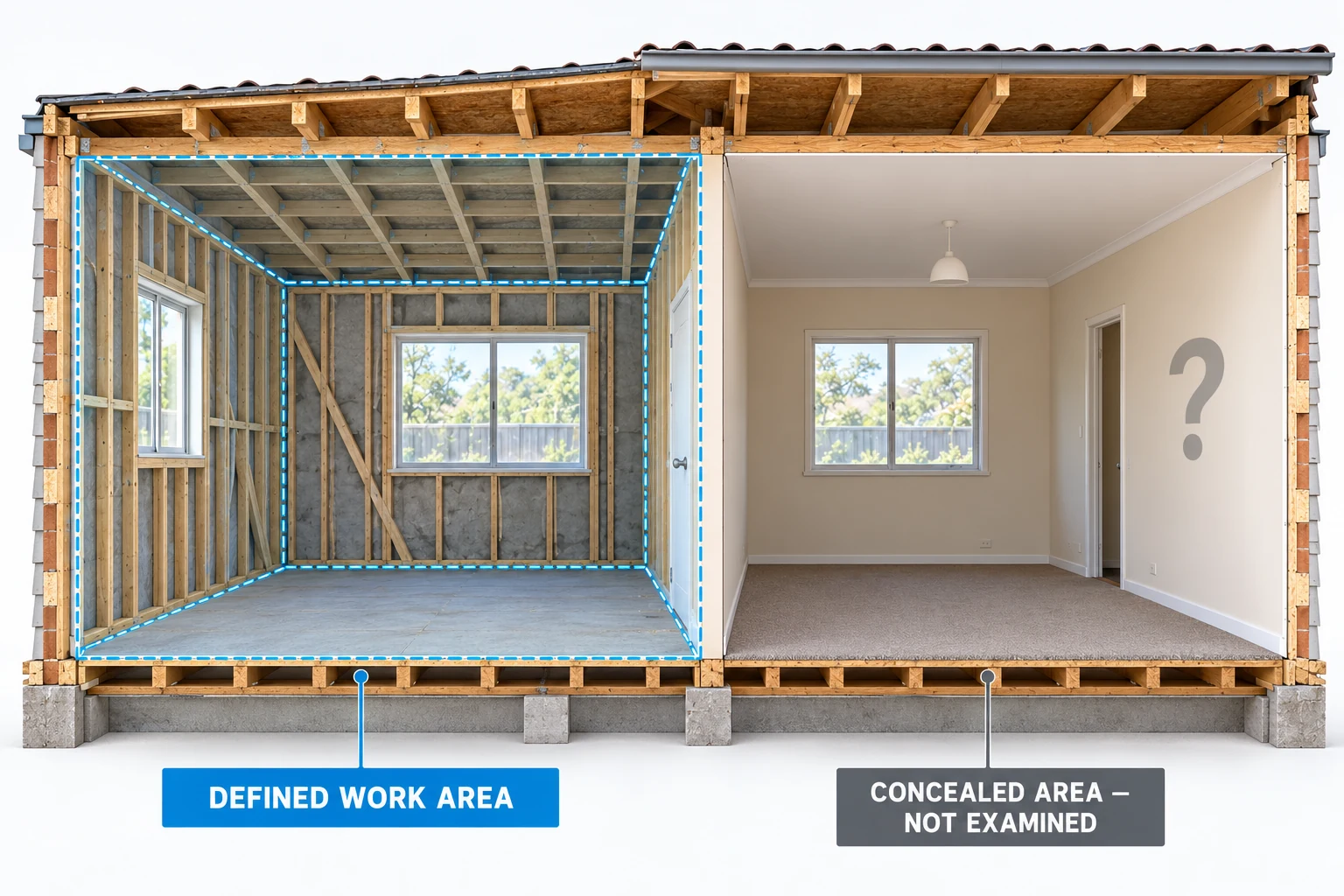
Evidence for a defined area does not establish conditions in concealed areas outside its scope.
This is not a clearance certificate, asbestos identification, structural assessment or release for work.
OnShift educational illustration, AI-generated and visually reviewed for this preview; not a project photograph.
- SafeWork NSW · Working as a licensed asbestos assessor
- SafeWork NSW · Asbestos
- NSW EPA · Construction and demolition waste
Waste and potentially contaminated equipment also need the correct handling and destination arrangements. A general rubble docket does not replace asbestos-waste documentation or demonstrate decontamination. The EPA's material-specific requirements remain relevant alongside worker-protection requirements. Do not infer that an item is suitable for reuse because it has been removed from the original building.
One enclosure may be cleared while another surveyed area remains excluded. The site plan, access controls and briefing must preserve that distinction. A broad verbal statement that the asbestos work is finished could mislead the next crew. A precise handover names the released area, evidence reference, continuing exclusions and outstanding actions. An assurance should not extend beyond the inspection or authority supporting it.
Interpreting a control record
A control record for a material-transfer area needs to identify the activity, location, revision and intended use. These details establish whether the document applies to the work. Its supporting information and unresolved assumptions are equally important: changing a heading does not make an unrelated record applicable.
A hazard entry must explain the route to harm. Terms such as plant or debris identify a subject but not the exposure. The record needs to establish how movement or material could reach workers, visitors, neighbouring property or an environmental receptor. Deliveries and changing work areas can alter those pathways.
The control entry distinguishes measures that are proposed from those already implemented. It identifies how each measure reduces exposure, who establishes and maintains it, and what technical information it depends on. Exclusion distances and load limits require the relevant site-specific basis; they cannot be derived from a generic form.
Verification must address the condition being relied upon. A photograph may establish the location of a sign, but it cannot establish the capacity of a structural support. A signature may record acknowledgement without verifying the assumptions behind the arrangement.
If a delivery blocks the planned route, the review must address the changed movement and exposure. The revised arrangement must be communicated and obsolete instructions withdrawn from use. Traffic arrangements, the demolition work plan, relevant safe work method statements, emergency access and briefings must remain consistent. A permit authorises a defined activity under specified conditions; it does not replace unrelated technical confirmations.
Unexpected hazardous materials
Unexpected material may appear behind a lining, beneath a slab or among stored items. Further disturbance needs to be prevented while the material is identified and the work is reviewed. Follow the site's unexpected-find arrangements and involve the appropriate responsible people. Do not break, scrape, burn or handle the material to prove what it is.
Record the location, activity, appearance and available context from a safe position. State suspected material rather than inventing a laboratory conclusion. Consider whether the discovery affects nearby work, waste already moved or assumptions in the survey. The review should define the affected boundary without casually declaring the whole site clear or contaminated.
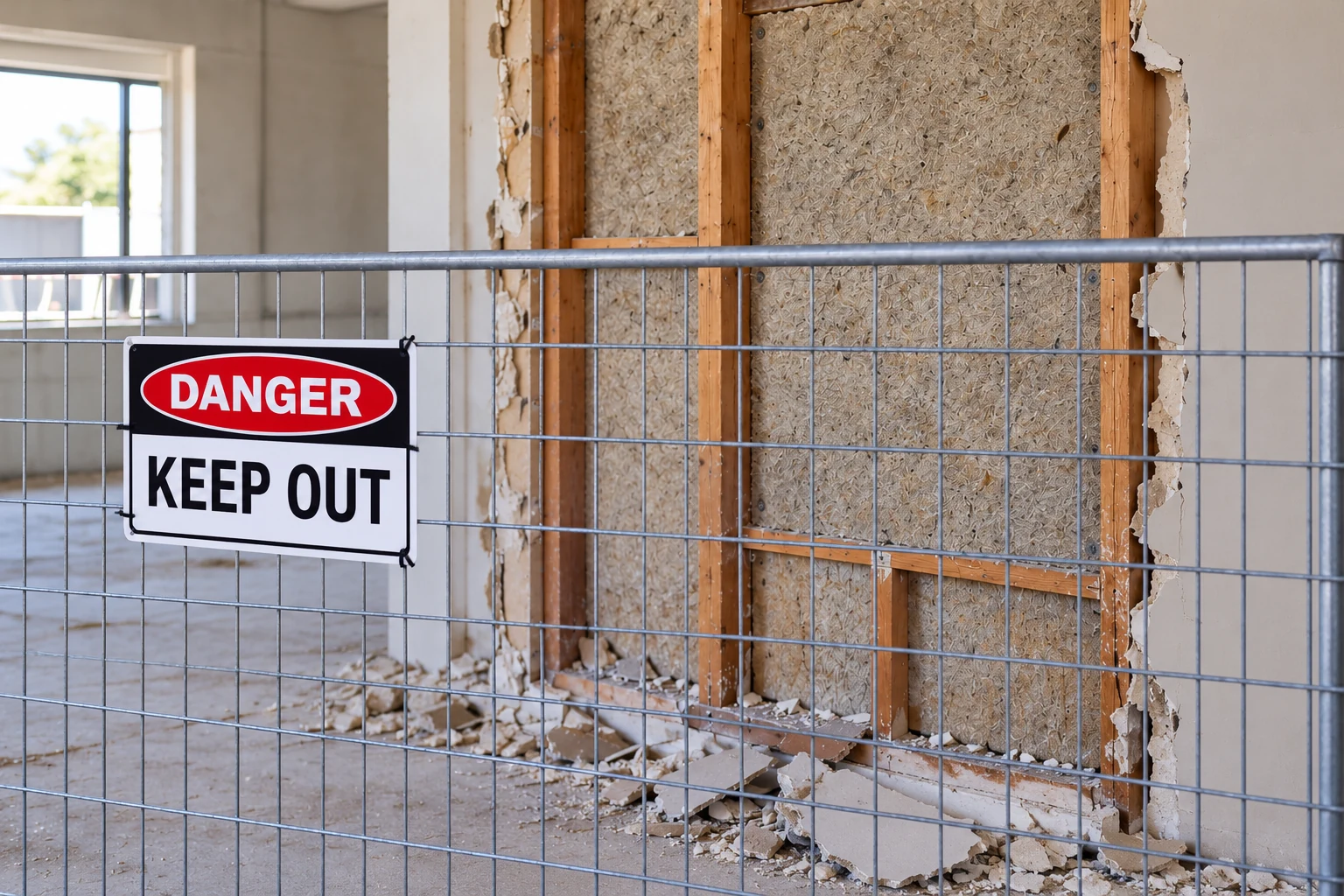
Record appearance and location from a safe position and follow the unexpected-find process. Keep further disturbance controlled.
The material is suspect, not identified as asbestos by the image. No sampling method, safe distance or clearance is supplied.
OnShift educational illustration, AI-generated and visually reviewed for this preview; not a project photograph.
Open full-size illustrationPreserve earlier information and add the new finding. Update the relevant register, plan, instructions and release status through the authorised process. If the discovery changes sequencing or access, communicate it to all affected work parties, including those whose task did not expose the material. A hidden hazard can become a shared interface very quickly.