
Experience and sound judgement
Experience becomes useful judgement when its context, evidence and limits are understood.
What experience reveals
Two people may spend the same number of years on demolition projects while holding different responsibilities. One may coordinate deliveries; another may plan work stages. Their job titles do not describe every skill they have exercised or every decision they are equipped to make.
Experience helps people recognise patterns: a crowded route, an unfamiliar machine response or a drawing that no longer fits the exposed construction. Sound judgement also recognises differences. An arrangement that worked on an earlier project may depend on space, equipment, structural conditions or support that is absent on the next.
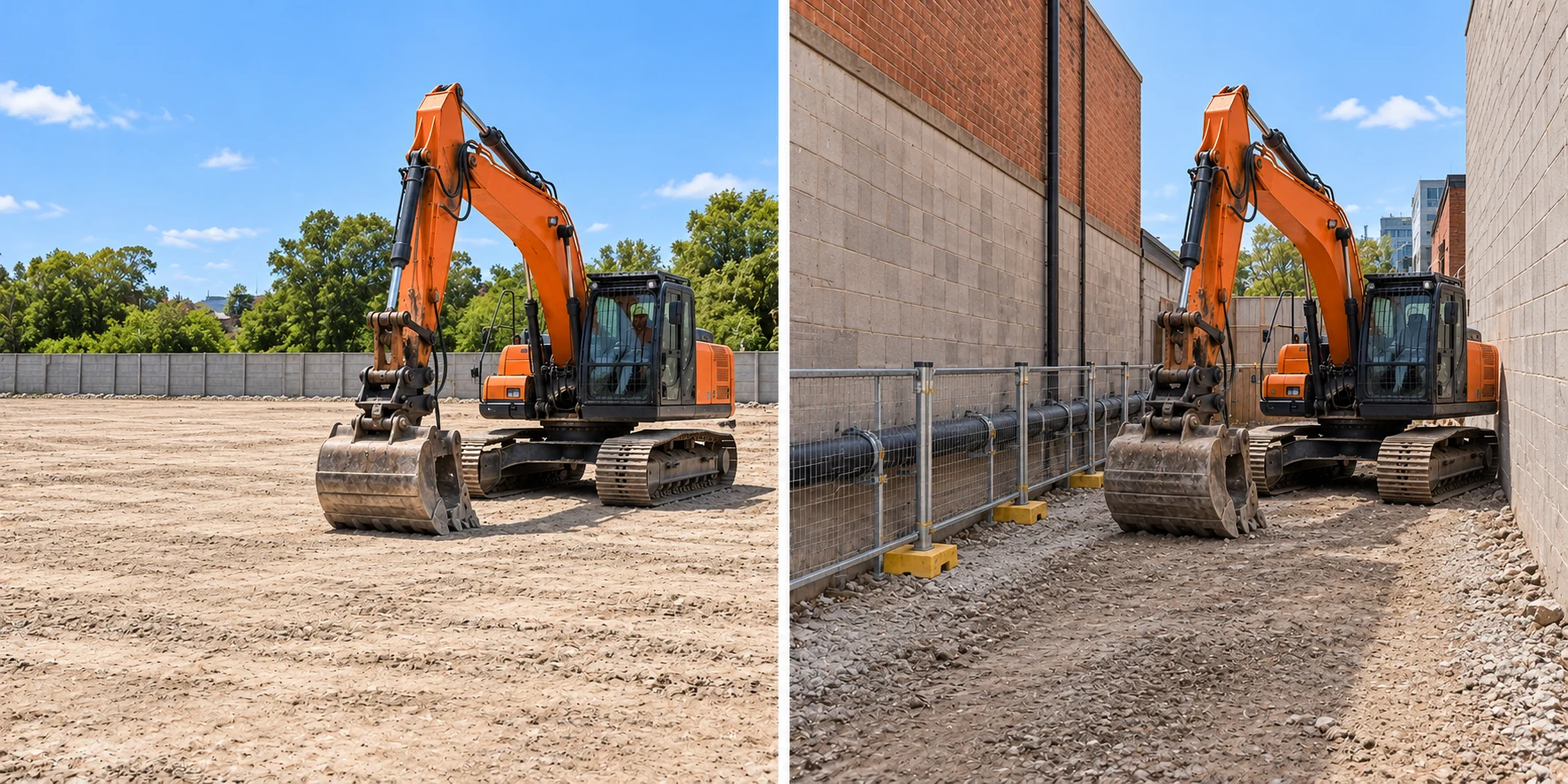
Space and retained assets change the questions that must be resolved before plant is used. Familiar equipment does not make the next job identical.
Neither view verifies machine suitability, ground capacity, clearance or an operating arrangement.
OnShift educational illustration, AI-generated and visually reviewed for this preview; not a project photograph.
Open full-size illustrationThe reason behind a familiar action matters. Requesting an updated drawing protects the connection between the instruction and the actual work. Understanding that reason makes experience useful when the next discrepancy looks different.
Experience and authorisation
Experience, training and permission to perform work are related but distinct. Familiarity with an activity does not establish that a person has the required licence or workplace authority for every task involving it. A demolition licence is a regulatory authorisation with its own scope and conditions.
The relevant question concerns the actual responsibility. A person may have coordinated work around plant without operating it, or reported a structural concern without deciding its solution. Assigning work requires an accurate understanding of that experience and of the authority the task requires.
Accurate accounts of work
An account of a workplace event distinguishes observation, action, decision and authorisation. At a meeting about a damaged access route, a supervisor might report the obstruction and later brief the crew on a revised route. The site manager or engineer may make decisions outside the supervisor's role. Recording who did what preserves the basis of the instruction.
Records also have limits. A photograph may show a barrier without identifying who selected it or whether it remained effective throughout the shift. A diary may show that a problem was reported without establishing that its technical cause was resolved. The record becomes more useful when these limits remain clear.
Workplace records can contain personal, commercial and site-security information. Their use and sharing belong within the organisation's authorised arrangements. Accurate attribution and dates matter. A later account must not appear to be a record made at the time. An unknown measurement must not be replaced with a plausible estimate presented as fact.
Recognising the limits of knowledge
Knowing a permit's purpose is different from understanding every condition attached to it. Understanding a structural principle is different from having the practical skill and authority to perform work that affects a structure.
These differences require different responses. A misunderstood term may need explanation. Unfamiliar work may need training and supervised development. An unresolved structural condition may need engineering advice. Judgement includes recognising which kind of uncertainty is present and keeping the affected decision within the right person's scope.