
Environmental, traffic and emergency plans
Environmental, traffic and emergency plans share the same site. Their routes, storage areas, controls and response arrangements need to remain compatible as work progresses.
Environmental controls and response triggers
Read an environmental plan from the receptor backwards. Which people, properties, waterways, soils or other values need protection? Which activities could affect them? What pathways connect the activity to the receptor? The proposed controls and monitoring should answer those specific relationships rather than present a general list of good intentions.
A usable arrangement identifies locations, responsibilities, inspection or measurement methods, relevant criteria and actions. A trigger is a defined condition requiring a response. It might be a damaged containment measure, a forecast event, an observed release or a measurement reaching a project-specific criterion. The criterion must come from the appropriate assessment and authority; the plan should not invent it.
A monitoring schedule should identify who receives results and how quickly a decision is made. If the information arrives after the affected activity has continued unchecked, the response arrangement may be ineffective. The planned action needs to be feasible with the available people, equipment and authority.
A dust-control plan may include a weather review but no one is assigned to respond to a wind change. The measurement or forecast is available, yet the decision link is missing. Define the responsible review and work restrictions through the authorised process. Keep records of the conditions, decision and follow-up. This turns environmental monitoring into a feedback system rather than a folder of measurements disconnected from what happened on site.
Interpreting a control record
A control record for a material-transfer area needs to identify the activity, location, revision and intended use. These details establish whether the document applies to the work. Its supporting information and unresolved assumptions are equally important: changing a heading does not make an unrelated record applicable.
A hazard entry must explain the route to harm. Terms such as plant or debris identify a subject but not the exposure. The record needs to establish how movement or material could reach workers, visitors, neighbouring property or an environmental receptor. Deliveries and changing work areas can alter those pathways.
The control entry distinguishes measures that are proposed from those already implemented. It identifies how each measure reduces exposure, who establishes and maintains it, and what technical information it depends on. Exclusion distances and load limits require the relevant site-specific basis; they cannot be derived from a generic form.
Verification must address the condition being relied upon. A photograph may establish the location of a sign, but it cannot establish the capacity of a structural support. A signature may record acknowledgement without verifying the assumptions behind the arrangement.
If a delivery blocks the planned route, the review must address the changed movement and exposure. The revised arrangement must be communicated and obsolete instructions withdrawn from use. Traffic arrangements, the demolition work plan, relevant safe work method statements, emergency access and briefings must remain consistent. A permit authorises a defined activity under specified conditions; it does not replace unrelated technical confirmations.
Traffic plans and supporting checklists
A checklist can prompt useful questions about separation, reversing, surfaces, visibility and access. It does not necessarily show the route, allocate responsibility or establish the arrangements for a particular delivery. Treat it as an inspection aid supporting the plan, not proof that a complete movement system has been designed.
The plan should connect the layout to operating arrangements: arrival information, waiting, entry, loading, pedestrian routes, communication, emergency access and changes through the project. Vehicle characteristics and the site's constraints need appropriate competent consideration. A line on a drawing does not demonstrate that the intended vehicle can use the route under actual conditions.
Identify interfaces with public roads and neighbouring access. Any required public traffic measures or permissions need the relevant authorised process. A private arrangement among contractors cannot automatically establish authority over a footpath, lane or shared access right.
A traffic plan may provide a safe pedestrian route in ordinary operation. During a large delivery, the gate arrangement blocks that route. The plan needs to describe the controlled alternative or the restriction on conflicting activities, not leave a visitor to negotiate around the vehicle. Test the scenario through a safe planning discussion and inspection. When the route changes, update the induction and emergency information too. The objective is a usable system for predictable variations, with a clear process for exceptions that were not anticipated.
Plant, people and public interfaces
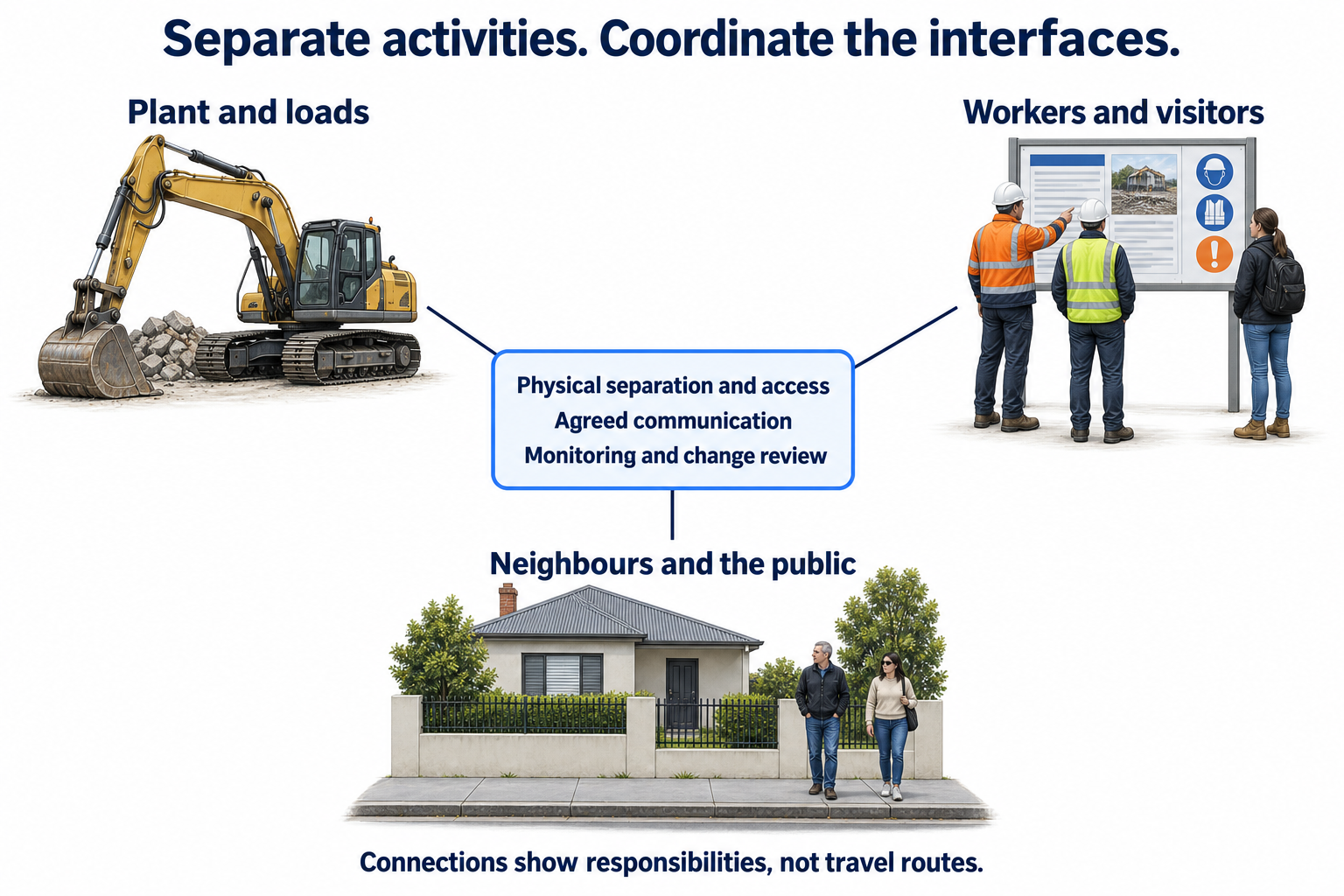
Separation depends on coordinated physical controls, access arrangements and communication.
 Open full-size illustration
Plant and loads, workers and visitors, and neighbouring properties and the public create interacting demands on a demolition site. The three groups in the diagram connect to shared controls: physical separation, access rules, communication, monitoring and review of changes. The lines represent these relationships, not movement routes.
The arrangement must also preserve emergency and authorised access. Its design depends on the work, plant, material behaviour, surrounding uses and relevant technical information. A boundary on a drawing does not itself provide a barrier, contain flying debris, verify ground capacity or protect an adjoining structure.
Deliveries, loading operations, changed pedestrian routes and open gates can create new connections between previously separated activities. Responsibility for access and communication must be clear. A sign or a spotter alone cannot establish that every exposure has been controlled.
Emergency arrangements must be available in the moment
An emergency plan should be understandable under pressure. It needs the alarm and communication arrangements, evacuation, assistance, emergency-service notification and access, responsible roles, training and testing. It should reflect the actual hazards, workplace size, location and people present, including visitors and other businesses sharing the site.
A contact list is useful but insufficient. The plan must say how people recognise and report an emergency, and where they move without entering another hazard. It must also say how their presence is accounted for and who coordinates the response. A person named in the plan but absent from the shift cannot perform the role unless a suitable alternative arrangement exists.
Specialist rescue interfaces require their own effective arrangements. A confined-space or fall-arrest task cannot rely solely on a general evacuation poster. Do not assume ordinary first-aid capability includes entry rescue or rescue from unstable structures. The applicable trained people and equipment must be planned and tested through suitable controlled arrangements.
An emergency plan needs a clear route from the initial call to responders reaching the site. Accurate location information, an accessible nominated gate and a person able to meet responders from a safe position support that response. Known service and structural hazards need to be available to the coordinator. Any practical test of the arrangements must be controlled so participants are not exposed to the hazard being rehearsed.
Interpreting a control record
A control record for a material-transfer area needs to identify the activity, location, revision and intended use. These details establish whether the document applies to the work. Its supporting information and unresolved assumptions are equally important: changing a heading does not make an unrelated record applicable.
A hazard entry must explain the route to harm. Terms such as plant or debris identify a subject but not the exposure. The record needs to establish how movement or material could reach workers, visitors, neighbouring property or an environmental receptor. Deliveries and changing work areas can alter those pathways.
The control entry distinguishes measures that are proposed from those already implemented. It identifies how each measure reduces exposure, who establishes and maintains it, and what technical information it depends on. Exclusion distances and load limits require the relevant site-specific basis; they cannot be derived from a generic form.
Verification must address the condition being relied upon. A photograph may establish the location of a sign, but it cannot establish the capacity of a structural support. A signature may record acknowledgement without verifying the assumptions behind the arrangement.
If a delivery blocks the planned route, the review must address the changed movement and exposure. The revised arrangement must be communicated and obsolete instructions withdrawn from use. Traffic arrangements, the demolition work plan, relevant safe work method statements, emergency access and briefings must remain consistent. A permit authorises a defined activity under specified conditions; it does not replace unrelated technical confirmations.
Testing and revising connected plans
Changes to gates, routes, stockpiles, staffing, structures, services or work hours can affect several plans at once. A controlled change review should identify those affected documents and the people who use them. Updating one drawing while leaving other plans unchanged creates competing versions of the site.
Testing can include document walkthroughs, safe inspections, communication checks and appropriately planned exercises. The method should suit the question. A desktop discussion can reveal conflicting roles but cannot establish that a radio works at every required location. A practical check should be conducted safely and should not become an uncontrolled simulation of a hazardous event.
After a test or actual event, record what worked, what failed, what assumptions were wrong and which actions are required. Assign owners and verify closure. Preserve the earlier record so later reviewers can understand why the arrangement changed. Repeating the same exercise without closing the findings is activity without improvement.
An environmental control needs space to operate without blocking traffic. Vehicle movements must preserve emergency access, and the response must protect people without exposing them to the original hazard. An unresolved conflict between those functions requires a decision by the responsible people before the affected arrangements can be relied on.