
Observation and verification
Different observations and records support different conclusions about site conditions, actions and control performance.
Understanding, action and evidence
Knowledge is what a person understands. Performance is what the person actually does in a particular setting. Evidence is information supporting a claim. Verification examines whether a specified condition or control has been established. These are related, but none automatically substitutes for the others.
A person explaining why a plant defect should be reported shows understanding of the reporting purpose. A dated defect report records a fault. Observation of the equipment and the response adds information about its condition and how it was dealt with. Each supports a different conclusion.
A dashboard showing that every pre-start form has been submitted establishes something about record submission. It does not establish that every machine is serviceable. That conclusion needs information about the checks, findings, unresolved defects and actual equipment condition.
The scope of an observation
A useful record has a subject, a source and a boundary. The subject is what it concerns. The source is where the information came from. The boundary is what was and was not examined. A photograph of a gate at the start of the shift has a narrow time boundary. A structural report may exclude concealed connections. A noise observation may concern one activity without representing a worker's total exposure.
Different evidence can complement rather than compete. A drawing can describe an intended route; an inspection can show how the route was arranged; a worker's account can reveal that deliveries repeatedly blocked it. The disagreement is useful because it directs attention to the difference between intended and actual work. Simply choosing the most official-looking document would lose that information.
Consider an undated photograph that seems to show a protected opening. It may be relevant, but its location, timing and context remain uncertain. The sensible response is not to declare the photograph worthless or to invent missing details. Keep the uncertainty visible and seek clarification through the appropriate process. Evidence becomes more useful when its limits are described accurately. A large pile of unexplained records can be less informative than a small set whose origin and relevance are clear.
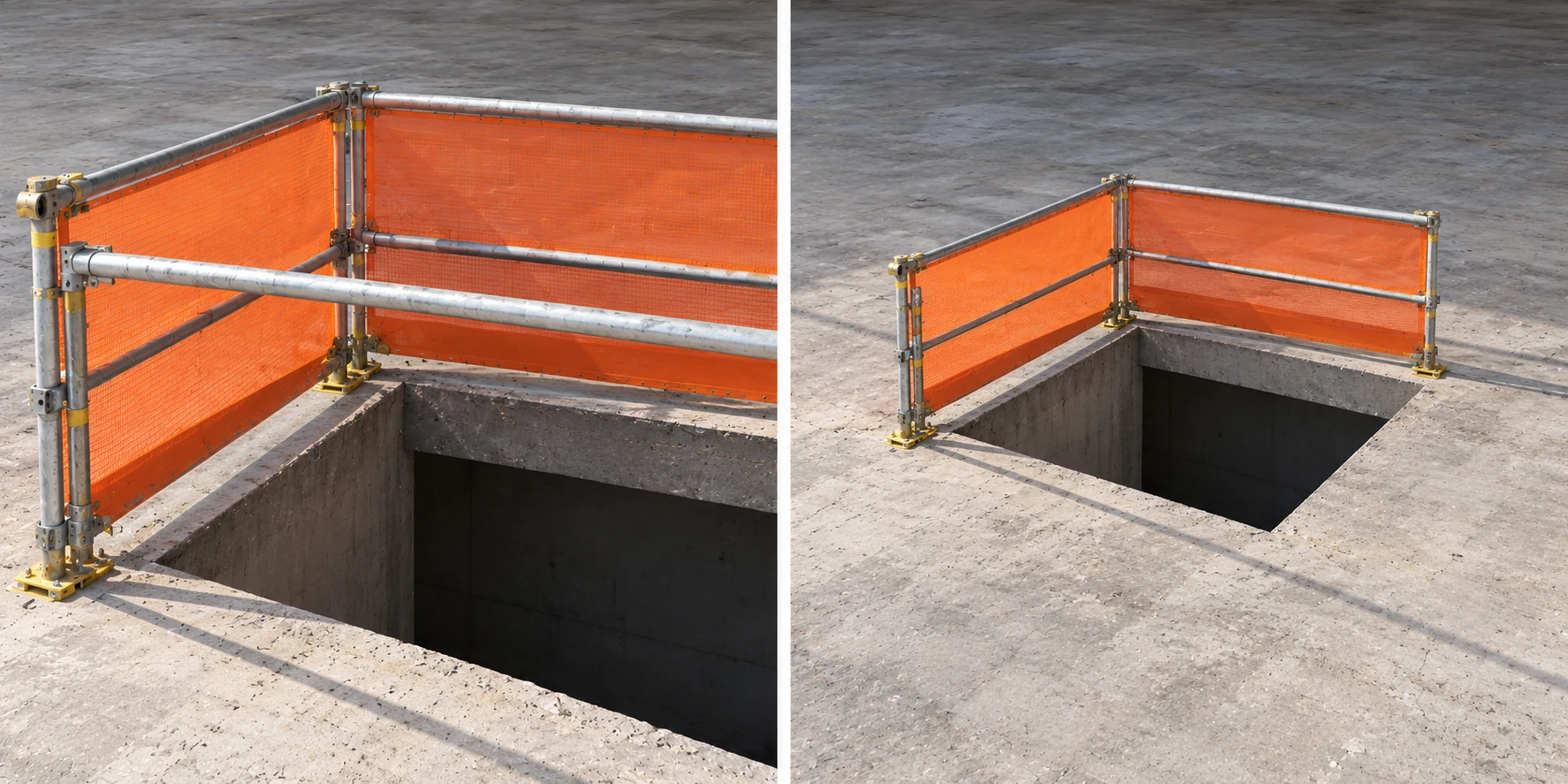
A photograph has a boundary. Check the location, time and parts of the arrangement outside its frame.
Both views depict an incomplete protective arrangement, not an acceptable way to guard an opening.
OnShift educational illustration, AI-generated and visually reviewed for this preview; not a project photograph.
Open full-size illustrationInterpreting a control record
A control record for a material-transfer area needs to identify the activity, location, revision and intended use. These details establish whether the document applies to the work. Its supporting information and unresolved assumptions are equally important: changing a heading does not make an unrelated record applicable.
A hazard entry must explain the route to harm. Terms such as plant or debris identify a subject but not the exposure. The record needs to establish how movement or material could reach workers, visitors, neighbouring property or an environmental receptor. Deliveries and changing work areas can alter those pathways.
The control entry distinguishes measures that are proposed from those already implemented. It identifies how each measure reduces exposure, who establishes and maintains it, and what technical information it depends on. Exclusion distances and load limits require the relevant site-specific basis; they cannot be derived from a generic form.
Verification must address the condition being relied upon. A photograph may establish the location of a sign, but it cannot establish the capacity of a structural support. A signature may record acknowledgement without verifying the assumptions behind the arrangement.
If a delivery blocks the planned route, the review must address the changed movement and exposure. The revised arrangement must be communicated and obsolete instructions withdrawn from use. Traffic arrangements, the demolition work plan, relevant safe work method statements, emergency access and briefings must remain consistent. A permit authorises a defined activity under specified conditions; it does not replace unrelated technical confirmations.
Judgement under working conditions
Real work involves noise, restricted visibility, changing materials and coordination with other people. The timing of an action can affect its consequences. A person may understand a tool's limitations while still needing supervised development to select and use it safely. An experienced worker may recognise a problem before being able to explain its cause.
A changed work area can invalidate the assumptions behind a familiar task. Recognising the difference, communicating it and acting within the relevant authority help prevent routine work continuing under conditions it was not planned for.
Obtaining information can itself create exposure. Approaching an unstable structure, disturbing suspect material or operating unfamiliar equipment requires the appropriate controls and authority. An ordinary observation must not become an uncontrolled investigation.
Proposed, checked, reviewed and authorised
Words such as proposed, observed, checked, reviewed and authorised describe different states. Proposed means someone has put forward an arrangement. Observed means a condition was seen or recorded. Checked means a stated check was performed. Reviewed means someone considered information within a scope. Authorised means the relevant decision-maker permitted a defined action. None of those words should silently mean every other one.
An invented example makes the distinction concrete. A supervisor proposes moving a storage area. A coordinator checks access implications. A specialist reviews an affected constraint. The authorised decision is then incorporated into the current plan and communicated. If the storage is moved before those dependencies are resolved, a later signature does not prove that the earlier exposure was controlled. Accurate dates and statuses preserve the sequence.
A review also needs a defined scope and a reviewer. Checking document consistency does not authorise a structural design or the start of work. Recording the subject, responsible person and limits of the decision prevents later readers from treating a narrow check as a general approval.