
Water, stormwater, groundwater, waste and environmental protection
Pollutants travel through air, water, ground and waste movements. Sediment control, water extraction, discharge, waste classification and destination checks address different parts of that movement.
Sources, pathways and receptors
Environmental protection becomes more concrete when you name a source, a pathway and a receptor. A source might be exposed soil, dusty stockpiles, fuel or demolition waste. Wind, runoff, vehicle movement and drainage can carry material. A receptor might be a worker, neighbouring property, waterway, soil, vegetation or a sensitive use beyond the fence.
This model explains why controls should be connected. Reducing dust with water may help one exposure pathway while increasing contaminated runoff. Moving a stockpile away from a neighbour may put it across a drainage line. The complete arrangement needs to manage the relevant pathways without creating another significant problem.
A site plan should distinguish clean-water routes, potentially contaminated areas, drainage structures, storage, loading, sensitive boundaries and authorised discharge arrangements where applicable. Ground shape and drainage can change as slabs, structures and temporary roads are removed. Yesterday's low point may no longer be the collection point today.
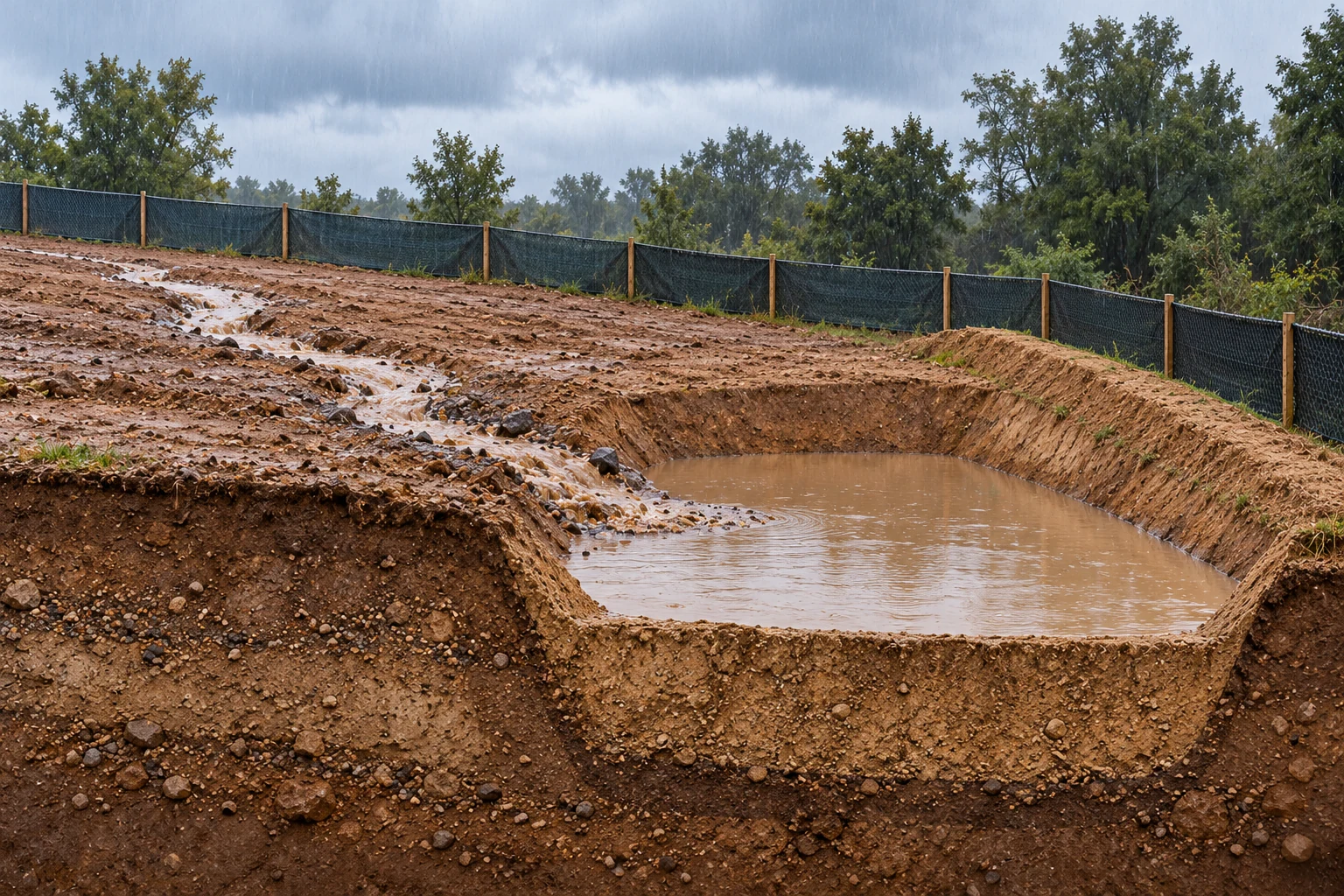
Connect the source, flow path and receiving area. Review changes in ground levels and the assessed water-management arrangements.
This is not a basin design, capacity calculation, treatment method or discharge permission. Containment does not establish water quality.
OnShift educational illustration, AI-generated and visually reviewed for this preview; not a project photograph.
- NSW EPA · Guidance for stormwater management: the drain is just for rain
- NSW EPA · Construction and demolition waste
- SafeWork NSW · Demolition work Code of Practice
Rainfall on an uncovered mixed-material stockpile near a gate can wash material into drainage and onto vehicle routes. Vehicles may carry it farther. The materials, flow direction and downstream receptors determine the investigation and controls needed. The stockpile's location alone cannot establish its waste classification or the required sediment-control design.
Sediment control is not universal water treatment
Sediment consists of particles carried by water or deposited from it. Coarser particles may settle more readily than very fine material. Dissolved chemicals are different: they are present in the water without necessarily making it look dirty. Oil may behave differently again. A device intended to retain sediment cannot be assumed to remove every chemical, dissolved metal or hydrocarbon.
This distinction matters when reading a water-control plan. Identify the expected contaminants and the function of each measure. Erosion controls aim to reduce material becoming detached and transported. Sediment controls manage material already moving in water. Containment keeps potentially contaminated water in a controlled area. Treatment must be selected for the water's actual characteristics. These functions complement one another but are not interchangeable.
Clear appearance is not a discharge test. Neither is a single result for one property. For example, a reading concerning acidity does not establish the absence of suspended solids or other contaminants. Appropriate sampling, criteria and interpretation depend on the receiving environment and the applicable approval or management requirements.
Housekeeping can reduce the burden on treatment: suitable storage, covered or protected materials, maintained routes and appropriately located washdown activities can prevent releases. Inspection should ask whether controls remain functional and have enough capacity for the conditions anticipated by the design. Basin dimensions, treatment methods and discharge limits need the relevant environmental assessment, design and current authority requirements.
Technical terms
Hazard — A source or situation with potential to cause harm.
Risk — The possibility of harm, considered with its likelihood and consequence in context.
Exposure — The opportunity for a person or receptor to come into contact with a hazard.
Consequence — The harm or loss that could result.
Control — A measure that eliminates or reduces risk.
Remaining risk — Risk considered after the specified controls have actually been applied.
Elimination — Removing the hazard or hazardous exposure from the work.
Substitution — Replacing a hazard with a less hazardous alternative.
Isolation — Separating people from a hazard.
Engineering control — A physical or designed measure that acts on a hazard or exposure pathway.
Administrative control — An arrangement such as procedures, scheduling, information or supervision.
PPE — Personal protective equipment.
RPE — Respiratory protective equipment.
SWMS — Safe work method statement; a document for relevant high-risk construction work.
DWP — Demolition work plan.
Permit — A bounded authorisation within a defined control system, not universal proof of safety.
Induction — Introduction to relevant site conditions, responsibilities and arrangements.
Pre-start — A check or briefing before work or equipment use; distinct from scheduled servicing.
Verification — Checking evidence that the required condition or control exists and works as intended.
Consultation — Sharing relevant information, hearing affected workers' views and considering them in decisions.
Load path — The connected route by which forces pass through a structure to its supports.
Compression — A pushing action within a material or member.
Tension — A pulling action within a material or member.
Bending — A response to loading that tends to curve a member.
Shear — Action tending to make parts move past one another.
Temporary works — Engineered or other temporary arrangements supporting construction or demolition needs; specialist design and control may be required.
Respirable dust — Particles small enough to reach deep into the lungs.
LEL — Lower explosive limit; the lowest flammable gas or vapour concentration in air at which flame can propagate under the relevant conditions. Percentage of LEL is not percentage gas concentration or a safe-breathing decision.
Receptor — The person, property or environmental feature potentially affected.
Change control — The process of recognising a change, reviewing affected assumptions and controls, and communicating the revised arrangement.
Air monitoring — Competently planned measurement of airborne contaminants to assess exposure and control effectiveness.
Health monitoring — Medical monitoring for health effects, carried out or supervised by an appropriately experienced doctor when required.
Groundwater involves both environmental and ground behaviour
Groundwater is water within the saturated ground system, not simply rain that has collected on a slab. Water entering an excavation may have several sources, including groundwater, surface runoff or a damaged service. Its origin matters because the management, approval and technical questions differ. Do not identify the source solely from the fact that a hole keeps filling.
Changing groundwater conditions can affect the surrounding ground and other water users or environmental receptors. A dewatering proposal therefore needs more than a pump capacity. Appropriate investigation considers the groundwater regime, possible effects of taking water, contamination, monitoring and the proposed destination of extracted water. The structural and geotechnical implications also need suitable review.
Water take and water discharge are separate questions. An authority or exemption relevant to taking groundwater does not automatically permit releasing that water into stormwater, sewer, land or a waterway. Current NSW water guidance also distinguishes water-access licence exemptions from other relevant approvals. An exemption should be checked against its actual scope and conditions, not treated as blanket permission.
A programme entry reading 'pump out basement, one day' conceals several dependencies: source identification, water quality, approval status, discharge arrangements, monitoring and possible ground effects. These need resolution before the equipment arrives. Pump capacity alone cannot establish a suitable dewatering arrangement.
Waste classification is not a visual guess
Demolition produces many material streams: concrete, masonry, metals, timber, plasterboard, soil, liquids and hazardous materials among them. A commercial description such as rubble or clean fill is not enough to establish the legal classification or permitted destination. Origin, composition, contamination and the applicable classification process matter.
The NSW EPA names six waste classes. Four are special waste, liquid waste, hazardous waste and restricted solid waste. The other two are general solid waste, putrescible, and general solid waste, non-putrescible. These are categories in the regulatory framework, not six visual labels that a supervisor can choose by looking at a load. The word general does not mean unrestricted disposal or reuse.
Classification is the process of establishing which class applies using the EPA Waste Classification Guidelines and the necessary information about the waste. The generator is responsible for appropriate classification. The applicable process may require investigation or testing; recognising a familiar material name is not a substitute. Separate storage preserves identified streams, while mixing can compromise their traceability and recovery options.
A waste facility being licensed does not mean it may receive every waste class. Check the actual receiving authority and acceptance conditions for the proposed material. Classification for disposal also does not automatically establish suitability for use on land. Resource recovery orders and exemptions, where relevant, are a separate boundary with their own conditions.
Read the classification information alongside the transport and destination records. A docket records what was described and delivered; it does not itself establish the technical basis for that description. Check that the material identity and applicable classification evidence follow through to the receiving authority and acceptance conditions.
Interpreting a control record
A control record for a material-transfer area needs to identify the activity, location, revision and intended use. These details establish whether the document applies to the work. Its supporting information and unresolved assumptions are equally important: changing a heading does not make an unrelated record applicable.
A hazard entry must explain the route to harm. Terms such as plant or debris identify a subject but not the exposure. The record needs to establish how movement or material could reach workers, visitors, neighbouring property or an environmental receptor. Deliveries and changing work areas can alter those pathways.
The control entry distinguishes measures that are proposed from those already implemented. It identifies how each measure reduces exposure, who establishes and maintains it, and what technical information it depends on. Exclusion distances and load limits require the relevant site-specific basis; they cannot be derived from a generic form.
Verification must address the condition being relied upon. A photograph may establish the location of a sign, but it cannot establish the capacity of a structural support. A signature may record acknowledgement without verifying the assumptions behind the arrangement.
If a delivery blocks the planned route, the review must address the changed movement and exposure. The revised arrangement must be communicated and obsolete instructions withdrawn from use. Traffic arrangements, the demolition work plan, relevant safe work method statements, emergency access and briefings must remain consistent. A permit authorises a defined activity under specified conditions; it does not replace unrelated technical confirmations.
Waste identification and traceability
Records connect the material, transport arrangements and authorised receiving destination.
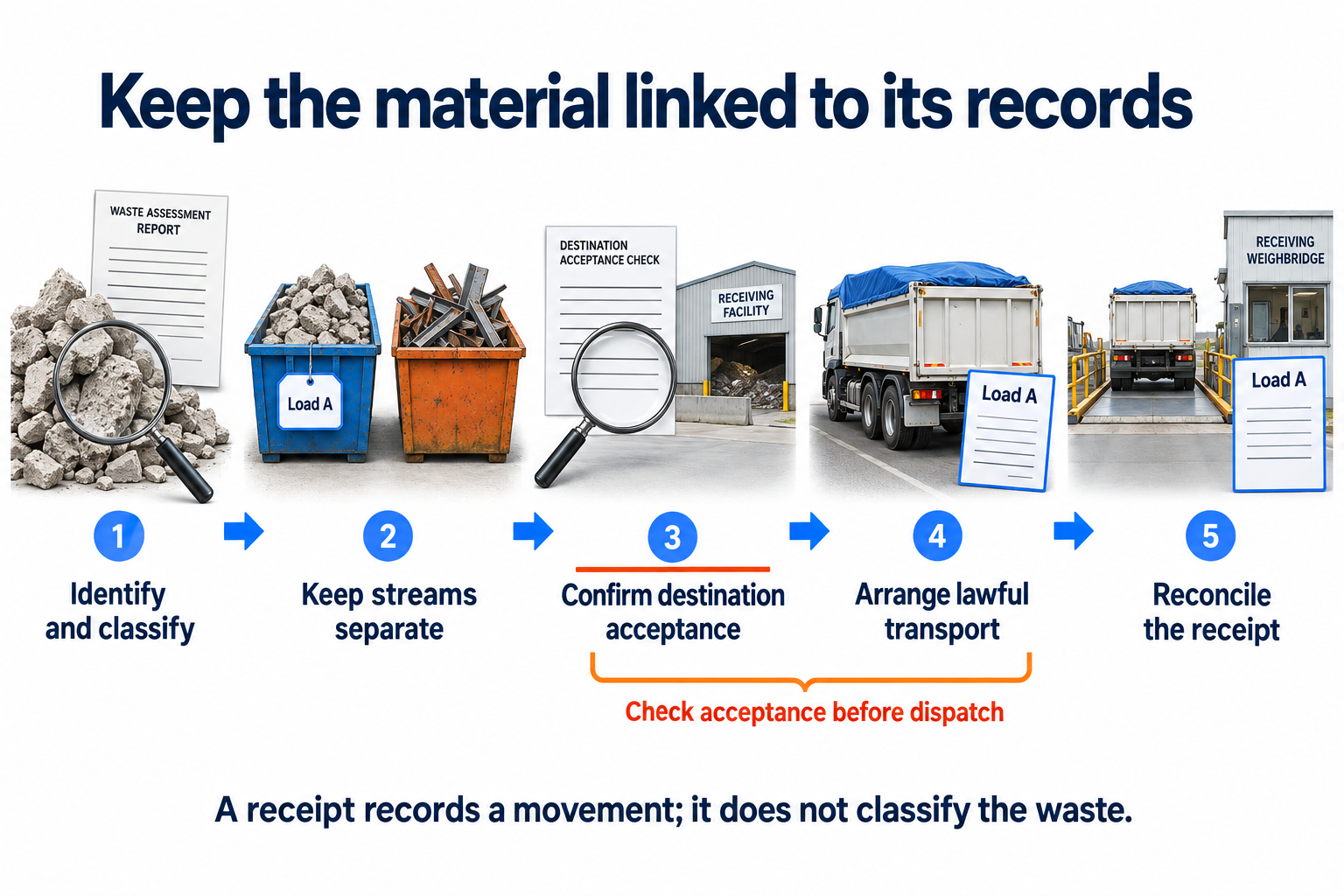 Open full-size illustration
Waste management begins with material identification and the required characterisation or classification. Appropriate segregation preserves the identity of each stream. The load must then be connected to lawful transport arrangements and a receiving facility authorised to accept that waste. Destination suitability must be confirmed before dispatch.
Records preserve the connection between what left the site, where it went and what was received. A receipt from a facility does not establish the destination of every other load or confirm that the recorded description matches the material. An estimated quantity must remain distinguishable from a measured weighbridge result.
Classification, testing, transport and resource recovery requirements depend on the material and circumstances. If material identity or destination acceptance is unresolved, changing a label does not resolve the underlying uncertainty. The affected movement needs the appropriate review before it proceeds.
Traceability continues through segregation, stockpiling, load-out and close-out. Records must describe the physical movement accurately, including discrepancies that require reconciliation.
Waste quantities and destination records
Waste traceability is the ability to follow a material stream from its origin through handling and transport to its receiving facility. Useful records connect the classification or characterisation, quantity basis, collection date, transporter, load identification and receipt. The purpose is not simply to collect dockets, but to make the material's journey understandable.
Keep estimates and measured quantities distinct. A volume estimate in cubic metres is not a weighbridge mass in tonnes. Converting between them requires an appropriate density assumption or evidence, and loose material can occupy a different volume from the original structure. Record the basis so that apparent discrepancies can be investigated rather than hidden by an unsupported conversion.
Reconciliation compares what was expected, what left site and what was received. Differences may reflect measurement methods, moisture, mixed loads, stock remaining on site or an actual problem. A discrepancy deserves explanation, not automatic alteration of the earlier record. Preserve the chain and add the correction or clarification.
Recovery should be planned before materials become mixed or damaged, while maintaining structural, hazardous-material and handling controls. A material having resale value does not remove those controls. Nor does a proposed reuse destination establish suitability. Current restrictions on asbestos and other hazardous materials remain distinct from ordinary salvage decisions. A recyclable label alone does not establish that recovery is lawful or safe.
Environmental inspection and spill response
Environmental inspection should follow likely changes: forecast rain, damaged containment, relocated stockpiles, new chemicals, altered drainage and increased traffic. The inspection record needs a location, observation, required action, responsible person and review of closure. A photograph of a control on installation day does not show that it is functioning after a storm.
A spill plan must fit the substances, quantities, pathways and site capability. Safety data sheets provide relevant product information, but the actual spill conditions still matter. Recognise danger, raise the alarm and keep people away from exposure. Any intervention by trained personnel must remain within the site's assessed arrangements and their capability. Do not enter a vapour cloud, pit or drain, and do not wash chemicals into drainage.
Emergency assistance and pollution reporting are different functions. The plan should identify both the emergency response and the applicable environmental notification arrangements, including who makes the decision and whom to contact. Do not assume that notifying one organisation automatically satisfies every other duty.
An overtopped sediment control is evidence that the arrangement needs attention under the conditions that occurred. The response includes protecting against continuing release, investigating the affected flow path, reviewing control performance and checking applicable reporting requirements. Replacing an inspection photograph without addressing those conditions would leave the problem unresolved.