
The NSW demolition context
NSW demolition work brings together legal duties, regulatory authorisations, project information and technical decisions.
NSW duties and project decisions
In New South Wales, the Work Health and Safety Act 2011 and Work Health and Safety Regulation 2025 provide the workplace health and safety framework. SafeWork NSW publishes demolition guidance and administers demolition licensing. Legal duties, licence conditions and project-specific controls apply to different aspects of the work.
A demolition licence does not settle the method for a particular structure. The project still needs information about its construction, condition, services, hazardous materials and surroundings. Planning connects that information with the scope of removal and the protection of people and retained property.
A retained wall connects several decisions
A change involving a retained wall brings several disciplines together. Drawing interpretation locates the wall and the stated work boundary. Structural reasoning identifies the importance of supports and restraints. Risk planning considers people and adjoining activities. Supervision checks that the current arrangement is communicated and followed.
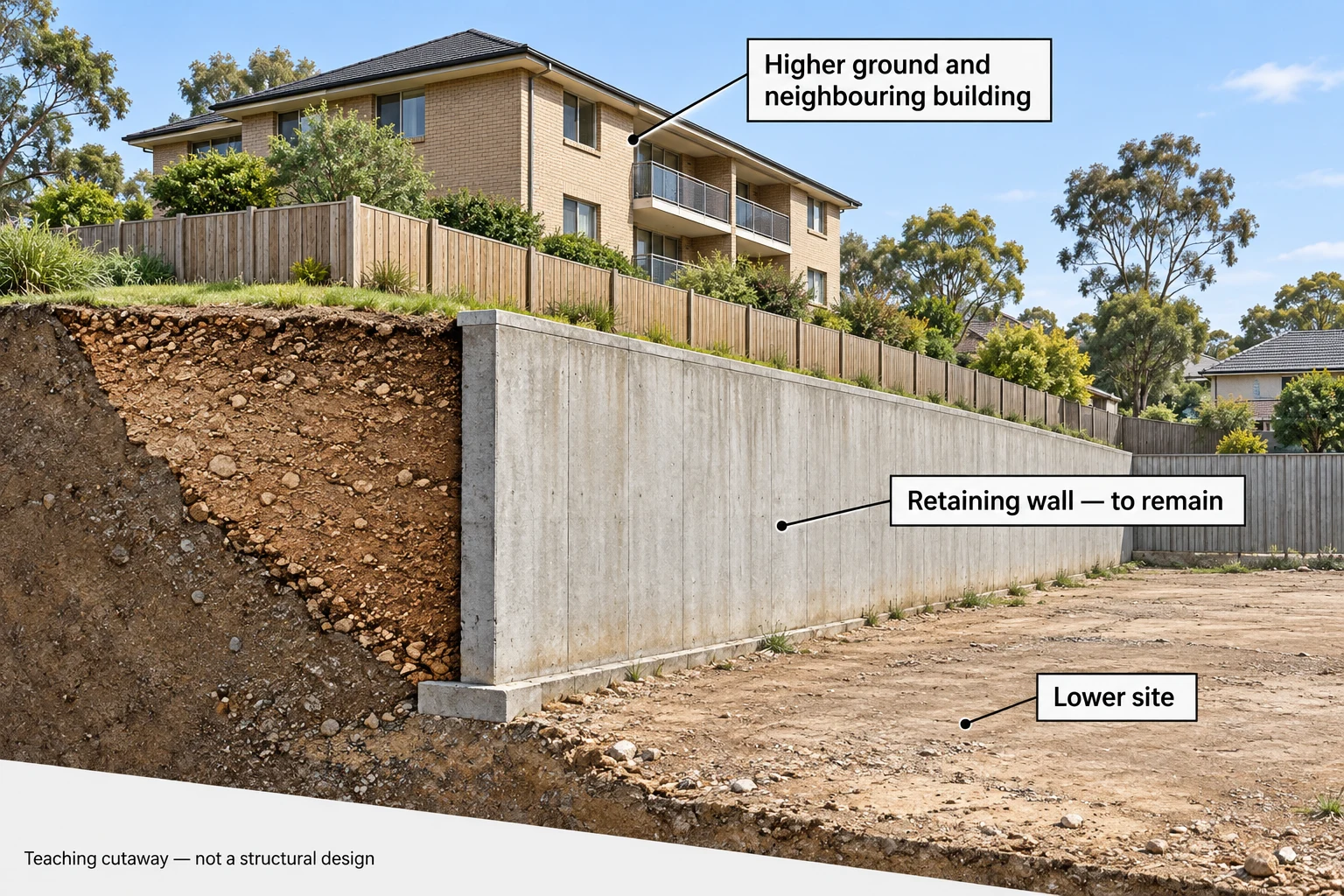
A retained wall is one left in place; a retaining wall holds back ground. This example is both. The wall separates the lower site from higher ground supporting a neighbouring building. Locate it, establish its function and coordinate protection of the wall, ground and adjoining property.
The soil slice is a teaching cutaway, not an excavation to carry out. The image supplies no wall capacity, footing dimensions, drainage specification, excavation limit or structural design.
OnShift educational illustration, AI-generated and visually reviewed for this preview; not a project photograph.
Open full-size illustrationThe business provides the authority, resources and records needed to carry out those decisions. An engineering conclusion that changes a restriction must reach the plan and the people doing the work. Knowing where the wall is does not establish its capacity; knowing its structural role does not establish that the required controls are in place.
The purpose and scope of a source
Legislation establishes legal duties. Approved codes describe ways of managing relevant hazards and risks within their legal context. Company documents describe the organisation's arrangements, while project documents apply decisions to a particular place and stage.
A company template with an old regulation reference cannot establish current law. A completed plan from another project may show how information is organised, but its method depends on that project's conditions. A technical standard also needs its applicable edition and provisions checked; its title alone does not establish a requirement.
Currency concerns the meaning and application of the information. Changing a date on a form does not resolve outdated instructions, responsibilities or technical assumptions.