
Soil, ground capacity, temporary works and adjacent structures
Ground condition affects bearing and settlement. Excavation, water, nearby loads and temporary supports interact, so structural and geotechnical information must describe the same location, loading and stage.
Ground can fail by loss of support or excessive movement
Ground supports a load through a volume of soil or rock, not only the visible contact surface. Bearing behaviour concerns how that ground resists the applied action. Settlement is downward movement under loading or changing conditions. Differential settlement means different parts move by different amounts. This can distort members and connections, redistribute loads and damage adjacent structures or services even without a sudden bearing failure.
Soil is not a uniform manufactured material. Natural layers, fill, buried waste, earlier excavations, moisture and groundwater can vary over short distances. A firm-looking crust can overlie weaker material. A paved surface may conceal a trench or void. Rock can contain joints and weathered zones; calling it rock does not remove the need to understand its condition.
Contact pressure depends partly on the load and the area over which it is transferred. But dividing a machine's weight by an apparent footprint does not complete a ground assessment. Load distribution, operating forces, eccentricity, ground variability and nearby features also matter. Movement can transfer more load to part of the contact area. A supporting platform has its own construction, drainage and maintenance requirements.
A general description of ground material does not establish its capacity for a particular load. A report saying clay was encountered describes a material; it does not by itself approve every loading condition. The assessment must connect the proposed plant, storage or temporary support to the actual ground and the relevant limits.
Average contact pressure is load divided by contact area. Use force rather than mass and keep the units compatible. One kilonewton per square metre equals one kilopascal, commonly written kPa.
In the generic learning example, a ninety-kilonewton load is spread evenly over three square metres. Dividing ninety by three gives thirty kilopascals. If the same load acts over one point five square metres, the average becomes sixty kilopascals. Halving the area doubles the calculated average pressure.
The arithmetic helps compare demand. It does not provide the allowable pressure of the ground. Uneven contact, operating effects, buried features and the supporting platform can change the real situation. The calculation aid LA-04 explains the relationship; its model is not a plant setup approval.
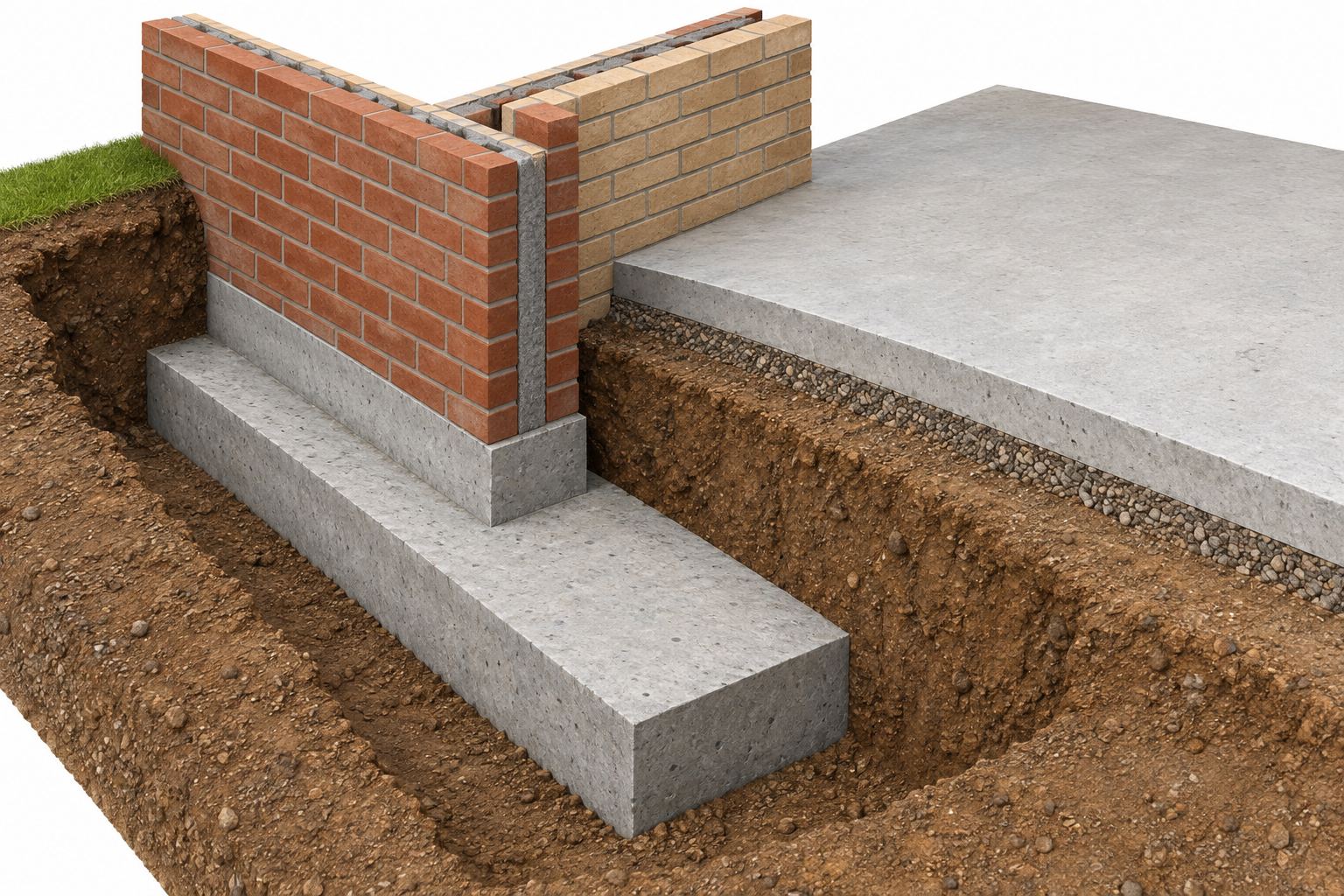
The strip-footing illustration LA-02 shows a generic continuous foundation beneath a masonry wall, beside a ground-bearing slab. It explains where a wall load can reach the ground. It does not provide a measured Cronulla section or a typical depth to use for that site. Reported loose soil near the coast does not establish a soil profile or bearing value.
Gravity loads and lateral stability
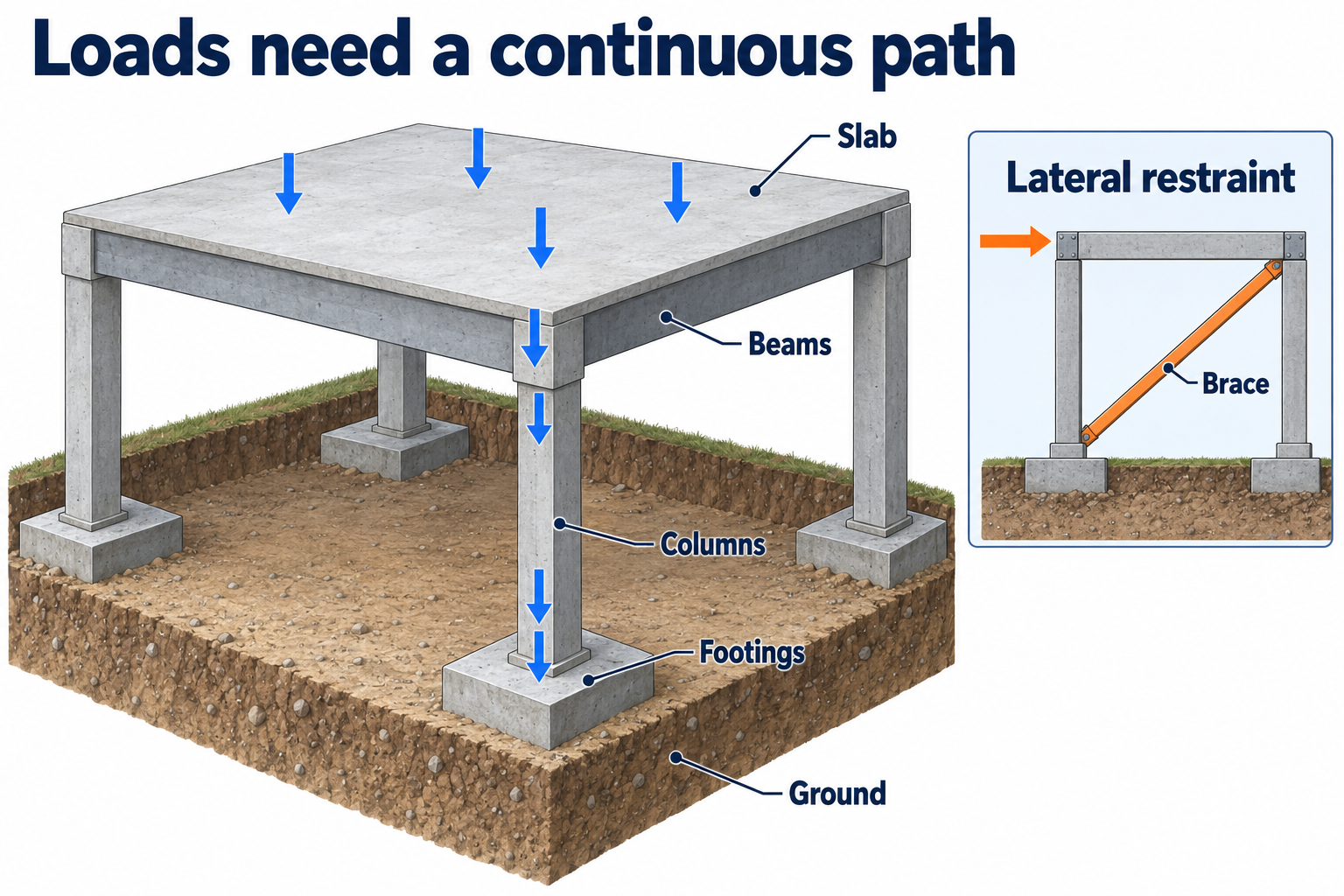
Structural elements transfer loads through connected supports and restraints.
 Open full-size illustration
Roof and floor loads pass through supporting beams or walls, then through columns or walls, into foundations and the ground. Each connection in the vertical chain represents a dependency: the receiving element must transfer the relevant action to the next support.
Lateral actions involve a different but connected set of relationships. Bracing, connections and restraints limit unwanted movement. An element that carries little gravity load can still provide essential lateral stability. Removing it may change the behaviour of the structure that remains.
Demolition alters loads, connections and restraints as work progresses. The partly dismantled structure must therefore be considered at each stage, using the current engineering information. Hidden construction, deterioration, ground conditions and temporary works may affect the assessment.
The schematic identifies load-transfer relationships, not member capacities or a removal sequence. Stage-specific structural decisions require information about the actual elements, their condition and their connections. An unresolved load path requires technical review.
How a strip footing supports a wall
LEARNING AID A teaching aid may illustrate a principle but does not establish a project fact, capacity, condition, authority approval or work release.
 Open full-size illustration
Generic cavity masonry wall on a continuous concrete strip footing, with an adjacent ground-bearing slab
A teaching aid may illustrate a principle but does not establish a project fact, capacity, condition, authority approval or work release.
This visual is draft case-study teaching material. Reading it is not an inspection, a measurement or evidence of performance.
Excavation changes confinement and water behaviour
Excavation removes material that may have been providing support or confinement. The remaining ground can deform towards the opening, and the effect can extend beyond the visible edge. The depth, ground profile, water, nearby loads and support arrangement influence the behaviour. A single remembered slope or setback is not a reliable rule for different sites.
Water can affect ground in several ways. It can add pressure against retaining or support systems, weaken some materials, erode fine particles or change the way forces are carried within the soil. Removing water can also cause movement in surrounding ground under some conditions. Water control is therefore part of the geotechnical and excavation plan, not merely a matter of making the work area look dry.
Surcharge is an additional load applied to the ground, such as a stockpile, vehicle or nearby structure. It can influence an excavation or retaining system even when it is not placed directly on the edge. Vibration and repeated plant movement can add further concerns. The appropriate assessment needs the actual loading arrangement and the ground model.
For example, debris storage may be proposed beside an excavation. Looking only at whether the pile physically fits misses the load's influence on the nearby ground and support. The issue needs coordinated consideration of storage, excavation support, drainage and access. Removing support, adding load and changing water can alter the same ground system together.
A property boundary is not a structural boundary
Ground movement and structural force paths do not stop at a site boundary. An adjoining building may have shallow foundations, a basement, shared support or services crossing the work area. Roads, footpaths and utility assets can also depend on the ground being altered. The demolition scope may be inside one property while its consequences extend beyond it.
The depth and form of an adjacent footing matter because removal of nearby ground can affect its support. A drawing of the neighbouring building's outline does not necessarily show its foundation arrangement. Historical information, surveys and appropriately scoped investigations may be needed to establish the interface. Access and information limitations must remain explicit rather than being filled with a standard assumption.
A condition survey records relevant existing observations within its scope. It can support comparison and communication, but it is not a design for protecting the structure and does not prove concealed capacity. Monitoring similarly needs a defined purpose, locations, interpretation and response arrangement. Collecting measurements without knowing what change requires action is an incomplete control system.
For example, a retained pavement may bridge an old service trench close to proposed loading. The pavement surface may look continuous, but its support could differ from the surrounding area. The relevant question is not whether similar plant has travelled nearby before. It is whether the actual support and proposed loading have been established for this location. Adjoining assets and buried interfaces belong in the same coordinated plan as the demolition and ground work.
Buildings and public landscaping
ORIGINAL / HISTORICAL SOURCE — SEE CAPTION A real-project image or an identified simulation aid. Use only for the stated observation; do not infer hidden construction, service position or approval.
 Open full-size illustration
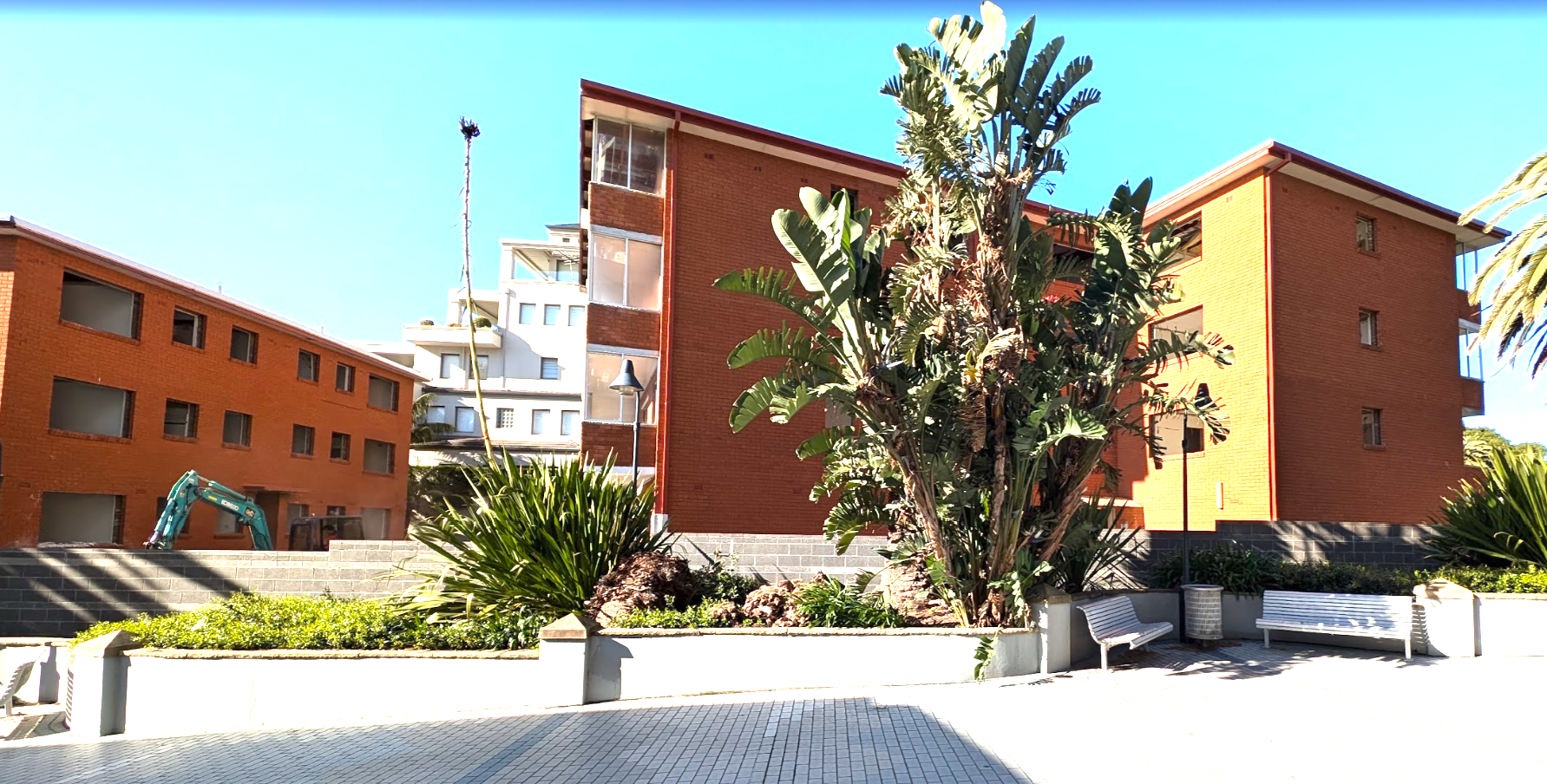
C-P02 – Buildings and public landscaping; wall function and dimensions are not established by this image.
A real-project image or an identified simulation aid. Use only for the stated observation; do not infer hidden construction, service position or approval.
This visual is draft case-study teaching material. Reading it is not an inspection, a measurement or evidence of performance.
Temporary works and their supporting load paths
Temporary works provide support, access, protection or stability for a limited stage. Propping, bracing, shoring and working platforms are examples, but each system has its own purpose. Temporary describes duration, not a lower consequence of failure. The system must carry its intended actions through a continuous path into adequate supports.
A prop's published component rating is not a rating for any arrangement assembled from it. Its length, end conditions, alignment, bracing, connections and supporting surfaces affect the system. Loads must pass into the element above and the foundation or structure below. A strong prop on an unsuitable base does not create a dependable support path.
The temporary-works information needs to define the relevant stages, loads, configuration, installation requirements, inspection and use conditions. It should also explain how changes are controlled and who confirms the required conditions. Where an independent check or other formal review is required, that requirement remains part of the controlled process. The supervisor must not silently redesign the arrangement to fit an obstruction.
Temporary and permanent works can interact. A support may load a floor that was not intended for that concentrated action. Or a brace may depend on a connection scheduled for later removal. The plan must account for those dependencies, including the safe temporary condition at breaks and the authorised removal of temporary works. The design and verification must address the complete assembly and its changing support conditions at each stage.
Ground reports, assumptions and changed conditions
A geotechnical report interprets available investigation and other information for a stated purpose. Boreholes or test locations provide evidence at particular places and depths; the report's ground model interprets the wider conditions. The locations, dates, methods, groundwater observations and limitations matter when deciding whether that information applies to the proposed work.
A structural report and a geotechnical report answer related but different questions. One may define the forces a foundation or temporary support must transfer; the other may assess how the ground responds. Their assumptions need to agree. If a plant configuration or stockpile changes, the loading supplied to the ground assessment may no longer describe the proposed condition.
Rain, leakage, erosion, newly exposed fill, unexpected voids, damaged platforms and movement can change the evidence available during work. An earlier assessment does not make those observations irrelevant. They should be recorded and managed through the applicable stop, restriction and review arrangements without placing people in the affected area to investigate casually.
A useful request for clarification identifies the planned load or support, location and stage, the report and assumption being relied on, and the new information. It asks for a coordinated response rather than a general statement that the ground is okay. The response needs to establish whether the earlier ground model and loading assumptions still apply, and which site-specific limits or support requirements need revision.