
Hazards, controls and decision authority
Hazard, exposure, control, dependency and authority describe different parts of a demolition decision.
Hazard, exposure and remaining risk
A hazard is a source or situation with potential to cause harm. Exposure is the opportunity for a person or another receptor to encounter that hazard. Consequence is the harm that could result. Risk concerns the possibility of that harm, considered with likelihood and consequence in the circumstances. A control changes those circumstances to eliminate or reduce risk. Knowing these distinctions helps you move beyond naming a hazard.
Loose material beside a shared access route illustrates the relationship. The material is not the whole explanation. Its position, potential movement and the people using the route create an exposure pathway. A control should address that mechanism. A risk score may help organise attention, but the score does not move the material, protect the route or verify the arrangement.
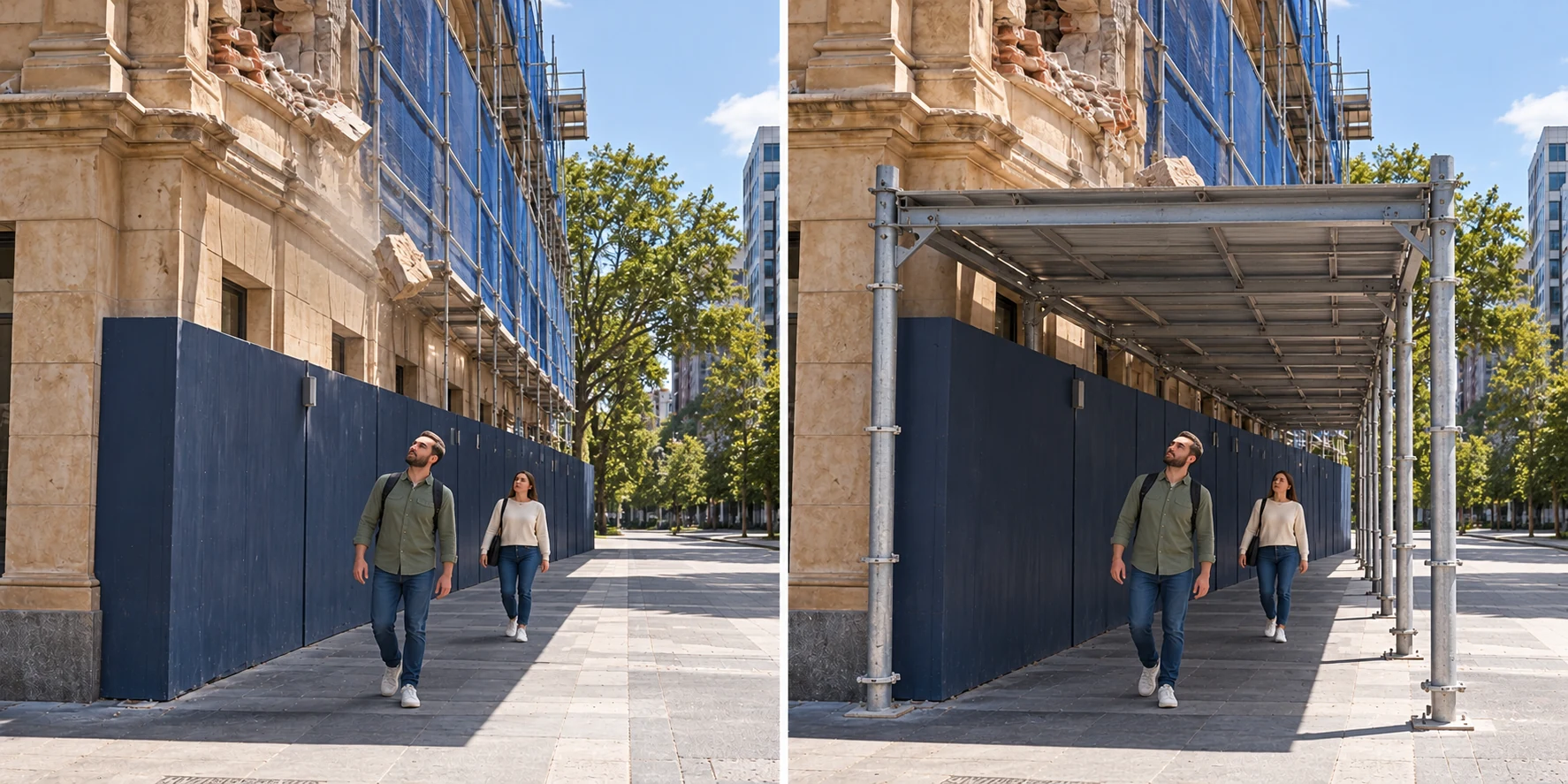
Compare the exposure pathway. The overhead structure illustrates physical interception; the unprotected view shows the potential for serious harm.
The left view is unsafe. This is not a gantry design, capacity claim or permission to keep a route open beneath demolition.
OnShift educational illustration, AI-generated and visually reviewed for this preview; not a project photograph.
- SafeWork NSW · Managing risk in the workplace
- SafeWork NSW · Demolition work Code of Practice
- SafeWork NSW · Managing hazards and risks
Remaining risk means risk considered after specified controls are actually in place. The word actually matters. A proposed barrier cannot be counted as an installed barrier, and an installed barrier cannot be assumed effective merely because it appears in a photograph. Ask what the measure must do, what could prevent it doing that job and how its performance will be checked. These are recurring supervisor questions because controls can degrade while work continues.
Types of control
Elimination removes the hazard or hazardous activity from the work. If elimination is not reasonably practicable, risk reduction considers substitution, isolation and engineering controls before relying on administrative measures and personal protective equipment. Substitution changes what creates the hazard; isolation separates people from it; engineering changes the physical arrangement. Administrative controls organise behaviour through information, procedures, scheduling or supervision. Personal protective equipment, or PPE, protects the wearer within its limitations.
A mixture may be needed, but several weak measures do not automatically equal a strong physical control. A warning sign and a verbal reminder both rely heavily on people noticing and responding. They do not become physical separation merely because there are two of them. Conversely, a physical measure may still need maintenance, instruction and monitoring. The hierarchy is a way to challenge dependence on behaviour, not a reason to neglect supporting arrangements.
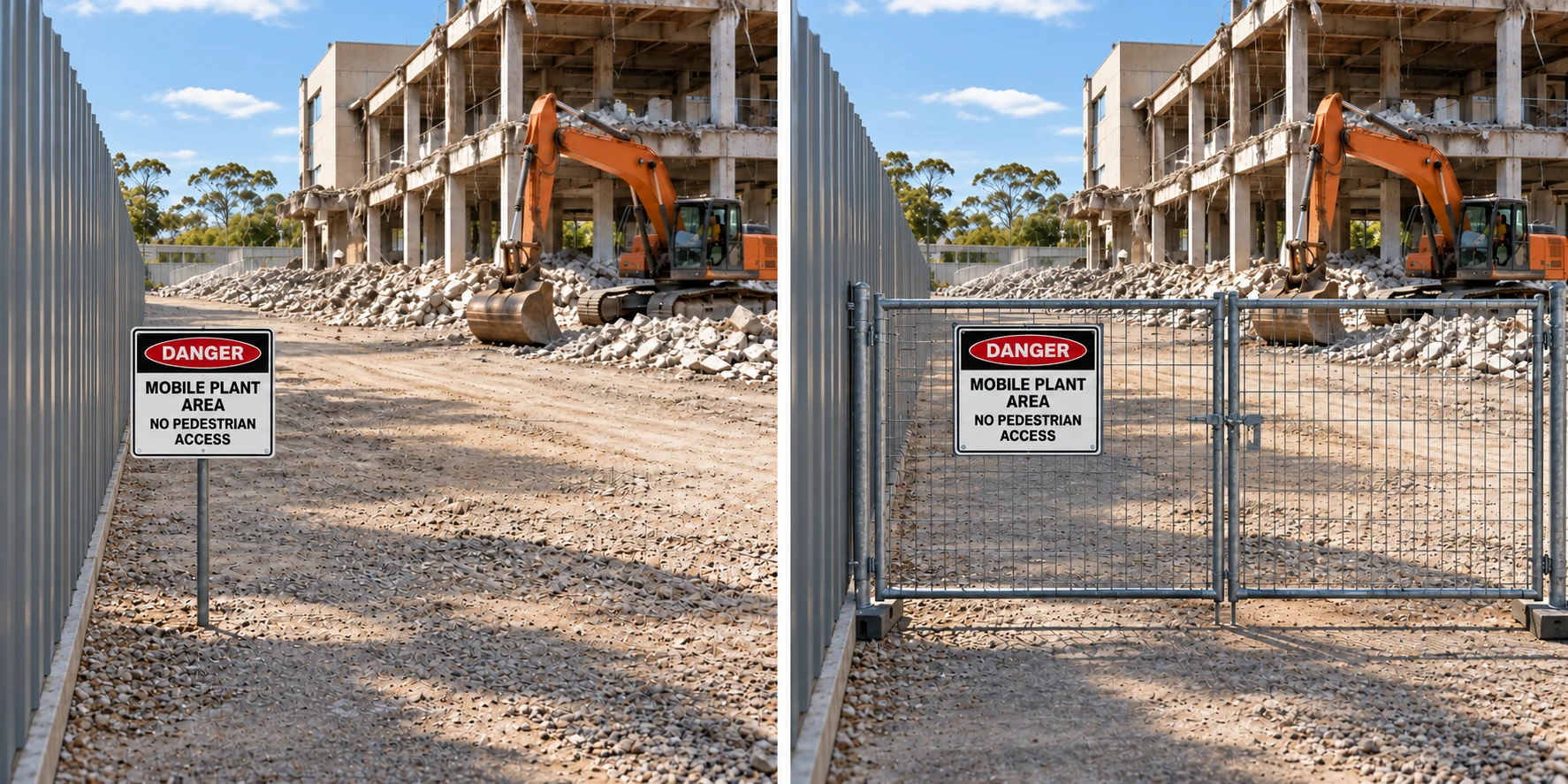
The sign communicates a restriction. The gate adds a physical access control. Their functions are different.
The fence is not shown as vehicle-impact protection. Signs are educational depictions, not certified artwork.
OnShift educational illustration, AI-generated and visually reviewed for this preview; not a project photograph.
Open full-size illustrationCritical control is a management term for a measure especially important to preventing a serious event or limiting its consequences. The label should lead to a clear performance expectation, ownership and verification. It should not become a decorative heading attached to every item. If everything is labelled critical without explanation, the business may lose sight of which failures demand immediate attention.
Dependencies, hold points and authority
A dependency is something that must be true or available for another activity to proceed as planned. A confirmed service isolation may be a dependency for affected work. A current engineering instruction may be a dependency for a particular stage. A hold point is a defined boundary beyond which specified work does not proceed until the required review or release occurs. It makes the dependency visible.
Authority concerns who may make a decision within a stated scope. A person can have authority to stop affected work without having authority to redesign a support. A commercial representative may approve expenditure without approving a structural change. A permit issuer may authorise a bounded activity without certifying the entire project. These distinctions prevent an available signature being mistaken for the right decision.
An interface is where activities, people or systems affect one another. A demolition boundary beside a retained business is an interface. So is the handover between a service specialist and the demolition team. Ask what each party assumes the other has done. Many coordination failures begin with two reasonable-looking plans that leave the same dependency to someone else. Naming the interface, the owner and the confirmation needed gives the concern a practical destination.
Changes, dependencies and status
A proposed change needs to be understood in relation to the work it affects. The intended activity, retained elements, information, people exposed and controls relied on all contribute to the decision. Control responsibilities include establishing the measure, maintaining it and checking its performance under changing conditions.
Relocating a waste container, for example, is not simply a question of whether it fits. Its new position may affect access, ground loading, emergency movement, material separation and neighbouring work. Those dependencies need project information and the relevant authority before the location can be selected.
Proposed, installed, checked, defective, suspended and closed describe different conditions. 'The issue is dealt with' hides those distinctions. 'The damaged item is out of use; replacement selection remains open' identifies both the protection in place and the decision still needed. Stopping use can prevent further exposure while the cause remains unresolved.
Technical terms
Hazard — A source or situation with potential to cause harm.
Risk — The possibility of harm, considered with its likelihood and consequence in context.
Exposure — The opportunity for a person or receptor to come into contact with a hazard.
Consequence — The harm or loss that could result.
Control — A measure that eliminates or reduces risk.
Remaining risk — Risk considered after the specified controls have actually been applied.
Elimination — Removing the hazard or hazardous exposure from the work.
Substitution — Replacing a hazard with a less hazardous alternative.
Isolation — Separating people from a hazard.
Engineering control — A physical or designed measure that acts on a hazard or exposure pathway.
Administrative control — An arrangement such as procedures, scheduling, information or supervision.
PPE — Personal protective equipment.
RPE — Respiratory protective equipment.
SWMS — Safe work method statement; a document for relevant high-risk construction work.
DWP — Demolition work plan.
Permit — A bounded authorisation within a defined control system, not universal proof of safety.
Induction — Introduction to relevant site conditions, responsibilities and arrangements.
Pre-start — A check or briefing before work or equipment use; distinct from scheduled servicing.
Verification — Checking evidence that the required condition or control exists and works as intended.
Consultation — Sharing relevant information, hearing affected workers' views and considering them in decisions.
Load path — The connected route by which forces pass through a structure to its supports.
Compression — A pushing action within a material or member.
Tension — A pulling action within a material or member.
Bending — A response to loading that tends to curve a member.
Shear — Action tending to make parts move past one another.
Temporary works — Engineered or other temporary arrangements supporting construction or demolition needs; specialist design and control may be required.
Respirable dust — Particles small enough to reach deep into the lungs.
LEL — Lower explosive limit; the lowest flammable gas or vapour concentration in air at which flame can propagate under the relevant conditions. Percentage of LEL is not percentage gas concentration or a safe-breathing decision.
Receptor — The person, property or environmental feature potentially affected.
Change control — The process of recognising a change, reviewing affected assumptions and controls, and communicating the revised arrangement.
Air monitoring — Competently planned measurement of airborne contaminants to assess exposure and control effectiveness.
Health monitoring — Medical monitoring for health effects, carried out or supervised by an appropriately experienced doctor when required.